Jeremy Holm, a coach of the U.S. disabled bobsledders, has done a lot of outreach work for people who, like him, suffer from anxiety and depression. In a sport that itself gets almost no press, Holm’s work gets even less.
Olympic gold medallist Steve Holcomb has something in common with Holm. It’s hard to discuss his revelations without using taboid-press terminology like “bombshell.” In a nutshell, though:
His rare form of vision loss, keratoconus, was something he hid, even from his sport. (Looking back on the press coverage, I see now he was never quite consistent about whether or not he disclosed his vision loss or how much it hindered his driving a bobsled.)
Fear of going blind led to depression, treatment for which was thwarted by international rules on medications athletes can legitimately take. (Those rules have hindered or disqualified countless other athletes; going back to the Paralympics for a moment, look at the case of Earle Connor.)
Holcomb actually attempted suicide, but, uncannily, he felt no ill effects from the pills he swallowed.
Then Holcomb underwent experimental eye surgery. Then he won gold at the Vancouver Olympics, not to mention a string of other medals on the bobsleigh circuit.
What I see here is an absence of support for an athlete with a disabling medical condition and with a mental illness. It isn’t just that straight guys don’t like to get help (in this case, for depression); Team USA gave Holcomb the impression he had nowhere to turn and had a bureaucracy to manage all by himself.
Also, Bears for Steve Holcomb needs to recognize that Holcomb’s status as a bear was largely due to a medication side-effect. Holcomb might have been the only bobsedder with a gut for a couple of years, but he was not a fat bastard. (Nor is he now.)
Why aren’t Holcomb and Jeremy Holm working together? Do they even know of each other’s cases?
Is there another bobsledder facing a similar health threat or disability? (Or, notwithstanding the You Can Play Project and the like, is gay and feels he has to hide it?) Where’s the support? Bobsleigh is an A-list sport in a B-list competition (the Winter Olympics); Holcomb is king of the castle among U.S. bobsledders. And this is how they treated him.
I continue to be baffled by the contradictions of bobsleigh, where everyone loves being around guys that big and strong (even big, strong bobsledders); where everybody on this side of the pond is one or another of Republican, Mormon, evangelical Christian, anti-abortion, or a hunter but also quite often in favour of what Americans insist on calling gay marriage; where disabled bobsleigh kind of begins to happen, then implodes, and at any rate allows a white supremacist in its midst. Now we know the best bobsledder in the world was left high and dry – virtually abandoned – as his eyes gave out, he suffered serious mental illness, and tried to kill himself.
There has to be a lot more going on here, but Holcomb isolates himself from the public better than an up-and-coming Hollywood starlet who just signed with the William Morris Agency. He’s basically unreachable, and not really amenable to a live interview.
Select a category to see additional posts. Add feed/ to a category to subscribe via RSS
The foregoing posting appeared on Joe Clark’s personal Weblog on 2012.11.30 13:27. This presentation was designed for printing and omits components that make sense only onscreen. (If you are seeing this on a screen, then the page stylesheet was not loaded or not loaded properly.) The permanent link is: https://blog.fawny.org/2012/11/30/holcomb-depression/
(UPDATED) Margaret Wente is the serial plagiarist unaccountably still in the employ of the Globe and Mail. Wente’s plagiarism was well documented by Carol Wainio on her personal Weblog for over a year before other journos woke the fuck up and noticed. Toronto journalists, a commentariat-class monoculture, have a shared technical incompetence that made them a year late on the biggest journalism story of ’012.
The problem here is that Toronto journalists think technology means Twitter and Gmail. “Data journalism” is this thing some distant cadre of kool kidz do that results in giant pins attached to Google maps. Toronto hacks tell themselves they’re computer-literate. All they are is not computer-illiterate. This illiteracy caused the local commentariat to be completely unaware of the Wente story for a full year. Now: Why? At root, because they don’t use RSS and don’t even know why they should.
Toronto hacks, a self-reinforcing lot who crystallize around nuclei like Ivor Tossell, all have the same technical skills. Instead of trying to explain how limited those skills are, I’ll explain my setup and how that setup keeps me better informed than any Twitter/Gmail hack at next to no cost.
I subscribe to 1,459 RSS feeds. An unimaginable number? You must be new here. Collected and pruned over the course of a decade, it isn’t remotely a lot of subscriptions. Easily a third of them are on the list to catch postings from writers who rarely publish. (You may download my OPML file [slightly invalid] if you wish.)
Any remotely interesting site with RSS I add to my list. It’s no skin off my ass; one more feed doesn’t cost anything measurable in time or attention. (And, for really interesting Weblogs, I read the entire archives.)
I read RSS over breakfast and maybe before quitting time. I use NetNewsWire, which lets me page or arrow-key through my feeds. I skip most, read some, and send other articles to Instapaper with a single keystroke. Google Reader is out of the question for serious usage, but there is a reason to maintain a Reader subscription (see below).
Anything even remotely important‑ or interesting-seeming I add to Instapaper. If it passes a very low threshold, I favourite it there, which posts it to Twitter and to Pinboard, which archives the full text. (I have other methods of archiving, but they wouldn’t help other hacks.)
I read Twitter directly when on the bus and so on, but to read articles linked by people on Twitter and Facebook, I use Flipboard. Its marvellous interface makes keeping up with the news fun. You can easily link a Google Reader subscription to Flipboard, making it an actual RSS reader that is no less pleasant.
You could clone my setup in an hour. You’d build up your RSS feeds over time. But because of my decade’s head start, I knew about Wainio’s blog roughly when it began and read the whole thing as each entry came out. I knew Margaret Wente was a plagiarist a year ago because I read the evidence when it was published. I could do that because I set myself up to make it not just possible but convenient.
Toronto hacks don’t know something happened until a member of their commentariat class Twits it
This method, a kind of journalistic homophily gone mad, is a proven failure yet is all that local hacks know. Something they don’t know is how much they don’t know. In my direct experience, they refuse to learn.
If you’re like Jason Kottke and figure that any article important enough to read will bubble up to your attention through many, many links by your friends, then you’ve set yourself up to miss everything that isn’t popular among your homogeneous friend circle. That approach works fine for civilians but is provably inadequate for journalists.
I’m going to pick on Tossell again even though it’s just an illustrative example, not a recitation of fact. To fine-tune this section’s subhed, Toronto hacks don’t know something happened until a beloved and trusted supernode like Tossell links to it. (Goldsbie is another example, but his Toronto-city-politics remit is rather small.) Then suddenly everybody falls into place re-Twitting the discovery and articulating essentially the same opinions about it. (This commentariat class agrees on everything.)
Tossell wasn’t the Big Bang nucleus in the Wente case, but he is exactly that a lot of the time. The big secret here – a seeming contradiction – is that these supernodes are no better informed than the Twits who follow them.
The endless travesty of J‑Source
J‑Source is almost a worst-case scenario of technical illiteracy leading to late coverage indistinguishable from other late coverage. A failure to rival that of the Design Exchange, this “project” of the Canadian Journalism Foundation is technically substandard, timorous, disconnected, and late to the game on everything.
I say this about a lot of things, but it’s true here as it is elsewhere: J‑Source doesn’t understand its own purpose. The Foundation makes matters worse by insisting on hiring only compliant, superficially pleasant young females as editrixen. Unless she’s Jennifer 8 Lee, a woman in her late 20s with a J-school degree just isn’t going to have the chops, moxie, or experience to run a journalism site. Gender is important here, because the ones who get hired are the ones who fit the mould I already cited – compliant and superficially pleasant.
The young female currently running J‑Source, Belinda Alzner, refused to answer my questions about her age, but judging by her LinkedIn profile she’s about 27. (I also made my biases and intent clear. Maybe that’s why she did the worst possible thing and refused to comment. Honestly, we mock sources when they do that.) Alzner’s Wente coverage was late and was tainted by an airy, defensive instinct to protect the guilty. Because she won’t answer my mail, Alzner couldn’t also confirm for me that she only found out about Wente’s plagiarism when her commentariat class’s Twitter feeds blew up with year-late news of it. But take a wild guess what really happened.
J-Source is the site that was too incompetent to doggedly follow the biggest journalism stories of the last year – Jan Wong, Kai Nagata, Margaret Wente. I’ve explained all this to J‑Source more than once and at length. Hire exactly the same kind of people every time and you’ll get exactly the same coverage. Compliant, superficially pleasant young female Toronto journalists are a monoculture even if saying so offends your sensibilities. Then again, those sensibilities wouldn’t let half the commentariat class call Wente a plagiarist, either.
Journos: Refusing to learn since the day they joined Gmail
The same people who think Gmail is E-mail, think top-posting is E-mail, think Twitter is where news breaks, and all know each other, like each other, and go to the same boozeups are a problem to be solved. They can solve it themselves – by upgrading their skills. But, as with easy things like character encoding and Web standards, they’d prefer to stay ignorant if the alternative is learning from me.
My system works. Their system is merely the one their equally-technically-incompetent friends all use. But their friends are awesome.
Select a category to see additional posts. Add feed/ to a category to subscribe via RSS
The foregoing posting appeared on Joe Clark’s personal Weblog on 2012.10.17 15:51. This presentation was designed for printing and omits components that make sense only onscreen. (If you are seeing this on a screen, then the page stylesheet was not loaded or not loaded properly.) The permanent link is: https://blog.fawny.org/2012/10/17/rss-hacks/
That, at least, is the only conclusion I can draw from a statement by New York Times Co. boardmember Michael Golden on Episode 4 of The Stack, the Monocle podcast about magazine publishing (at iTunes). At ≈32:00:
Reporters don’t work alone. They work with editors, and that is the unique quality of great journalism. And that’s where the New York Times excels – is the editorial support that helps shape the story and helps the an—the reporter understand the perspective they’re coming from and the perspective that the ins—that the company wants, that the newspaper wants to project. And that’s – it’s just not possible for an individual to do that.
I interpret this statement to mean that, well above and beyond the usual work of editors, corporate managers and even boardmembers lecture New York Times journalists on what the official company line might be on any given topic and force those journalists to conform to it.
I called the New York Times Co. for a comment, but no one was available, according to the receptionist (whom I believed). I E-mailed Abbe Serphos, the company’s executive director of corporate communications; consistent with the Times’s own David Carr’s advice, I was quite clear with Serphos about what I wanted confirmed:
I take this quote at face value. It says that the Times newspaper and company, as a matter of practice, forces or induces its reporters to write coverage in ways that correspond to corporate or newspaper interests. As such, what Golden is saying is that Times reporters do not have journalistic independence (beyond the standard editor/journalist relationship) and are expected to hew to official corporate positions on various, although unspecified, topics.
This would be your chance to explain how this plain reading of Golden’s words is wildly incorrect and does not in fact confirm generations of assumptions about the newspaper’s actual practices and biases.
Serphos did not reply.
To paraphrase Christopher Hitchens, we can begin to make the case for making the case for institutional bias and journalistic interference at the Times with this quote from one of its own boardmembers.
Select a category to see additional posts. Add feed/ to a category to subscribe via RSS
The foregoing posting appeared on Joe Clark’s personal Weblog on 2012.10.16 14:26. This presentation was designed for printing and omits components that make sense only onscreen. (If you are seeing this on a screen, then the page stylesheet was not loaded or not loaded properly.) The permanent link is: https://blog.fawny.org/2012/10/16/nytimes-golden/
Criminal defendants, to name but one group, unquestionably deserve the strongest possible defence in the justice system. Whom does former “child soldier” and accused murderer/terrorist Omar Khadr have in his corner? As I see it, a perfect feminist barrister in the person of Brydie Bethell. Of Omar Khadr:
He’s 26. In some ways, is he still a child?
Well, I think all males are immature.
But all blacks aren’t lazy and all Jews aren’t cheap?
I would hate to be a male law clerk or any kind of subordinate in a hostile work environment like hers. (Asked to verify she made the statement and back it up, Bethell ignored my E-mail. Her law office is a loose conglomeration of associates with no apparent boss.)
Select a category to see additional posts. Add feed/ to a category to subscribe via RSS
The foregoing posting appeared on Joe Clark’s personal Weblog on 2012.10.15 14:06. This presentation was designed for printing and omits components that make sense only onscreen. (If you are seeing this on a screen, then the page stylesheet was not loaded or not loaded properly.) The permanent link is: https://blog.fawny.org/2012/10/15/bethell-khadr/
Yesterday (2012.10.13) I was the sole hack in the room for the Guide Dog Users of Canada annual conference. The penthouse ballroom of a second-rate hotel with no discernible wheelchair entrance played host to the whole shebang, save for group outings to Sambuca’s and Hair of the Dog (!) on Church St. (With about 23 hounds in attendance, first of all that was more customers than Sambuca’s has ever seen before, and second of all that’s a lot of dogs inside Hair of the Dog.)
It was a reminder that, at blind events, you can easily seat everyone at circular tables without the slightest inconvenience – nobody will be craning their necks to watch whoever’s at the podium. There were other reminders, as of how easy it is to spot lifelong blinks just by body language, posture, facial expression or lack of it, and ticcing.
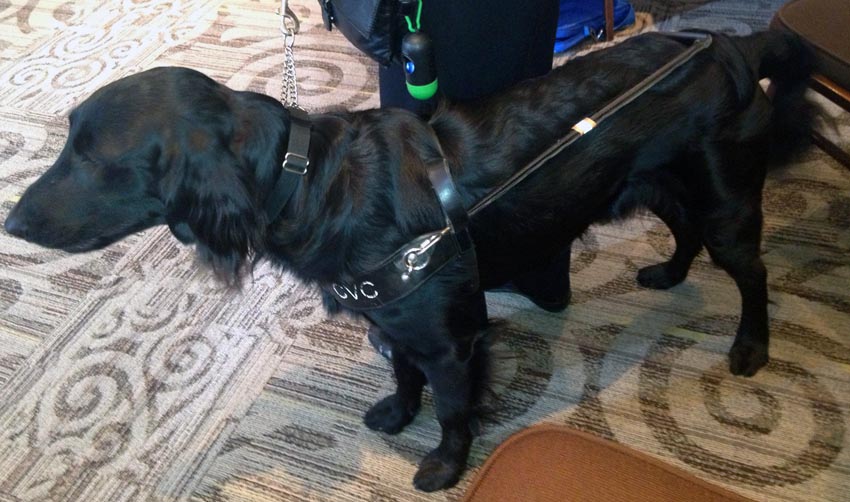
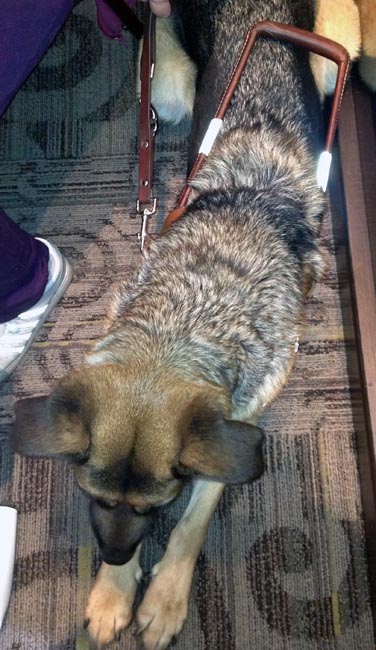
I was there only for the presentation on GPS apps and gadgets that elite blinks use to get around town. Then again, broadly speaking it is only elite blinks who have guide dogs. (And jobs. And iPhones, of which I saw four, along with a single iPad and two Braille displays.) Now, at this point a black Labrador guide dog is coin of the realm. Seen one black-Lab guide dog, you’ve seen ’em all. (Except for that one lovely specimen with the glossy short coat.) Instead, I chatted up the owners of the two exceptional hounds in the group.
Fergus the flat-coated retriever. I have some kind of mental block about the name of this variety. The owner and a dog trainer recited it to my face four times and I still had to jot it down. (I had to double-check it just now.) They’re an uncommon breed for guide-dog use. Unlike poodles, which are often assigned to owners who are allergic to dog fur, flat-coated retrievers’ flat coats are of no particular advantage. They’re high-energy dogs who suit similar owners. Fergus is a mere 16 months old and indeed has a lot of verve. But, in perfect guide-dog style, he never once acknowledged my presence.
Dobry the German shepherd. In another era, practically all guide dogs were German shepherds. This is one dog I liked on sight, and not just because of his unusual colouration. The owner insists on shepherds because Labs are “too playful.” German shepherds enjoy having a mission and, it was implied, basically can’t function without one. They have unbeatable focus and they’re workaholics: Dobry “roams the house” when he’s off duty. Three years old. He’s from Leader Dog in Michigan.
Dobry sort of looked up at me in that heart-rending way dogs have. To that point I liked only dachshunds.
I wanted to drop in on the hounds and their masters at Hair of the Dog but basically couldn’t get my act together. Maybe next year.
Select a category to see additional posts. Add feed/ to a category to subscribe via RSS
The foregoing posting appeared on Joe Clark’s personal Weblog on 2012.10.14 12:59. This presentation was designed for printing and omits components that make sense only onscreen. (If you are seeing this on a screen, then the page stylesheet was not loaded or not loaded properly.) The permanent link is: https://blog.fawny.org/2012/10/14/gduc2012/
Select a category to see additional posts. Add feed/ to a category to subscribe via RSS
The foregoing posting appeared on Joe Clark’s personal Weblog on 2012.10.11 22:00. This presentation was designed for printing and omits components that make sense only onscreen. (If you are seeing this on a screen, then the page stylesheet was not loaded or not loaded properly.) The permanent link is: https://blog.fawny.org/2012/10/11/network/