(Title updated 2005.08.09 with irresistible Rosa von Präunheim reference.) Danah Boyd:
After reminding folks at Blogher that there are gender differences in networking habits
And reminding us elsewhere that “men” and “women” link and write differently, as though there were exactly two types of people. You know, I’m tired of being lumped in with straight guys. In fact, I’m really tired of Boyd’s complaints about “male” online behaviours in the first place.
Few LiveJournals have a blogroll but almost all have a list of friends one click away. This is not considered by search tools that look only at the front page.
Readily fixable.
Male bloggers who write about technology (particularly social software) seem to be the most likely to keep blogrolls. Their blogrolls tend be be [pre]dominantly male, even when few of the blogs they link to are about technology. I haven’t found one with [more than] 25% female bloggers (and most seem to be closer to 10%).
Please give us the numbers of male Webloggers who link mostly to technology blogs vs. those who link only to “few” such sites. Given that most technology bloggers are men, why are we surprised that technology blogrolls have more male authors represented?
Is there some suggestion that 25% or even 10% female representation should automatically be attainable? What if the author (taken as a distinct individual, not simply as a “man”) does not like many of the female-authored technology blogs he has read? Taste is never accounted for in these discussions; the insinuation is that taste and unfair discrimination are the same thing.
What do female technology bloggers’ blogrolls look like? Almost exactly the same, I’d expect.
I also get the impression that blogrolls are not frequently updated (although I have to imagine that the blogs one reads are). I wonder how static blogrolls are.
That probably explains another chunk of the group of male technology bloggers who link to few women. Perhaps their female blogroll has been subsumed into their daily RSS feed.
Bloggers often talk about other people without linking to their blog (as though the audience would know the blog based on the person). For example, a blogger might talk about Halley Suitt’s presence or comments at Blogher but never link to her.
Boyd does the same thing: “A fraction of the Top 100 have blogrolls of blogs. Some have blogrolls that are a link away (like Crooked Timber).” Like whom?
[M]en tend to have large numbers of weak ties and women tend to have fewer, but stronger[,] ties. This means that in traditional social networks, men tend to know far more people but not nearly as intimately as those women know.
I need an explanation of how this analysis translates into something as off-the-cuff as a blogroll. To what extent do men “know” the authors in their blogroll? What qualifies? Meeting in the hallway at SXSW? (Careful how you handle yourself there.) Attending the same 20-person group dinner at a conference? Presence on your buddy list? Time spent at his (indeed his) house?
While blog linking tends to be gender-dependent, the number of links seems to be primarily correlated with content type and service. Of course, since content type and service are correlated by gender, gender is likely a secondary effect.
Does this mean that Boyd admits that “men” aren’t linking mostly to other men because they’re discriminating against women but because the topics of conversation are covered mostly by male bloggers in the first place?
In other words, is this not a power law in another guise? Is there any actual human intent involved at all?
All links are created equal. All relationships are not. Treating everything like a consistent weak tie is quantity over quality and in social networks, that means male over female.
Start using XFN and that disappears overnight. Of course, to do that you’d have to actually understand HTML well enough to add a rel attribute to your links, and blogging tools would have to actually produce standards-compliant code with a useful added degree of semantic richness.
Links indicate no weight, no valence, no attributes.
See above.
And even if people did, that kind of articulation is a social disaster (…think Friendster).
No, don’t think Friendster. Think XFN. Boyd presents a problem and rejects an existing solution.
They’re very effectively measuring the available link structure. The difficulty is that there is nothing consistent whatsoever with that link structure.
On the contrary, what they’re measuring is a link structure that is too consistent, formed exclusively by unadorned anchors (a href="") without XFN-style relationship coding. The consistency of the link structure is the problem. It a problem at the HTML level. It is not a question, as Boyd continues, of “norms.” It’s a question of microformats and semantic richness.
While I’ve been looking into the linking patterns, Mary Hodder has been thinking through new metrics for measurement.
Let’s not reinvent the wheel. Consider the prior art, please, Mary.
And in our current system, we are doing a damn fine job of replicating the power structures that pervade everyday life under the auspices of creating a new system that usurps power.
Here’s a thought experiment. Would Boyd be complaining about this if the roles were reversed – as indeed they are on LiveJournal – and most bloggers were women, as were the authors they linked to?
If you object to that experiment because it’s too simplistic (or it hits too close to home for your personal biases), try it this way: Would Boyd be complaining if all the men who were at the top of this power structure were gay? Does an army of queer bloggers upset your apple cart? How about an army of women bloggers, then? Would men be studying them as though they were a problem?
Why does an army of straight-guy bloggers attract so much of your attention? Maybe the guy part is not as important as you think.
[I don’t have a blogroll, though I publish the sites I subscribe to (via Kinja).]
Select a category to see additional posts. Add feed/ to a category to subscribe via RSS
The foregoing posting appeared on Joe Clark’s personal Weblog on 2005.08.08 13:06. This presentation was designed for printing and omits components that make sense only onscreen. (If you are seeing this on a screen, then the page stylesheet was not loaded or not loaded properly.) The permanent link is: https://blog.fawny.org/2005/08/08/roll/
Bruce Gillespie, “Meet the Lexicographers,” Quill & Quire, May 2005, p. 28:
[Katherine] Barber [q.v.] admits that many of the team’s editorial tasks can become arduous. For example, it took about two months simply to proof the new Oxford Canadian Dictionary of Current English…. Tedium also set in when the team spent four weeks doing little else but inserting wordbreak dots – which show readers how to hyphenate each word properly – into each headword for the second edition of The Canadian Oxford Dictionary. “It can be hard on the eye and the brain,” says Barber.
Maybe it’s so hard to proof your dictionaries because the type needs serious improvement.
Select a category to see additional posts. Add feed/ to a category to subscribe via RSS
The foregoing posting appeared on Joe Clark’s personal Weblog on 2005.08.08 11:47. This presentation was designed for printing and omits components that make sense only onscreen. (If you are seeing this on a screen, then the page stylesheet was not loaded or not loaded properly.) The permanent link is: https://blog.fawny.org/2005/08/08/oed/
Select a category to see additional posts. Add feed/ to a category to subscribe via RSS
The foregoing posting appeared on Joe Clark’s personal Weblog on 2005.08.07 18:28. This presentation was designed for printing and omits components that make sense only onscreen. (If you are seeing this on a screen, then the page stylesheet was not loaded or not loaded properly.) The permanent link is: https://blog.fawny.org/2005/08/07/pillers/
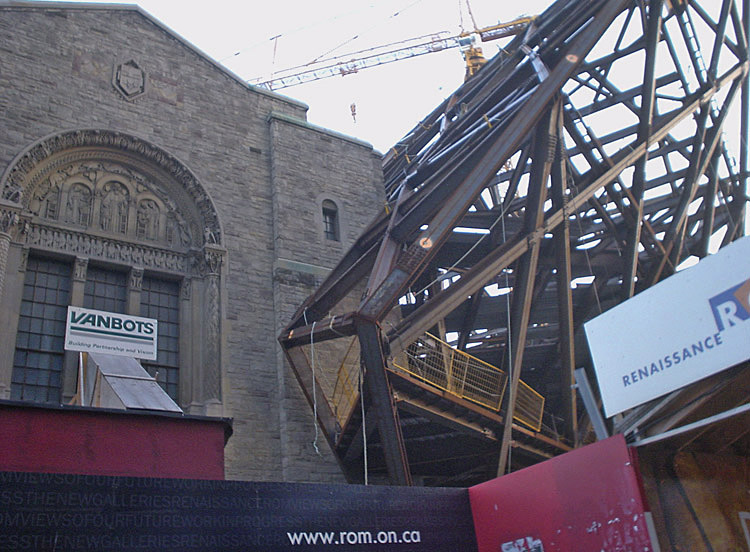
Lisa Rochon, in an article you’ll have to Google-news for by title (embarrasingly: “Raw metal is a major turn-on”), writes:
Fronting the redevelopment of the Royal Ontario Museum in downtown Toronto is a massive steel structure that is raw and mysterious and dirty…. Dark, rough to the touch, heavy enough to crush a man, steel is rarely left exposed. It’s easy to figure out why: It might upset our urbane sensibilities…. During the year that it took to raise up the structure, the workers started to feel the steel come alive. One enormous face in the shape of an X wears bolts like jewellery on a giant….There’s too much to distract an audience looking upon an integrated truss system whereby 3,000 pieces of steel (each weighing about three tons) have been miraculously joined together. […]
A restrictive fire code is often to blame for the architect’s penchant for covering up steel. The truth is that a steel structure painted in tumescent paint meets the code…. At the ROM, the last structural steel beam went in last week at the museum’s topping-off ceremony. The iron workers have gone home. Cherish this moment at the ROM. Visit it like public art.
Select a category to see additional posts. Add feed/ to a category to subscribe via RSS
The foregoing posting appeared on Joe Clark’s personal Weblog on 2005.08.07 18:27. This presentation was designed for printing and omits components that make sense only onscreen. (If you are seeing this on a screen, then the page stylesheet was not loaded or not loaded properly.) The permanent link is: https://blog.fawny.org/2005/08/07/acier/
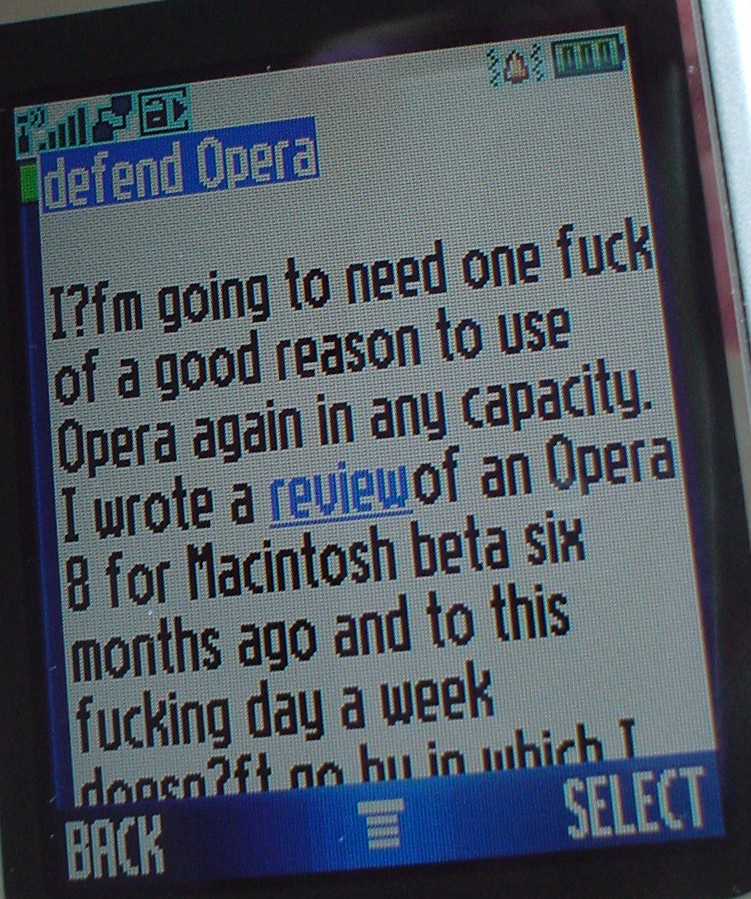
Because I can’t read the page on my esteemed colleague’s new Motorola Raz(o)r shoephone!
Love that character encoding. I don’t know (and could not find out) what browser the phone uses, but it’s clearly not Opera. And what are these, video-game fonts? Get Spiekermann in there.
And you do realize that this page has a handheld stylesheet?
Select a category to see additional posts. Add feed/ to a category to subscribe via RSS
The foregoing posting appeared on Joe Clark’s personal Weblog on 2005.08.07 18:26. This presentation was designed for printing and omits components that make sense only onscreen. (If you are seeing this on a screen, then the page stylesheet was not loaded or not loaded properly.) The permanent link is: https://blog.fawny.org/2005/08/07/razr/
I’m going to need one fuck of a good reason to use Opera again in any capacity. I wrote a review of an Opera 8 for Macintosh beta six months ago and to this fucking day a week doesn’t go by in which I am not reminded of the viciousness of Opera fanboys, who called me a serial liar and otherwise impugned my knowledge of browsers and Macs. (I’ve been using both since they came out.)
It seemed particularly difficult to get across the idea that Opera’s localizations for Windows and Linux windowing schemes do not work on Macs, that tabs are what tabs are called even if Opera started calling them windows first, that closing a tab should take me to the next one and not the one I already saw, and that I fucking know what I’m talking about when it comes to Macintosh browsers and you fucking do not.
Face it, fanboys: You are tinkerer-geeks who use Windows or Linux because you love it when shit goes wrong. That lets you get all ninja on your commodity chopshop Wintel box’s arse and fix it.
Whereas we who are a higher form of life use Macs to actually get our work done in a pleasant and reliable manner. We’ve got taste and you don’t.
I want standards-compliant browsers of all stripes to succeed. I want to like Opera. However: If, every time I dare to question Operatic orthodoxy, I get a fusillade of name-calling and character defamation from borderline Aspergerians who wouldn’t know a salad fork from a browser tab, then I’m just not gonna talk about Opera.
You want my help anyway? You come to me, we’ll keep it private, and nobody’ll get hurt.
Select a category to see additional posts. Add feed/ to a category to subscribe via RSS
The foregoing posting appeared on Joe Clark’s personal Weblog on 2005.08.05 12:33. This presentation was designed for printing and omits components that make sense only onscreen. (If you are seeing this on a screen, then the page stylesheet was not loaded or not loaded properly.) The permanent link is: https://blog.fawny.org/2005/08/05/opera/
Some of us can best be understood through the model of organizing principles, rather after the manner in which Frances Urquhart sized people up in To Play the King. These principles tend to be distinguishable from any objective qualifications; they don’t make you better or worse at what you do for a living.
Molly E. Holzschlag is a person with organizing principles. She believes firmly in getting along and maintaining a happy ship. We have no gender-neutral variation of the phrase “peaceable kingdom,” yet that indeed is what she tries to maintain.
I expect Molly does not heartily object to the mild falsehood that Paul Festa wrote:
In March, [Robert] Scoble approached WaSP members, including Holzschlag, at the SXSW Interactive conference in Austin, Texas.
Holzschlag initially rebuffed Scoble and his Microsoft colleagues. Soon after, Scoble complained about the snub in his blog. Holzschlag read Scoble’s blog, and in the blog’s comments section apologized. From there, she and Scoble began talking about ways WaSP and Microsoft could work together.
I apologize when I make a mistake and you’d better believe I don’t do it otherwise. It is among the least of my endearing qualities, surely, but it’s what I’ve got to work with. Molly’s approach is different. She had no reason to apologize: Scoble was trying to crash the party, to barge in on a private meeting of Web Standards Project leaders. Scoble is as unwelcome there as any uninvited outsider would be at, say, a Microsoft project meeting. Scoble had, and still has, no right whatsoever to expect to intrude into, and then of course report on, private meetings. (He acts otherwise: “WaSP turned me away from a meeting that they were holding in the middle of the SXSW conference hall… quickly and, I might say, rudely.” The tone of hurt would be more credible from another writer.)
Scoble has no standing whatsoever in this regard, and is unreservedly in the wrong. If I had tried to do the same thing, I would be just as wrong.
Yet Molly apologized anyway, because that’s what she does. The historical record, thanks to Festa, now shows this as a pivotal moment in collaborations between Microsoft and WaSP. How pivotal was this event, in actual fact? Molly had nothing to apologize for; Festa implies that she did. (Festa labels as a “snub” Molly’s refusal to let an interloper crash her own meeting.) A collaboration was inevitable anyway, and it took a mere three months before it was announced. Would it have taken six months otherwise? Probably not; there’s no way in hell that Chris Wilson would have permitted IE7 to go into beta without some kind of public collaboration. So maybe the announcement would have taken four months or maybe five, a difference that does not matter.
A collaboration between Microsoft and the Web Standards Project has a lot going for it, but Scoble’s whining about being excluded from a meeting of a group he never belonged to should not be regarded as actually important.
Select a category to see additional posts. Add feed/ to a category to subscribe via RSS
The foregoing posting appeared on Joe Clark’s personal Weblog on 2005.08.05 11:19. This presentation was designed for printing and omits components that make sense only onscreen. (If you are seeing this on a screen, then the page stylesheet was not loaded or not loaded properly.) The permanent link is: https://blog.fawny.org/2005/08/05/snub/
Select a category to see additional posts. Add feed/ to a category to subscribe via RSS
The foregoing posting appeared on Joe Clark’s personal Weblog on 2005.08.03 16:31. This presentation was designed for printing and omits components that make sense only onscreen. (If you are seeing this on a screen, then the page stylesheet was not loaded or not loaded properly.) The permanent link is: https://blog.fawny.org/2005/08/03/asquith/
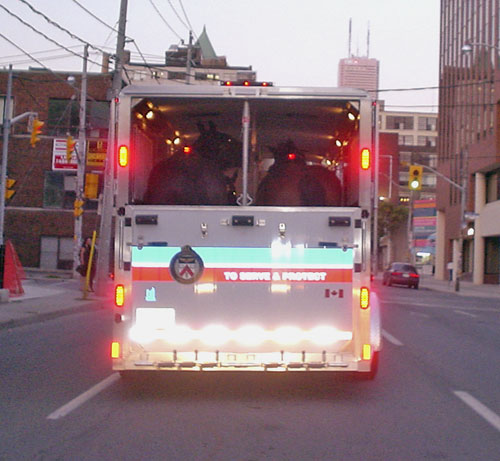
Technically a shite photo, and would be even if I spent all afternoon dodging and burning, but it’s always magical seeing the police horsies get carted around.
I’m publishing this to make myself feel better for being two seconds late to snap the best-ever mounted-police photograph late last week. How often do you get two cops on horses (with blinking taillights) stopped at a traffic signal while a firetruck races past? Rather as with limerent objects, you never forget the ones that get away.
Select a category to see additional posts. Add feed/ to a category to subscribe via RSS
The foregoing posting appeared on Joe Clark’s personal Weblog on 2005.08.03 16:29. This presentation was designed for printing and omits components that make sense only onscreen. (If you are seeing this on a screen, then the page stylesheet was not loaded or not loaded properly.) The permanent link is: https://blog.fawny.org/2005/08/03/horsies/