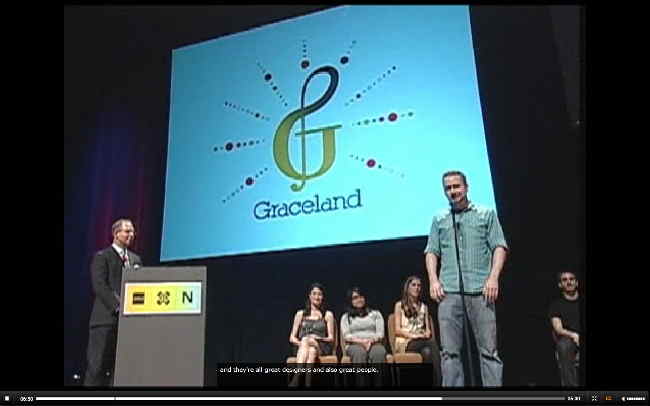
I keep telling you Michael Bierut oughta give up the pretence of being an important design writer and just host his own goddamned game show! (Or at least podcast.) He did it before and he’s done it again – at the second “Command X” game show at an AIGA conference, where students are given a limited time to complete three design projects.
It’s harder to watch this year’s video coverage than the same from two years ago because you can’t download it onto your iPod. It’s Flash-in-browser video all the way (Episodes 1, 2, 3).
There’s captioning, but captions aren’t positioned and they’re dwarfed into nothingness in fullscreen view.
This is admittedly much better than nothing. (If you’re clever, you can download the plain-text caption files masquerading as XML.)
Now. Bierut? Zinger after zinger. Stage presence that, like a black linebacker’s ass, you could bounce a quarter offa. He even recovers from mistakes well. Watch and learn. My God, I love him.
But what else happened?
Gays in village
The final challenge involved visiting the National Civil Rights Museum and producing some kind of call to action. The results were weak. My blood began to boil when the obviously gay contestant, Ryan Fitzgibbon, claimed he had a hard time addressing the topic as a white male. I see the identity politics of hateful 1990s leftist girls are still goin’ strong down there. Seriously, where’s a whip-wielding Camille Paglia when you need her?
I thought the American concept of civil rights applied to everybody, not just minorities. (Is the Constitution just for whites? No? Then who’s it for?) And anyway, this guy is a minority and he does not have the same civil rights as straight people where he lives.
Who’s the better designer – married Roger Black or Roger Black amid a harem of tall, strapping assistants? Does honesty get you more than a clean conscience? Is your work better if you refrain from telling lies of omission?
I suppose it was kind of Chip Kidd not to call bullshit on this, but I would have stormed the stage.
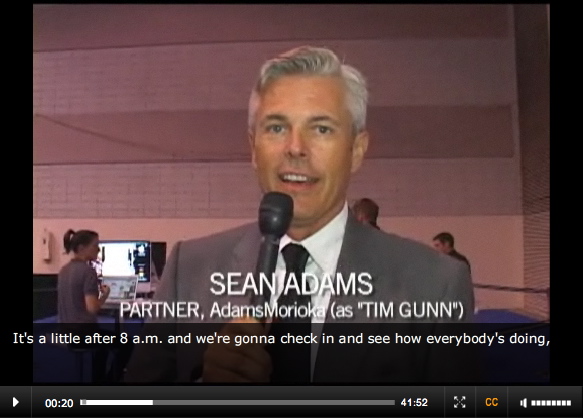
Episodes 2 and 3 were somewhat tediously introduced by the obviously gay Sean Adams, who pre-interviewed contestants before their work was ready.
Tim Gunn he ain’t. Adams’s Facebook profile merely describes him as “married.” Straight people never hide who they’re married to.
So that’s what, two more gay graphic designers? We’re up to how many now? A dozen?
I don’t even remember what his name is – I don’t care. The pornographic cereal box… I decided to check myself, largely, because what I would have said is “This is a giant fuck-you to the jury and I think you’re an asshole for doing it.” Like, why would you throw away… It was a stupid card to play. “Risk” involves some intelligence to me.
Genalo’s ethos? Burn out, not fade away. He did blow a chance to honestly answer the question “What’s the free toy inside?” with “A cock ring.” Not quite enough guts for glory there.
Why is all this not on TV?
Why is Bierut not on TV? Or a podcast?
What’s it going to take to disabuse him of the notion that because his day job involves marks on paper the only way he can discuss similar marks on paper is by marks on paper? What’s it going to take to persuade him that he doesn’t have to be all classy all the time and write tedious designery exegeses in 79 different fonts? Get back on the fucking stage, Michael.
Select a category to see additional posts. Add feed/ to a category to subscribe via RSS
The foregoing posting appeared on Joe Clark’s personal Weblog on 2009.12.29 14:25. This presentation was designed for printing and omits components that make sense only onscreen. (If you are seeing this on a screen, then the page stylesheet was not loaded or not loaded properly.) The permanent link is: https://blog.fawny.org/2009/12/29/commandx09/
Blog (short for “Web log,” a kind of online journal or diary)
The Awl. Needlepoint and Lite-Brite used pixels well before monitors came into use. The Awl is a Gawker manqué rendered in needlepoint and Lite-Brite – a hand-crafted Gawker, sold at an artisanal farmer’s market free of 4chan-like agents provocateurs. Here, comments work.
Runner-up: Well, the Tea Makers, obviously, now populated solely by 4chan-like agents provocateurs. Here, comments FAIL. Of course I regret the great schism, which I think about all the time, but I didn’t cause it. Alphonse Ouimet will continue to thrive, until something else blows up, and possibly after that, too, if history is any guide.
Not the winner: Mondoville. The fourth iteration of this concept is tolerable only in no-JavaScript, no-Flash view and has nothing to offer anti-Twits. Here, comments are AWOL.
Honourable mention for consistency: The Torontoist. Not all guys in their 20s are on 4chan.
“Viral” video
“Web Site Story.” Needs captioning, but they all do. Approaches Pythonesque levels of canonicity; I can recite the whole thing. Bonus? Green-shirt guy is doable. “True love on the Intanet? Ha!”
Overdue realization
Even the most Aspergerian of Toronto new-media strategists are slowly coming to realize the way their “friends” and “followers” present themselves onliné is an act. Nobody, but nobody, is that happy, optimistic, or blithe all the fucking time. Like Kuznicki, Toronto, and indeed Canada, these people need more curmudgeons in their lives. People who are right more often than they’re wrong tend to have what Normals call a bad attitude. This doesn’t mean I’m getting my hopes up.
Select a category to see additional posts. Add feed/ to a category to subscribe via RSS
The foregoing posting appeared on Joe Clark’s personal Weblog on 2009.12.26 12:11. This presentation was designed for printing and omits components that make sense only onscreen. (If you are seeing this on a screen, then the page stylesheet was not loaded or not loaded properly.) The permanent link is: https://blog.fawny.org/2009/12/26/x09/
Do you have a sneaking suspicion that your managers have bound and gagged the magazine, ferried it in the trunk of a car to a remote plot of land in the countryside, and forced it to kneel down before its own open grave? (Can you hear a distant rifle being cocked?)
Here are two skill-testing questions you can use to find out for sure!
Do you believe a “digital magazine” should have “pages”?
Do you believe the “pages” of a “digital magazine” should “flip”?
If the answer to either of these questions is yes, then somebody has a plan to drive your magazine into the ground.
Select a category to see additional posts. Add feed/ to a category to subscribe via RSS
The foregoing posting appeared on Joe Clark’s personal Weblog on 2009.12.22 14:57. This presentation was designed for printing and omits components that make sense only onscreen. (If you are seeing this on a screen, then the page stylesheet was not loaded or not loaded properly.) The permanent link is: https://blog.fawny.org/2009/12/22/md2/
Canada does not have “gay marriage”; all we have is marriage. Gays can get married, and that has resulted in sanding down some spiky points in our English usage.
Here are two facts some might find disturbing:
The man you’re married to is your husband even if you are a man yourself.
The woman you’re married to is your wife even if you are a woman yourself.
Hence not only is it proper to refer to his husband or her wife, those are the only terms you can use, at least if you want to be accurate. (George Smitherman does not have a “partner” named Christopher Peloso.)
So: Has the usage of his husband and her wife expanded in recent years? I checked the Canadian Newsstand and Candian Business and Current Affairs (CBCA) databases. I looked at years before, during, and after what Americans insist on calling “gay marriage” became legal nationwide. Every use is included, including pejorative or mocking usages from right-wing assholes; phrases with intervening words (his so-called “husband”; her pretend “wife”) are not included.
Year
2009 YTD
2008
2005
2000
1999
1990
Source
News
CBCA
News
CBCA
News
CBCA
News
CBCA
News
CBCA
News
CBCA
his husband
25
16
11
7
8
5
5
0
2
1
0
0
her wife
17
10
19
7
24 (!)
8
5
0
14 (!)
1
4
0
In the last three years, usage has doubled for her wife (outlier excluded) and tripled for his husband.
Popped the question? Got a yes? Not hitched yet? Then what you have is a fiancé(e). That one I haven’t looked up.
Select a category to see additional posts. Add feed/ to a category to subscribe via RSS
The foregoing posting appeared on Joe Clark’s personal Weblog on 2009.12.22 14:06. This presentation was designed for printing and omits components that make sense only onscreen. (If you are seeing this on a screen, then the page stylesheet was not loaded or not loaded properly.) The permanent link is: https://blog.fawny.org/2009/12/22/husband-wife/
The American Dialect Society is what its name implies, a society concerned with the American dialect of English (and is not really what its catchphrase claims, a society interested in “the English language in North America”). They publish an annual Word of the Year list, always including an entry from my esteemed colleague Grant Barrett, who now also writes an annual piece in the Times (2009; 2008).
Wordlists from all nominators but one are nonsensically provided as PDFs. Since nobody else has bothered, I have merged and deduped all nominees and present them here without comment, attribution, or definition. (Well, one comment: Some of them are obvious nonstarters and a few of them just stink.) [continue with: Concordance of Word of the Year 2009 entries →]
Select a category to see additional posts. Add feed/ to a category to subscribe via RSS
The foregoing posting appeared on Joe Clark’s personal Weblog on 2009.12.22 13:30. This presentation was designed for printing and omits components that make sense only onscreen. (If you are seeing this on a screen, then the page stylesheet was not loaded or not loaded properly.) The permanent link is: https://blog.fawny.org/2009/12/22/woty09/
Today I begin an occasional series on how the magazine industry insists on decanting its Evian into lead goblets. Because isn’t it obvious these people are just getting stupider?
Remember Magazines Canada?
This shadowy organization somehow secured a six-figure grant from an Ontario government agency, the OMDC, to launch some kind of digital newsstand. How well do you think that was gonna turn out? As I warned:
As in other fields, when print publications move to online distribution, they make the same mistakes over and over again. A “provider of digital services” becomes “seasoned” in Canada by recapitulating the same mistakes, not by learning from them and trying something else. In this case, the mistakes are much worse than those to which we’ve become inured in the Web domain – tables for layout, “font tags,” Flash.
The only reason to run up a six-figure consulting bill is to reinvent the wheel. To justify that kind of budget, you have to write a custom software platform and/or reader application. While this is exactly the wrong thing to do, Magazines Canada and the Ontario government don’t understand that. But it is the only outcome that justifies the grant money.
And lo has it come to pass. Magazines Canada handed an undisclosed amount of money to Americans. Zinio now runs two digital newsstands, magazinescanada and magazinescanadafr (for the obviously marginal Francophone “market”).
Now, what’s a digital magazine in this context? An image of each page of the print magazine rendered in a proprietary format. The idiocy of this measure is apparent to everyone who actually uses the Web and doesn’t work in the magazine industry, where people can barely run their computers. Let me put it to you this way: Nobody wants to fly their avatar through a virtual West Edmonton Mall to shop online, and nobody wants move a loupe around a tiny picture of a magazine page.
Magazine people understand “publishing” to mean “export to PDF.” They don’t understand their own product – a tactile object that offers both graphic design (the arm’s-length view) and typography (the up-close view). As far as these people are concerned, a PDF export is a digital magazine even though it gives you none of the features of a print magazine, with the rare exception of viewing a double-page spread on a very large monitor. (And even then, what does the paper feel like?) [continue with: Magazine deathwatch (1) →]
Select a category to see additional posts. Add feed/ to a category to subscribe via RSS
The foregoing posting appeared on Joe Clark’s personal Weblog on 2009.12.21 14:28. This presentation was designed for printing and omits components that make sense only onscreen. (If you are seeing this on a screen, then the page stylesheet was not loaded or not loaded properly.) The permanent link is: https://blog.fawny.org/2009/12/21/md1/
’Tis the season to play “Jingle Rock Bell” by P.S. Tail (MP3) no less often than once a day. It is, of course, a cover version of “Jingle Bell Rock” using only the words bell, rock, and jingle (and a few spoonerisms). It’s hard to duplicate. Try it yourself. You’ll feel like Krusty singing “The Star-Spangled Banner” and within seconds you’ll be dying for the right moment to give up and just bellow “in the frosty air!” and nuke a mug of veggnog.
And now, a transcript
Bell jingle rock jingle rock rock bell Bell rock jingle rock bell rock bell Rock bell jingle rock bell bell bell Rock bell rock bell jingle jingle jingle Jingle rock bell rock jingle bell rock Bell rock bell bell rock bell jingle Jingle rock bell rock bell jingle jingle Jingle bell rock rock bell! Bell rock jingle! Bell rock jingle! Jingle jingle rock rock bell Bell bell rock! Jingle rock bell! Bell rock bell rock jingle bell rock rock Bell rock jingle rock bell jock ringle Ringle jock bell rock bell Bell rock jingle rock rock jingle rock bell rock rock bell jingle rock
Jingle rock bell rock rock rock bell Bell jingle jingle bell rock rock bell Bell rock jingle rock bell rock jingle Jingle rock bell rock jingle rock bell Rock bell jingle rock bell bell bell Bell jingle jingle jingle rock rock rock Rock jingle jingle rock bell bell bell Bell jingle rock rock bell
Bell rock jingle! Bell rock jingle! Jingle rock bell rock bell! Bell rock jingle! Bell rock jingle! Jingle rock bell rock bell jingle jingle!
Jingle rock bell rock jingle rock bell Bell rock jingle rock bell Bell rock jingle rock bell bell bell Bell rock jingle rock bell Ro-o-ock bell! Ro-o-ck bell! Jingle jingle jingle rock bell Ro-o-ock bell! Ro-o-ck bell! Jingle rock jingle rock bell bell bell
Bell rock jingle rock jingle bell rock Rock bell jingle rock bell Bell rock jingle rock jingle rock bell Bell rock jingle rock – bell rock jingle rock – bell rock jingle rock bell!
Select a category to see additional posts. Add feed/ to a category to subscribe via RSS
The foregoing posting appeared on Joe Clark’s personal Weblog on 2009.12.21 09:20. This presentation was designed for printing and omits components that make sense only onscreen. (If you are seeing this on a screen, then the page stylesheet was not loaded or not loaded properly.) The permanent link is: https://blog.fawny.org/2009/12/21/jbr/
Two paralinguistic observations about Ariel Levy’s endless feature on Caster Semenya (New Yorker, 2009.11.30):
On the New Yorker podcast, host Blake Eskin deployed Northeastern Elite American English, in which any and every word that could use the vowel [æ] in a stressed syllable instead uses [ɑː]. The standard examples are Mazda, plaza, pasta, and names like Tanya and Julianna. Canadians use [æ] on the whole, as do lower-class Americans and Americans with accents (e.g., from Buffalo). But that sounds twangy and uneducated to the northeastern elite, which prefers [ɑː].
Eskin consistently called Caster Semenya [ˈkʰɑːˌstɘɹ] Semenya. In other words, Kahhhster. (Actually Kʰahhhster, with a strongly aspirated K.) If we are to believe Old Farmer’s Wikipedia, the only ah in Sesotho languages is in fact [ɑː]. But in American (and Canadian) English, the only rational pronunciation of Caster is just like the word “caster” (as in caster sugar or broadcaster) – with an [æ].
But that’s not the interesting thing. The interesting thing is how Levy’s pronunciation drifted from [æ] to [ɑː] until, at interview’s end, there she was calling the athlete she’d actually met and talked to [ˈkʰɑːˌstɘɹ] Semenya. Using that pronunciation won’t gussy Semenya up any more than that “painfully uncomfortable… garish” makeover did.
Here are all the proper names of South Africans appearing in the article (when full names are given):
Jeremiah Mokaba
Phineas Sako
Caster Semenya
Zola Budd (pseudonym)
Johanna Lamola
Nelson Mandela
Makhenkesi Stofile
Jacob Zuma
Phat Joe (pseudonym)
Lolly Jackson
Winnie Madikizela-Mandela
Noluthando Mayende-Sibiya
Saartjie Baartman
Leonard Chuene
Harold Adams
Debora Patta
Molatelo Malehopo
Dorcus Semenya
Funeka Soldaat
Julius Malema
Benedict Phiri
Maphela Semenya
Wilfred “Wilfie” Daniels
Kobus van der Walt
Are these names indicative of a flourishing and integrated multicultural society or of an ungovernable nation of competing ethnic groups?
Select a category to see additional posts. Add feed/ to a category to subscribe via RSS
The foregoing posting appeared on Joe Clark’s personal Weblog on 2009.12.17 13:23. This presentation was designed for printing and omits components that make sense only onscreen. (If you are seeing this on a screen, then the page stylesheet was not loaded or not loaded properly.) The permanent link is: https://blog.fawny.org/2009/12/17/levy-phonology/
Surely there is a tad too much guilt by association tied up in modern defenders of manhood. (Now Jack Donovan [q.v.] is equating feminism with Dockers.) But there’s an alternative. If you like manly men in sincere and ironic ways but don’t feel the need to defend war, violence, or carnivory as part of the package, why not enlist Jockohomo as curator?
Né James Alex, this mysterious and, it is rumoured, sometimes troublesome American bodybuilder/art major may or may not live in Montreal. Details, details: He’s one of the original homosexualist bloggeurs and is best understood as a constellation of online identities. (Again: Bodybuilder/art major.) He’ll find you all sorts of contemporary art you didn’t know you needed to see, especially on his old blog, but also manages to “reblog” photographs of terribly strong, broad-shouldered lads taking up a lot of space, an essential manly attribute (q.v.).
What’s the best part? Some of these photos are sideways. Rotate 90° and one man’s erotica becomes another man’s art.
Jockohomo’s curation is a pleasing antidote to 98-pound-weakling Butt readers who think by avoiding the gym and folding in on themselves they are enacting some kind of commentary on commodity gay culture. They’re just scrawny and unkempt. (Hey, need a hand hauling that bag of basmati rice up your stairs?)
On another day, let’s discuss how an emphasis on strength and big shoulders leaves behind a lot of men with disabilities. Surely a necessary ingredient is presence, and being able to do 10 × 45# reps of dumbbell flyes determines little. I could tell you the tale of the head of security at an American sports arena who wheels up in a power chair, levels a cold stare, and makes half-drunk troublemakers with bloodied noses lose their shit.
Nonetheless, the Jockohomo æsthetic is a pleasing one. Follow his lead.
Select a category to see additional posts. Add feed/ to a category to subscribe via RSS
The foregoing posting appeared on Joe Clark’s personal Weblog on 2009.12.13 17:27. This presentation was designed for printing and omits components that make sense only onscreen. (If you are seeing this on a screen, then the page stylesheet was not loaded or not loaded properly.) The permanent link is: https://blog.fawny.org/2009/12/13/jockohomo-aesthetic/