The severely-hit-and-miss Ignite presentation soirée is coming back to Toronto, and this second outing is as badly run as the first.
People seem to be treating this presentation format as another kind of DemoCamp or some kind of hot new way to pitch to the many venture capitalists who attend free events here. The first Toronto Ignite sessions seemed like crashing bores. They haven’t shown up on the podcast feed yet; I’m trusting firsthand reports. (Though I see now there is a Vimeo feed – rather inconvenient when one wishes to watch on an iTouch.)
I do feel this is another example of Toronto’s arriving late to somebody else’s party. Why do we hold Ignite sessions here? To prove we’re as world-class as San Francisco, though without the filth, decay, and aggressive homeless men. But we’re putting a local stamp on things through the organization of the event, which seems so half-assed and clubby it could only happen here.
The signup form states “Awesomeness is the only metric by which your presentation will be evaluated.”
Your presentation has to already have been completed before you apply to speak.
You cannot apply without using the official Ignite template.
You need to ask for the template before you can even fill out the form.
So: I am expected to work on spec, create slides according to a format I don’t even know, and ask for that format at some point before I’m even allowed to apply to speak for five measly minutes at a free event. And even then I might get turned down because of awesomeness failure. (That isn’t why I would get turned down.)
This whole enterprise is set up for nerds, so you have to talk about something technological. (Ignore the [theo]bromides about how “hacking chocolate” is a perfect Ignite topic. It isn’t.) So here’s what I’ve been planning to talk about for the better part of a year: Why can’t computers read the Goof sign?
It has to do with sudoku, Mongolian, and what an ambulance looks like in your rear-view mirror.
I’ve been presenting for 20 years. I don’t know why we’re expected to put up with an application procedure rivalling that of a literary prize or a midlevel private school. It’s not just that I’m special; it’s that I have a proven track record and an idea nobody else has. Awesome enough, or do you want to run a few more sessions on social media?
Select a category to see additional posts. Add feed/ to a category to subscribe via RSS
The foregoing posting appeared on Joe Clark’s personal Weblog on 2009.10.16 09:42. This presentation was designed for printing and omits components that make sense only onscreen. (If you are seeing this on a screen, then the page stylesheet was not loaded or not loaded properly.) The permanent link is: https://blog.fawny.org/2009/10/16/ignitpick/
Nonetheless, some useful points from The Law of Libel and Slander in Canada are as follows:
A defamatory statement is one which has a tendency to injure the reputation of the person to whom it refers; which tends, that is to say, to lower him in the estimation of right-thinking members of society generally; in particular, to cause him to be regarded with feelings of hatred, contempt, ridicule, fear, dislike, or disesteem. [p. 6; from Salmond on Torts, 1981]
Where the allegedly defamatory statement is to the effect that the plaintiff has committed a criminal offence, the defendant must prove that the plaintiff committed the crime. It will not suffice for the defendant to adduce proof of conviction; there must be proof of commission.
The wisdom of this rule may well be questioned…. However, it should be noted that this rule is supported by English decisions. It may be that a Canadian court would recognize proof of conviction to be the best evidence of commission of the offence. [8]
[T]o state that other members of society “heartily detest” the plaintiff would probably cause his reputation to suffer. [10]
The mere inclusion of an article in a series may be libellous. For example, a weekly publication may print a series of articles exposing chicanery and dishonesty. The inclusion of an article about any individual in this series may lead readers to draw the inference that he indulges in such conduct. [18]
What is the difference between libel and slander? It is not strictly true that libel is written and slander is spoken (or, presumably, uttered in sign language).
An action for a libel may be brought on words written, when the words, if spoken, would not sustain it.
Thus, the distinction between written and spoken defamatory comments was important. However, the distinction between written and spoken defamatory comments is not the only test for determining whether words are libellous or slanderous.
It is generally said that libellous comments are those which may be observed and are published in a permanent form. There must be a publication which may be perceived by the sense of sight and which is permanent. Both elements must exist before the publication will be libellous. Slanderous comments are all those which do not amount to libel. [45]
Any comment communicated in a form which is permanent and visible to the eye is libel. Any communication which is temporary and only audible is slander. Therefore, publications in books and newspapers are libels and those in spoken words are merely slander…. [P]ublications which are permanent but only audible are difficult to characterize. Similarly, representations which are visible but not permanent are hard to categorize. [49]
The plaintiff must set out the libellous and slanderous words of which he complaints. The plaintiff must specify precisely what these statements were. [55]
Malice may be one of various states of mind. It may be spite, ill will, or a desire to do harm for its own sake. There is a general presumption in favour of the absence of malice….The malice may be indicated by the words of the statement or it may be found in the surrounding circumstances. [88]
Select a category to see additional posts. Add feed/ to a category to subscribe via RSS
The foregoing posting appeared on Joe Clark’s personal Weblog on 2009.10.15 14:16. This presentation was designed for printing and omits components that make sense only onscreen. (If you are seeing this on a screen, then the page stylesheet was not loaded or not loaded properly.) The permanent link is: https://blog.fawny.org/2009/10/15/lawoflibel/
For up to a year I’ve been putting off writing a definitive article – one that everyone could use as a reference – that demonstrates universal design is a myth. (The same goes for inclusive design: Inclusive design is a myth.) This posting will have to do for now.
Basic facts
Whenever anyone uses the term universal design or inclusive design, they only ever mean “design accessible to disabled people.” And they only ever mean some disabled people.
There’s real design and then there’s universal design. Designers create the real object, and then, in rare cases, bolt on a bit of accessibility afterwards. There are, in practice, almost no designers anywhere who engage in genuine universal design, save for certain elite Web developers.
Research confirms that universal design just means accessible design, if it means anything.
The attested statements of designers themselves show that so-called universal design is just for disabled people, often limited to one specific group of disabled people.
Select a category to see additional posts. Add feed/ to a category to subscribe via RSS
The foregoing posting appeared on Joe Clark’s personal Weblog on 2009.10.15 13:36. This presentation was designed for printing and omits components that make sense only onscreen. (If you are seeing this on a screen, then the page stylesheet was not loaded or not loaded properly.) The permanent link is: https://blog.fawny.org/2009/10/15/universal-design-myth/
Select a category to see additional posts. Add feed/ to a category to subscribe via RSS
The foregoing posting appeared on Joe Clark’s personal Weblog on 2009.10.14 12:18. This presentation was designed for printing and omits components that make sense only onscreen. (If you are seeing this on a screen, then the page stylesheet was not loaded or not loaded properly.) The permanent link is: https://blog.fawny.org/2009/10/14/supercalifreakonomicsexpialidocious/
In a podcast interview with Ugly Pete Sampras, bear fetish object and motor-vehicle pitchman Mike Rowe manages to utter the phrase cock ring but never shit (always crap, even in nonsensical compounds like “crapload”), name-drops Ayn Rand out of nowhere, and essentially argues for complete deregulation of blue-collar professions. Why? Safety Third.
Rowe found a receptive audience in the host, who here reiterates his endorsement of capital punishment and has previously screamed for 15 minutes (MP3) that torture has to work because it’s been used for millennia.
Select a category to see additional posts. Add feed/ to a category to subscribe via RSS
The foregoing posting appeared on Joe Clark’s personal Weblog on 2009.10.09 14:23. This presentation was designed for printing and omits components that make sense only onscreen. (If you are seeing this on a screen, then the page stylesheet was not loaded or not loaded properly.) The permanent link is: https://blog.fawny.org/2009/10/09/dirty-objectivists/
Yesterday, TTC sent along a press release stating that new fines for infractions would come into effect Monday. They’ve had the right to levy those fines since the bylaw was updated, but, we were told, Special Constables have instead been spending all that time “educating” passengers about the new rules. (Oddly, passengers are called passengers, which they are, instead of customers or patrons, which they aren’t.)
All this is a lie, of course. Special constables don’t deserve capital letters and are second-tier cops. They aren’t educators, they don’t educate anybody, and they don’t do anything on their own initiative. Constables demonstrably have not been going around talking to people and “educating” them. Seriously: Do you think they’d bother lumbering out of their Crown Vics for that kind of pussyfooting?
Still, every news outlet in town has dutifully parroted this bullshit, almost as if copying from a news release. Could that be what actually happened?
Spacers: “Over the past several months, Special Constables have been educating TTC riders about the upcoming changes”
Tubby: “Up until now, TTC constables only warned of changes to TTC bylaws” (seemingly a more honest description of what might or might not have been going on)
In other TTC-pseudocop news, I am just waiting for somebody to try to give me a ticket for taking entirely permissible noncommerical photographs on the subway. I would actually love for that to happen; see you in court.
Select a category to see additional posts. Add feed/ to a category to subscribe via RSS
The foregoing posting appeared on Joe Clark’s personal Weblog on 2009.10.09 13:03. This presentation was designed for printing and omits components that make sense only onscreen. (If you are seeing this on a screen, then the page stylesheet was not loaded or not loaded properly.) The permanent link is: https://blog.fawny.org/2009/10/09/ttc-pseudocop/
Throw in “drunken, grizzled positoid” and whaddya know, you’ve got a blog every queer in Manhattan reads that takes down your browser in half a minute.
Select a category to see additional posts. Add feed/ to a category to subscribe via RSS
The foregoing posting appeared on Joe Clark’s personal Weblog on 2009.10.08 20:44. This presentation was designed for printing and omits components that make sense only onscreen. (If you are seeing this on a screen, then the page stylesheet was not loaded or not loaded properly.) The permanent link is: https://blog.fawny.org/2009/10/08/atheists-carnivores-windoids/
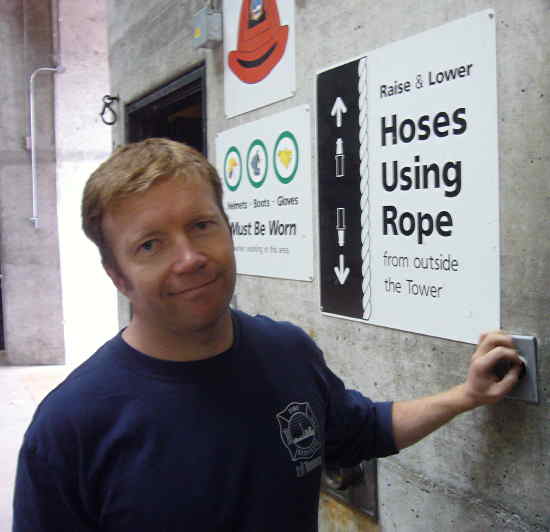
I almost didn’t go to the fire academy’s open house, as I do every year. One reason is because I was planning on hosting a group event for the day, but never got my act together. (My group events always turn out so well anyway, do they not? Nonetheless, come back next year for Nerds on Firetrucks™.) Plus I’ve been on every apparatus and I almost know the keyless ignition sequence for one of them. (Just the sort of minutiæ nerds go for. See you in ’010.) What else did I have to learn?
I managed to think of something and showed up. I walked around to the parking lot and beelined toward the obvious target. “A dying breed,” I said to one lad: “A red-haired fireman.” He kind of smiled.
I told him I’d done everything except tour the tower, a seven-storey concrete monolith that simulates an apartment building, among many other functions. (They never burn it; they have a burn house 30 feet away for that purpose. It’s actually used for smoke and flashover testing, not really fighting “fire.”)
We went through the whole place. Room after room contains obstacles and pinchpoints and little confined spaces you have to get through while wearing full turnout coat and breathing apparatus. Many more rooms sit empty, like prison cells. They can run you up and down the stairs and simulate various kinds of evacuations using heavy mannequins.
I asked a million questions. There is no such thing as too much information when it comes to firefighting. I couldn’t ever do the job and really I don’t want to, but I have to know everything.
My host, Jason, has been on the force eight years. Previously he held down a crushingly dull day job that was eating him up inside. Now he’s doing something rangy and physical – just the sort of thing that suits the Fire Venturers cadets I later talked to. (One of them volunteered the following: “I don’t like writing.” He’s in the right place.)
At ground level, we shook hands goodbye and back Jason went to the cluster of firemen who’d been standing around waiting for something to do. “Aww, back with your buddy?” one of them loudly said. I pretended not to notice, but it bothered me, as everything does. I’d been happy as a clam getting an informative tour of a fire-training facility from a self-effacing redhead fireman. It’s the happiest I’ve been in weeks.
I thought things couldn’t get better, but they did. I closed my visit with a good half-hour chat with another red-haired firefighter. (This time it was a she.) We talked about just what’s involved in recruiting gays and disabled people. If you feel really uncomfortable and bored at Woody’s, if you like to take up space, if you can drive and swim, if you know CPR, if you’re strong as an ox with good VO₂ max, if you want to do something where you’re actually doing something, then, man, have I got a job for you. And if you want, I’ll be your fan.
Select a category to see additional posts. Add feed/ to a category to subscribe via RSS
The foregoing posting appeared on Joe Clark’s personal Weblog on 2009.10.05 14:23. This presentation was designed for printing and omits components that make sense only onscreen. (If you are seeing this on a screen, then the page stylesheet was not loaded or not loaded properly.) The permanent link is: https://blog.fawny.org/2009/10/05/ginger-fireman/
I was the “guy” you all groaned at last night at RyeHigh’s “What’s Next for News?” presentation – the one you had to download a PDF to find out about. (Tomorrow’s journalism today: News delivered in a file your browser can’t read.)
The technology journalist who passes for an éminence grise in this country, Mathew Ingram, again failed to disclose his mile-wide conflict of interest as, dressed in his Sunday-best sweatshirt, he “moderated” a panel consisting of international megastars Clay Shirky and Andrew Keen.
I adore Shirky. I’ve read everything he’s written. (And he looks as nice in person as he does in photographs; the ears are actually the best feature. He’s solidly packed into a shorter frame than I expected, and that blue-grey colour palette rather suits him.) I understand where Keen is coming from (I’ve read his books), and he has offered me a bit of help from time to time. So I was predisposed to like our invited guests.
You were too. That’s why they were invited. They’re “Internet personalities.”
But if the ostensible topic is the future of journalism, this isn’t about personalities. Shirky would be the first to tell you it’s about structure. Structurally, there is something offensively colonial about asking an American and a Brit to teach us how to dig ourselves out of a Canadian hole.
A kind of Toby Young effect
I was first in line at the mike for Q&A (at about 16:00 in the resulting video). I asked a fact-checking question first: Andrew, do you have American citizenship? After a great deal of peeved murmuring from stage and audience, Keen took it upon himself to haul out his burgundy U.K. passport. Fine: If we’re here at Ryerson University, I asked, what are we telling journalism students when we import an American and a Brit to lecture us on how to fix our newspapers?
I’d only been up there a minute and the crowd was already against me. Shirky looked insulted and objected to the word “lecture.” I withdrew that and replaced it with “inform.” Shirky replied that national variation will shrink rather than grow, which is another way of saying everybody will naturally do what Americans do. (Surely that is always the way.)
Keen at least reacted to the structural theme of the question, wondering why so much of our online mediascape is dictated by a small elite (in Northern California).
Ingram weakly protested that he was Canadian and I told him he didn’t matter here, which he didn’t. Who is the Canadian Clay Shirky, Keen asked? Don Tapscott was the first name to come up. A plausible choice, I said, but you two and Tapscott benefit from a power law. You’re already popular, so you get more popular. And you’re the ones with the book deals. I knew Shirky would respond well to one of his buzzwords, and he took time out from resentfully staring at the floor to agree with me.
It’s obvious to you I was out of line asking that question
I would expect a reaction like that from conflict-aversive starfuckers, as nearly everyone in the Toronto media could be described. You’re so steeped in Americana that of course you consider Clay Shirky one of your own. He’s an American who became famous in America, and that automatically gives him credibility here. Keen is British and gained fame in the United States; the same applies. You aren’t famous in Canada till you’re famous somewhere else. You don’t even have to be Canadian to be famous here for being famous somewhere else.
You don’t want to accept that Canada is a sovereign nation that might actually need to solve its own problems its own way. (Want a real example of a digital economy? Try Finland or Estonia, not America or Britain.) You still haven’t gotten past the bright, shining lie we heard so often in the sales pitch for the Free Trade Agreement – “Canada is too small a market.” (Too small for what? Implicitly, for anything.)
Canada is a nation of 32 million people occupying a greater land mass than any other country save one. Canada is not “small,” unless you believe nothing counts unless it happens within the boundaries of our former colonists. (You may not know that Americans colonized Canada. They did; they gave you the language you speak.)
You aren’t consistent about this, of course. Your exercise in consensus permits a few complaints around the edges, which in turn are also an exercise in consensus.
You think Canada has way shittier and more expensive cellphone service than other civilized countries. (Paraphrased: “Rogers makes my iPhone suck.”) A gripe like that is technical, not cultural.
You want made-in-Canada copyright law (i.e., you want whatever Michael Geist tells you we need), but everything you talk about in that regard has its basis in U.S. law. You want U.S. fair use in the guise of “enhanced fair dealing.” (You want it so badly you ignore the evidence [PDF] it won’t work here.) Most of all, you want Canada to avoid anything that reeks of the DMCA. (You know what the DMCA is even though it doesn’t apply to you.)
That’s pretty much the limit of permitted disagreement. Even daring to point out that a city this size has too many technology conferences isn’t permitted. What you very much do not want is a forceful break from consensus. You won’t even tolerate disagreement on details.
You especially don’t want to hear any disagreement from me. Being older than you, and having been online for nearly 20 years, gives me expertise and authority you very much don’t want to hear about. You certainly don’t want me to act like I have expertise and authority, though it’s fine if foreign nationals do. You believe the worst man to voice disagreement is the man who’s probably right.
Hence, no, of course you couldn’t possibly tolerate any suggestion that we aren’t as good as real cities, like New York and London, or real countries, like America and Britain. (We import their “Internet personalities” and put them onstage.) You’re so defensive you don’t even see I am not making that suggestion.
I insist merely that Canada is a country separate from the United States and the United Kingdom. We need our own solutions to our own problems. Only a special kind of cultural sellout would object to that sentiment. You are that kind of sellout. Put that in your Twitpic and smoke it.
What’s next for news? Well, “the future in our industry” appears to centre around the Globe and Mail’s fabulous colour printing presses.
Select a category to see additional posts. Add feed/ to a category to subscribe via RSS
The foregoing posting appeared on Joe Clark’s personal Weblog on 2009.10.03 13:39. This presentation was designed for printing and omits components that make sense only onscreen. (If you are seeing this on a screen, then the page stylesheet was not loaded or not loaded properly.) The permanent link is: https://blog.fawny.org/2009/10/03/whatsnext/