If Johnny Cochrane is the go-to lawyer for guilty “celebs,” the Electronic Frontier Foundation (EFF) is the go-to advocacy group for copyleftists. This summer EFF went off the deep end in claiming the much-unloved DMCA indirectly prevents censorship of TV captioning. Yes, EFF blames the DMCA for preventing the censorship of captioning.
EFF alleged that the DMCA and another U.S. laws are preventing TVGuardian from selling a set-top box that would filter out obscenities from digital TV programming. Since I actually own a TVGuardian analogue caption decoder and know a thing or two, I call bullshit.
EFF:
Why can’t TVGuardian get access to CC data after the digital TV transition? The real reason is not that the television programming is digital, but that a large portion of it (including satellite TV and much of pay-cable service) will be encrypted, and the DMCA will prohibit TVGuardian from circumventing that encryption in order to read the captioning.
As I explained to the author of the blog entry (via electronic mail, which he dutifully replied to via top-posting), TVGuardian’s analogue-TV censorship methods rely on analogue-TV captioning procedures: Captions are transmitted alongside the picture, but only come into being inside your TV set when you ask for them. You ask for them by turning on your caption decoder. Captions, then, are postprocessed.
The TVGuardian adds a level of post-postprocessing, as it reads the captions and creates an expurgated version. That is what you see, finally and at long last. The sequence is TV signal → caption decoding → caption expurgation → TV display.
Digital-TV captions aren’t postprocessed; they are integrally intermingled with the signal. They are transmitted with the picture and not on a line of the television screen that sits above the picture. (Of course everything gets its own defined data stream, but all data streams are transmitted together.)
Hence digital-TV caption decoding is just another kind of of processing that your display undertakes just to make the picture visible. Digital-TV captions are not postprocessed. The sequence is TV signal → TV display.
[There is a significant exception here in the case of analogue TV shows broadcast digitally, which must retain old analogue captions in exactly the same place (typically a duplicate of the intermingled caption data). But the EFF posting discussed only digital television, so this is a distinction without a difference.]
To make TVGuardian work on digital television, censorship has to happen in the same place that decodes the whole picture including captions. It isn’t the last step of the process, it’s one of the steps before the final step.
So I don’t know what EFF is complaining about. For digital TV, TVGuardian needs to sell its technology to equipment-makers, not to home users. If the company can’t do that, them’s the breaks. It has nothing to do with the DMCA.
EFF has, of course, failed to update its posting with any of these facts. It’s the EFF; when it comes to the DMCA, they always know what they’re talking about, correct?
I also wonder why EFF is advocating for in-home censorship. Americans are picky about that word, pedantically insisting it isn’t censorship unless the government does it. Nobody actually believes that, but it is a longstanding American myth. Here EFF is willing to go to bat for censorship because it lets them take another swing at the DMCA, thereby reinforcing the cherished prejudices of the EFF base.
Select a category to see additional posts. Add feed/ to a category to subscribe via RSS
The foregoing posting appeared on Joe Clark’s personal Weblog on 2009.09.08 14:40. This presentation was designed for printing and omits components that make sense only onscreen. (If you are seeing this on a screen, then the page stylesheet was not loaded or not loaded properly.) The permanent link is: https://blog.fawny.org/2009/09/08/not-dmca/
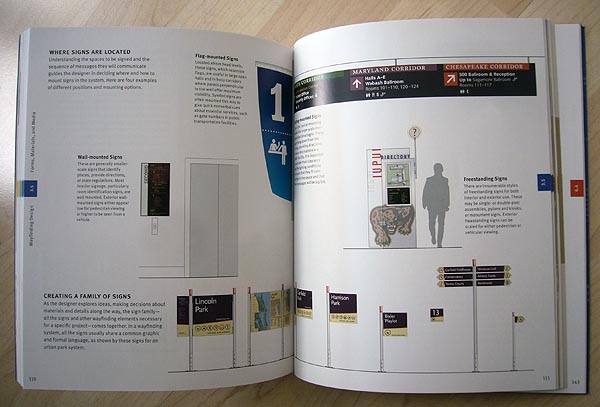
The Wayfinding Handbook: Information Design for Public Places by David Gibson is meant for students. It’s somewhat elementary, but that is a relief compared to other books, which assume a degree of reader expertise and lovingly indulge in detailed exegeses of claims that are just incorrect in the first place.
It’s a tale told mostly in pictures. I’m amazed by the breadth of examples Gibson dug up – and the fact that the signage displayed is crystal clear even in reduced thumbnails. (Gibson is Canadian but hasn’t lived here in a while. That may explain why he thought the Astral Info-to-Go advertising panels were worthy of inclusion [mislabelled as “Information kiosk”].)
There’s a lot of explanation about how to bid on contracts, something I haven’t seen before. And I’d never seen the corporate, university, or other “campuses” broken down into four wayfinding models.
The book turned me into a believer in a bit of whimsy in one’s signage. Or just something other than perfectly legible type at all times. (In other words, keep the TTC font on subway walls. But I believed that already.)
I learned a lot from the discussion of sign materials and fabrication processes.
Select a category to see additional posts. Add feed/ to a category to subscribe via RSS
The foregoing posting appeared on Joe Clark’s personal Weblog on 2009.09.07 15:56. This presentation was designed for printing and omits components that make sense only onscreen. (If you are seeing this on a screen, then the page stylesheet was not loaded or not loaded properly.) The permanent link is: https://blog.fawny.org/2009/09/07/wayfindinghandbook/
Select a category to see additional posts. Add feed/ to a category to subscribe via RSS
The foregoing posting appeared on Joe Clark’s personal Weblog on 2009.09.07 12:16. This presentation was designed for printing and omits components that make sense only onscreen. (If you are seeing this on a screen, then the page stylesheet was not loaded or not loaded properly.) The permanent link is: https://blog.fawny.org/2009/09/07/mightier-than/
I call for whatever passes for the technology demimonde of Toronto to shun Joshua Errett, online editor of Now.
No ordinary sourpuss, Errett turned an early incarnation of the Torontoist into this city’s own Juicy Campus, a cultivated, curated, enabled, facilitated forum for cyberbullying. Temporarily exiled to Ottawa (almost far enough away), Errett later fit into Now like hand in glove. It’s an environment where balls-out capitalism masquerades as leftist critique and the entire corporate culture can be summed up in one word – nasty.
With his sneering, his imperiousness, his dismissiveness, all young Josh needs in order to cement his career trajectory at Now is shoulder-length hair. He’s so vicious he could run the place someday.
In his actual work output, Errett shows a toxic mixture of youthful inexperience and personal technology bias. Just last week Errett made an argument that seems improbable for a progressive alternative newspaper – the wholesale transfer of a public asset to a foreign multinational. Am I talking about water? the tar sands? the Northwest Passage? Nope – TTC and Toronto city data. For no apparent reason other than Errett’s own use of Google Transit, TTC and City of Toronto data should be handed over to Google pronto, he argued.
As this topic had been discussed endlessly on the Toronto blogs that should already be in the RSS feed he likely does not have, this was the last straw. In today’s issue, Now cunningly edited out the first graf of my letter to the editor, which read thus in the original:
With his ill-suppressed nasty streak and his ability to recapitulate conventional wisdom as though he originated it, Joshua “Reign of” Errett fits right into Now’s corporate culture. This hardly qualifies him to give advice to public bodies on how to use their data.
Errett may just love Google Transit, but what he thinks doesn’t matter when it comes to public agencies, whose offerings have to be accessible to people with disabilities. Google Transit isn’t. Google could reasonably become one of many nonexclusive users of public data (along with indie developers), but such data could not just be handed over to a foreign-owned multinational corporation. It’s public data. We are the owners and it’s got to stay that way.
Hence a TTC trip planner or the database of deep listings of Toronto city services has to be kept in public hands. Of course this takes longer. Giving away public assets to corporate interests may be expedient, but that’s a bug, not a feature.
What would shunning mean?
Don’t help him with his research. If he even bothers asking you for a quote, ignore him. Don’t even say “no comment.”
Don’t link to his pieces. (You’ll note I am not.)
Delete his comments from your blog. In fact, block him from your system – already a tried-and-true method in this town.
De-“friend” him on the Facebook (where, as of today, he has but one “friend”).
Select a category to see additional posts. Add feed/ to a category to subscribe via RSS
The foregoing posting appeared on Joe Clark’s personal Weblog on 2009.09.03 15:03. This presentation was designed for printing and omits components that make sense only onscreen. (If you are seeing this on a screen, then the page stylesheet was not loaded or not loaded properly.) The permanent link is: https://blog.fawny.org/2009/09/03/reignoferrett/
(NOW WITH UPDATES) Because that’s what your magazine needs. Not “improvement.” Unfucking. Let’s not mince words. They pretty much all suck. I can’t think of one that doesn’t. (And don’t say [U.S.] Wired, because the magazine and the Web site are two separate entities. Actually, that is a model right there.)
You aren’t publishing a “magazine Web site.” You are publishing a Web site. What does your site need to do?
Think the unthinkable
You need to do what the Times is doing and actively prepare for a future in which the print edition has ceased to exist. Accepting second-best for the Web site is a recipe for disaster even if that iceberg seems a long way away right now.
Do what works. Don’t do what doesn’t work
Great artists steal. My advice in general is to do what we know works and not do what we know doesn’t work. (This should be self-evident but isn’t.) Or, stated another way, look at whatever Toronto Life is doing and do the opposite.
Finances
While a Web site and a print magazine need to be largely decoupled, their finances aren’t going to be. It would help the whole enterprise if you pulled a Monocle and seriously increased subscription prices. Doubling them would be a good start and tripling isn’t a bad idea. (No more discounts. A discount is an apology.) As with Monocle, treat subscribers like investors and they’ll start acting that way. Single-copy price at newsstands needs to at least double.
Advertising
Start your own online ad network modelled after the Deck. (Or just sublicense the Deck.) Sell fewer and better-targetted ads across more publications and charge more for them. No crappy Google AdWords.
Redesign
Hire a real Web designer, not a hack, to provide typography and interaction design for the site. No Flash, no geegaws, no nonsense, just actual HTML, CSS, and JavaScript. Permanently divorce Web and print design, but learn from the mistakes of Wired and don’t just serve up styled text online.
Importantly, design for immersive reading. You publish longform articles, which people don’t like to read off a screen. You can file the edges off that reluctance with an immersive-reading mode, or several. You also need a viable print CSS.
Comments
To the extent you want comments at all, which is debatable on a good day, do what the most successful forum on the Web – MetaFilter – does. In fact, clone them exactly: Charge five bucks for lifetime membership, force new members to wait a day to comment or post, require use of real names (at least on profile pages), and above all start up a Meta* forum to discuss the site itself.
Set guidelines, not rules, and for heaven’s sake don’t be afraid to enforce them. It’s your site, not the mob’s.
Stay off the bandwagon
Twits love Twitter but it will go south one day, as every other social-networking site has done. Don’t treat Twitter as a faux-RSS. Use it, if only begrudgingly, as a way to volley short aperçus back and forth. I have some ideas for Facebook, but don’t invest too much in that site because it too will die a slow death someday. (It always happens.)
Concentrate on the Web site you control. Don’t put too much effort into sites other people control, because not only will they fade into oblivion, somebody there might just pull the plug on you. It happens.
But the evidence shows that ancillary podcasts work well for print magazines (and MetaFilter, actually), so start one of those, with transcripts.
Publish everywhere
One of the myriad benefits of good code is mutability into other formats. A properly-engineered site can be reasonably refactored into ePub, the standard E-book format. That means you can sell articles or the entire magazine on services like Shortcovers and the Kindle (the latter has complications). You need explicit authorization to do this from outside authors and they have to get a cut.
Of course this is about The Walrus
Of course the foregoing is the vegan meat substitute of my application for the low-paying job of online editor at The Walrus, which needs all the help it can get.
You now know everything important I have proposed to a magazine that is actively hiring. Did you put your name in as well? You ostensibly “know as much as I do” because I have just “given away the store.”
But do you really think you could implement all this, or any of it? Somehow I doubt it.
Special update for haters: These are people who cannot insert one single link
(2009.12.20) David Eaves wanted a link to his post added to the online version of a story. (He explained that the link economy is how Web journalism works. That’s one way to say it, and he’s broadly correct. But don’t follow his practice of using “click here”–style links.)
Now, what was The Walrus’s response? “We don’t go in and insert links into our magazine pieces because we don’t have the resources.” Then why the fuck did you hire an online editor and second an intern for that editor? And Eaves wasn’t asking for multiple links everywhere; he was asking for just one link, which The Walrus couldn’t manage. They did manage a tendentious and self-serving blog post.
Here’s an idea: Wouldn’t it be a good place to start to recruit writers who hand in copy in HTML instead of senior citizens who somehow delude themselves that MS Word is a valid composition medium? Mm?
As at newspapers and J-school, these are people from another century. As I told The Walrus, a magazine gets the online editor it deserves.
Additional update
Last night (2010.03.25) I dropped by the soirée of the BookNet Canada Technical Forum, which was all I could manage since BookNet refused to issue me a press pass. (Did you even know the event happened? Of course not: There were no press there.) I chatted with an adorable scamp who identified himself as working for The Walrus. His female colleague was eventually able to guess my name and conveniently had to walk away to refresh her drink. As I explained to the scamp, as ever in Toronto they’d prefer to just drive the business into a ditch than take the advice of somebody whose attitude they don’t like.
Incidentally, I revealed to these two a plain, simple fact: I have read every issue of The Walrus.
Select a category to see additional posts. Add feed/ to a category to subscribe via RSS
The foregoing posting appeared on Joe Clark’s personal Weblog on 2009.09.03 12:05. This presentation was designed for printing and omits components that make sense only onscreen. (If you are seeing this on a screen, then the page stylesheet was not loaded or not loaded properly.) The permanent link is: https://blog.fawny.org/2009/09/03/magsites/
Select a category to see additional posts. Add feed/ to a category to subscribe via RSS
The foregoing posting appeared on Joe Clark’s personal Weblog on 2009.08.27 21:01. This presentation was designed for printing and omits components that make sense only onscreen. (If you are seeing this on a screen, then the page stylesheet was not loaded or not loaded properly.) The permanent link is: https://blog.fawny.org/2009/08/27/townhallwhiners/
Sylvia Bashevkin’s Women, Power, Politics: The Hidden Story of Canada’s Unfinished Democracy is a tiny paperback with atrocious type, layout, page imposition, and binding. It’s already falling apart in my hands. (The publisher? Oxford.) The book addresses the issue of the alleged scarcity of women in politics, somewhat overlooking the fact that not everyone agrees women are the ones who need affirmative action. (If I want more people with disabilities in Parliament and you want more women, and we can’t agree to just put more disabled women there, and if your candidate has to lose for mine to win, who carries the day?)
Women, Power, Politics explains how to muzzle the press so more women get elected. A remedy Bashevkin proposes is to “contest media portrayals.”
Contesting media portrayals in a formal way is extremely tricky. First of all, civil liberties in general and freedom of expression in particular are highly valued in Canada, as reflected in the text of the 1982 Charter of Rights and Freedoms….
Second, struggling against biased press coverage is an inherently reactive approach…. [T]here is reason to believe it’s better to be proactive and perhaps celebrate balanced accounts of political women… rather than to give more attention to bad practices in news organizations….
Third, fighting media portrayals in the courts would likely prove costly on a number of levels…. Even with these constraints, there is arguably an educational benefit that would accrue from attempts to hold reporters, editors, and publishers publicly responsible for the stories and images they disseminate.
For “an educational benefit,” read “a useful chill” and “a favourable prior restraint.”
Bashevkin then offers a step-by-step analysis of how to:
File a legal action under the Charter. “To bring the case into the realm of criminal law, litigants would need to prove the use of hateful speech.” But the Criminal Code does not prohibit expression of hatred based on sex, she reports. Bashevkin still suggests going for it, as “gender could be ‘read into’ the criminal law.” She notes the numerous defences to such claims.
File a class-action lawsuit or a complaint “via self-regulatory bodies in the media industry.” “Demonstrating that women candidates… or a combined class of individuals known as female politicians were collectively damaged by unfair media coverage would establish a common-issue foundation for a lawsuit.” She admits that press councils are usually an exercise in futility.
To her credit, Bashevkin does not suggest filing human-rights complaints against journalists, photographers, and illustrators who dare to exercise their constitutional rights in ways that displease her. Nonetheless, she advocates an explicit legal and paralegal program of infringing the free-speech rights she acknowledges and uses herself in her book. The problem of a few or too few women politicians is so serious that the constitutional rights of the entire free press ought to be abridged in order to solve it, Bashevkin essentially argues.
Select a category to see additional posts. Add feed/ to a category to subscribe via RSS
The foregoing posting appeared on Joe Clark’s personal Weblog on 2009.08.26 12:00. This presentation was designed for printing and omits components that make sense only onscreen. (If you are seeing this on a screen, then the page stylesheet was not loaded or not loaded properly.) The permanent link is: https://blog.fawny.org/2009/08/26/bashevkin/
Three months after covering South African exolinguistics, I have now seen District 9 – with audio description using a headset that actually worked, unlike at Brüno. The description track interfered with linguistic evaluation from time to time, as in the frequent case of listening to non-English speech and English description speech and reading English subtitles all at once.
Nonetheless, with a week and a half to ruminate, I actually have the chance to put my linguistics degree to use for the second time in a single year. Almost a new record.
No credits
First of all, I looked, I listened, I Googled, but I fail to see any credit given to the creators of the alien language. It could be worse: They could have called up a nerd at a second-rate captioning house and asked him to think up something that matched English mouth movements. (That really is how Klingon came into being.)
The lazy sound designer’s choice: Clicks
I have not read any mention of the fact that the alien language uses creaky voice, actually quite a common feature in human language. We even use it in English for a kind of emphasis from time to time.
But it’s been well noted in reviews that the aliens, whose species does not even merit a name, employ clicks in their language. Clicks are the go-to symbol of foreignness for anglo, and especially American, screenwriters. Even the Tenctonese on Alien Nation used clicks (actually just the alveolar click, though Americans can easily make the lateral click). They were scattered amid a language delivered in atrocious Hollywood accents.
At root, white people, accustomed to their own noble and mellifluous languages and centuries of intellectual and technical progress, simply cannot imagine how primitive, illiterate, often nomadic African tribes came up with sounds this complex. Nobody else knows either. We weren’t around when the sounds were invented.
If clicks made Tenctonese seem like aliens to California, then clicks merely make District 9 aliens fit right into Africa. Apart from one tribe in Oz, there is no other place that uses click consonants. Boy, did they ever pick the right spot to “land.”
The film falls into the trap of viewing clicks as exotic or savage when it fails to subtitle a Nigerian gangster’s click-filled utterance. But African Languages, Development and the State by Fardon and Furniss mentions that click or Khoisan language groupings are the only African groupings not represented in a country with 500 spoken languages. Checking through the Ethnologue lists for Nigeria and South Africa, I find no language in common that uses clicks. I stand to be corrected on this, but that actor was speaking a non-Nigerian language. But the fact he wasn’t given the courtesy of subtitles means we (or at least hearing people) are expected to find him foreign, bizarre, incomprehensible.
A rationally developed alien language in a feature film would do something nonobvious. It would show at least the degree of creativity Okrent depicts in the formation of artificial human languages. And unlike Klingon, whose phonology is a joke, all the action would take place at the grammatical level. Even something as simple as object-subject-verb word order would be a good place to start. Instead, District 9 commits the classic Hollywood dodge of dressing up Toronto as New York on the assumption that surface appearance will easily fool us. An alien language has to do more than sound weird.
Anyway, movie languages recapitulate other movie languages. If the aliens sound vaguely familiar, it’s because the creature they most vocally resemble is R2-D2. [continue with: Xenolinguistics of ‘District 9’ →]
Select a category to see additional posts. Add feed/ to a category to subscribe via RSS
The foregoing posting appeared on Joe Clark’s personal Weblog on 2009.08.25 11:49. This presentation was designed for printing and omits components that make sense only onscreen. (If you are seeing this on a screen, then the page stylesheet was not loaded or not loaded properly.) The permanent link is: https://blog.fawny.org/2009/08/25/d9lingo/
Select a category to see additional posts. Add feed/ to a category to subscribe via RSS
The foregoing posting appeared on Joe Clark’s personal Weblog on 2009.08.23 13:48. This presentation was designed for printing and omits components that make sense only onscreen. (If you are seeing this on a screen, then the page stylesheet was not loaded or not loaded properly.) The permanent link is: https://blog.fawny.org/2009/08/23/bruno-brady-jovo/