I QUIT


We know already that “SEO consultants” are liars, or, as they would insist you write it, /03/10/11/we-know-already-that-%22seo-consultants%22-are-liars-32671.aspx/. When you pay a consultant to tell you how to rewrite your “content” to “optimize” it for “search engines,” that consultant is feeding you lies that perpetuate his own business.

If you want an analogy, corporate IT departments exist because the Windows systems they insist on buying crash constantly, are beset by security faults, and are so hostile and dangerous that actual users require constant handholding. Buy Macs and the reason for being of an IT department vanishes. Write intelligible content, mark it up semantically, and use slugs you can dictate over the phone and the reason for being of an “SEO consultant” also vanishes.

Now let’s look at another colony of industry parasites whose entire message is based on a lie: Consultants in “community engagement.” They’re the ones who counsel newspapers to install comment sections on news stories, even though these are a proven failure in every respect. They even cost money to police, which should be your first clue right there.

But they’re wrong in principle. As I’ve explained before, even if we accept there are overt and covert biases in news reporting, at root we are reporting the facts, and a newspaper has no interest whatsoever in what readers’ opinions of the facts are. Nobody cares what you think about the fact that two plus two equals four. There is certainly no cause to install a forum in which anonymous cowards yell at each other, which is what every newspaper comment section becomes.

But to admit all that is to admit that high-profile advisors who have been wrong from start to finish, like Mathew Ingram, were actually wrong from start to finish – and you wasted your money hiring them. It would be an admission that clients hired consultants to recommend a method that is a known failure. It would further admit that maintaining comment sections is throwing good money after bad, and that doing so is an injury – self-inflicted, no less – to the stature and repute of journalism.

We now have a new colony of parasites

It’s the professional apologist for anonymous commenting. Today’s exemplar is Adario Strange (no relation). He makes two mistakes: Asserting that “the conversation” is in some respect valuable, which is akin to asserting that God created the earth in six days, and comparing comments to letters to the editor. Here, though, he gives the game away:

[W]hile anonymous trolling comments are indeed one of the troublesome aspects of featuring comments on certain sites, […] anonymous [sic] can be an incredibly effective way to fuel reader engagement.

“Trolling comments” aren’t the actual issue, though it is another in the constellation of lies and misdirections charlatans charge good money to feed you. The moral argument against comment sections as obvious, and as unspoken, as their worthlessness: Comments hurt real people.

Site owners act as though they have no responsibility whatsoever for personal invective and insults expressed in their comment sections. Legalities mean nothing here; the sites are the owners’ and everything that takes place on those sites is the owners’ responsibility. Permitting personal attacks is an approval of those attacks.

It is flagrantly false that the cost of free expression in comment sections is hurting a few people here and there. That cost is much too high, and it is amoral and inhumane to pretend that your own indifference to the suffering of others is the minimum level everyone must tolerate. Your “thick skin” is really a form of callousness or autistic-spectrum disorder. When you allow personal attacks on your site, you are the co-author of those attacks and you wear them.

Anonymous commenters are the worst offenders, but of course they aren’t the only ones. Nonetheless, experience shows that associating real names with comments prevents people from launching into personal attacks. Running your commenter-authentication system through Facebook or Twitter opens up you and your commenters to a range of privacy dangers, yes. But privacy is an accepted topic of conversation; the personal harm caused by the alternative is not discussed. That’s almost as bad as the harm itself.

When you run a comments-enabled site, you have an ethical responsibility to police the fuck out of it to ensure that nobody gets hurt – not your worst enemy, not somebody you think got off easy this time, not somebody “everyone hates anyway,” not anybody. If you aren’t doing that, then you are actually in the business of inflicting harm on others. You are running an amoral business. You are profiting off the suffering of others even if no money changes hands.

It’s even more shocking when mature people who should know better, like Zeldman, outsource commenting to Twitter, the most efficient cyberbullying medium that networks have ever known. Twitter induces insults and invective. It is almost a truism of the medium. (And it just got a local journo fired – a couple of months, I should note, after I separately complained to his bosses about his cyberbullying of me.)

Meanwhile, as I explained already, the only site of note where comments actually work, MetaFilter, succeeds because four people tend to every corner of the site 24 hours a day and an entire auxiliary forum is set up to air grievances about itself. They’re doing something right, since MetaFilter is 11 years old, has about 70,000 active users, just passed its 100,000th post on MetaFilter proper, is profitable, and actually pays those four people. And if you need to post anonymously, you can, within limits.

And your newspaper site is what?

Your defunct blog about a public broadcaster, run from a foreign country under a voided pseudonym, is what?

Your career as a proponent of “joining the conversation” and “community engagement” is what?

The first thing you want to do in response to this posting is what?

At some point, you’re going to have to snap out of your denial. Comments are a proven failure on news sites and are a minefield of personal harm everywhere.
The foregoing posting appeared on Joe Clark’s personal Weblog on 2011.03.10 14:55. This presentation was designed for printing and omits components that make sense only onscreen. (If you are seeing this on a screen, then the page stylesheet was not loaded or not loaded properly.) The permanent link is:
https://blog.fawny.org/2011/03/10/amorality/


  • Claire Berlinski, Menace in Europe (2006), p. 190: “Most compelling is vocalist [Till] Lindemann, a massive former swimming champion from the town of Scnwerin.”

  • Berlinski, Times, 2005.01.09: “This colossal former swimming champion looked bloated and unwell.”

Actually, the Times piece served as a dress rehearsal for the full chapter Berlinski devoted to Rammstein – a bit of an anomaly in her book, which, like “There Is No Alternative”: Why Margaret Thatcher Matters, is dense, sparklingly written, and as close to a page-turner as right-wing argumentation gets. Who the hell would want to trudge through Naomis Wolf and Klein after enjoying this kind of verve and moxie? (And unlike Wolf, Berlinski won’t hand you your ass on a platter if you so much as hint she’s pretty. Nobody does sexy authoress photos like right-wing girls.)

In retrospect, it is no surprise that Berlinski is the writer who succeeded in gutting the publishing industry in the shortest wordcount ever. (Let’s not tell her about the poor typography of her books. Not yet, at least.) As the saying goes, one does not have to agree with any, or in fact all, of her points to like her style. My kind gal.

The foregoing posting appeared on Joe Clark’s personal Weblog on 2011.03.06 14:22. This presentation was designed for printing and omits components that make sense only onscreen. (If you are seeing this on a screen, then the page stylesheet was not loaded or not loaded properly.) The permanent link is:
https://blog.fawny.org/2011/03/06/rammclaire/

Nothing epitomizes the corruption of the Canadian television industry like Ken Finkleman, a man so contemptuous he circles all the way back to contemptible. For some unknown reason, TV executives take him for some kind of lovable curmudgeon, oblivious to the fact that he hates them – along with his viewers and everyone else in the country.

Canada has a lot to answer for in its endemic tall-poppy syndrome. Still, nobody in Canada is less deserving of fame than Ken Finkleman.

The foregoing posting appeared on Joe Clark’s personal Weblog on 2011.03.05 12:31. This presentation was designed for printing and omits components that make sense only onscreen. (If you are seeing this on a screen, then the page stylesheet was not loaded or not loaded properly.) The permanent link is:
https://blog.fawny.org/2011/03/05/fink/

(UPDATED TWICE) Months ago, a CBC Fifth Estate producer contacted me for a documentary on gays in sports. It is another evergreen story topic that’s complete bullshit, like how to organize your Oscar party or what to do for Valentine’s Day.

It’s bullshit because the story has been written, and rewritten, and re-rewritten dozens of times since the 1980s. I should know: I did a lot of that writing and rewriting. The overt angle is easy to state: Why aren’t there any (or why aren’t there more) openly gay athletes?

The implicit angle completely knocks the knees out from under the story, Tonya Harding–style, but journos are the last to realize they are plumbing a desiccated vein. When a journalist asks about gays in sport, they’re really asking: [continue with: What keeps gay athletes in the closet? Journalists, for a start →]

The foregoing posting appeared on Joe Clark’s personal Weblog on 2011.03.04 14:58. This presentation was designed for printing and omits components that make sense only onscreen. (If you are seeing this on a screen, then the page stylesheet was not loaded or not loaded properly.) The permanent link is:
https://blog.fawny.org/2011/03/04/gaysinsportisover/

A recap of stories lazily reiterating the claim that gays are rich, which we aren’t.

  • Nice, France believes the “gay and lesbian clientele… often have more disposable income and can travel outside of the peak school holiday periods.” I’ve seen no data for French homosexualists to back this up, and the quoted functionary, Denis Zanon, didn’t respond to an inquiry. There’s no reason to believe any of this is true, least of all the idea that we don’t have kids hence can travel anytime.

  • The least credible claim about India made in the 21st century: Suddenly that filthy Second World country, which can’t even keep a power grid running, views us as having

    high levels of disposable incomes and awareness about travel in the LGBT community.

    “They have high levels of disposable income and a desire to travel. Earlier, they used to visit countries like Thailand, Malaysia and all, but now as India opens up to this new phenomenon, they want to travel here,” [a functionary] added.

    And none of us would be caught dead in a cesspool like India. I would tend to expect quite a few of the gay males who travel to Thailand and Malaysia are sex tourists. (The last friend who travelled to Thailand picked up giardia there.)

    The piece then falls prey to the seemingly irresistible alliteration that plagues British hacks:

    Many international cities like London, Antwerp and Vienna are trying hard to woo “the pink dollar, Euro and Yen” travellers, as the niche market is known.

    The quoted functionary, Rika Jean-François, did not respond to my questions.

  • A much-syndicated AFP story almost fell prey to Pink Pound Syndrome (here it was the nonalliterative “pink dollar”) and paraphrased Clark Massad of the International Gay and Lesbian Travel Association thus: “As most are not parents, they have more disposable income, and have the added bonus that they can travel outside peak holiday periods.”

    To his credit, Massad denied saying anything of the sort. “I make it a point to state to people that it is not necessarily whether or not gays and lesbians earn more or have more disposable income than their straight counterparts, but rather that they tend to devote a higher percentage of their disposable income towards leisure travel.” This would imply that journo Denholm Barnetson misquoted him; I have asked Barnetson for a comment and will add an update here if I get one.

  • Does Shawn Pelofsky have a message for the children?

    Yeah, make a lot of gay make friends [sic]. They will provide, provide, provide! And they have disposable income [sic].

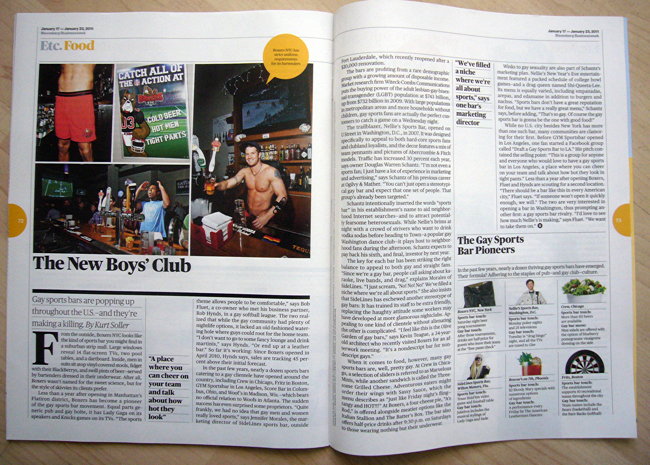
  • Did you know there’s a boom in gay sports bars and it’s because of our “disposable income” which “fuels profits”? Well, that’s the claim made in Bloomberg BusinessWeek, a magazine with one of those classy Helvetica nameplates that are like catnip to urban intellectuals, so it’s gotta be true!

    The photo used in the print-edition spread isn’t stereotypical at all. Obviously this is a brand-new kind of gay bar, one that isn’t all about cute boys whose roommates borrowed their shirts or they just forgot them at home or something.

    Layout features shot of shirtless bartender, shirtless guy in baggy shorts

    And I guess the hot new thing with gays is wearing shorts so baggy they remind you of the shapeless paranoia/overcompensation shorts preferred by straight guys who never want anybody to notice they have an ass or a basket. (Look at American boys at a beach. Then look at Australian boys.)

    Sports bars are for fags what tiki bars are for straights: Homogenized theme restaurants redolent of a land you’ll never visit, let alone call home.

    When asked about the gays-are-rich angle, hack Kurt Soller replied with a form letter.

Researcher roundup

  • I enjoyed Allison Martell’s presentation at Hacks & Hackers on journos’ mathematical illiteracy. It barely scratched the surface, of course. (I’m not going to write a full review of that event, where I asked all the assholish questions. But good job, Ivor Tossell, for trying to squelch my efforts to help out another member of the audience.) Allison told me she’d written a paper on lesbian incomes back dans la journée, but I’m obviously never going to see it despite asking for it twice.

  • Kathleen Lahey at Queen’s complimented me on my bibliography, adding I’d “missed some Canadian research – all peer-reviewed, some of which was used in the Canadian marriage cases.” I could just search under her name, I was told.

    This is so insipid it reminds me of Jefferson Frank, the British researcher who, when given a list of citations with a request to receive those papers, top-posted a response that repeated the citations. Lahey seems like the kind of academic who answers the question “Do you know what time it is?” with “Yes.” Or she seems like Orly Taitz, who responds to every challenge to back up her statements with a demand that you do your own research.

    Just send me the papers, Kathleen. We’re too old to play “Rumpelstiltskin.”

The foregoing posting appeared on Joe Clark’s personal Weblog on 2011.03.02 16:01. This presentation was designed for printing and omits components that make sense only onscreen. (If you are seeing this on a screen, then the page stylesheet was not loaded or not loaded properly.) The permanent link is:
https://blog.fawny.org/2011/03/02/fagonomics-roundup/

← Later entries ¶ Earlier entries →

(Values you enter are stored and may be published)


Information

None. I quit.

Copyright © 2004–2026