Toronto on Film is a book published by the Toronto International Film Festival, a very world-class institution that just opened its own Modernist film shrine. The book is more or less readable yet has no real reason to be a printed book, except of course for the fact that printed books are classy and intellectual, two perennial pretensions of Toronto cinema.
An appendix offers a claimed “175 Key Toronto Films.” The number is derived from Toronto’s age, not because there really are that many films of interest.
There’s a director and year credit for each title, plus a short graf about each. This, at the very least, should be available in its entirety online – and not as a shitty PDF export, either. So let me make this standing offer to TIFF: Send me a PDF with live text, or the Quark or InDesign file, of this appendix and I’ll convert it into semantically perfect HTML for TIFF’s and everybody’s benefit.
They won’t, of course. They’d prefer this information to be locked up in a monograph available at a single public library in Canada – Toronto’s (five circulating copies).
While we’re waiting, here’s the title list. It’s OK if you’ve never heard of half of them. These are, after all, not just Canadian films but Toronto films, hence why should anyone, least of all anyone actually in Toronto, have actually seen them? [continue with: ‘175 Key Toronto Films’ →]
Select a category to see additional posts. Add feed/ to a category to subscribe via RSS
The foregoing posting appeared on Joe Clark’s personal Weblog on 2010.10.22 12:30. This presentation was designed for printing and omits components that make sense only onscreen. (If you are seeing this on a screen, then the page stylesheet was not loaded or not loaded properly.) The permanent link is: https://blog.fawny.org/2010/10/22/175torontofilms/
Craig Morgan Teicher is the latest to complain that poetry has lousy “formatting” in E-books.
E-books do not contain “formatting.” As they are miniature Web sites, what they contain are structured markup and presentational instructions, i.e., HTML and CSS. One cannot “format” an E-book; this isn’t MS Word, and we are not dragging a cursor through a line of text and hitting a little box with a B in it.
Josh Tallent’s code sample is, predictably, invalid (you can’t run STYLE on top of elements in BODY), though that is merely an error of excerpting; the ePub file is valid. Now, this also isn’t the way I’d do it, but I can’t say it’s actually wrong. Nonetheless, Teicher recapitulates the tendency of delicate artistique types to freak out at the sight of any form of markup: He dismisses Tallent’s tiny sample as being “swamped in code.” (It uses P and some classnames. Clearly this guy has never seen real tag soup.)
Even somebody who wears a beret to the indie coffeeshop to scratch despondent musings in his Moleskine can be taught structural markup. Teicher’s attitude of “It’s Greek to me!” isn’t helping, is it?
Select a category to see additional posts. Add feed/ to a category to subscribe via RSS
The foregoing posting appeared on Joe Clark’s personal Weblog on 2010.10.18 15:33. This presentation was designed for printing and omits components that make sense only onscreen. (If you are seeing this on a screen, then the page stylesheet was not loaded or not loaded properly.) The permanent link is: https://blog.fawny.org/2010/10/18/teicher-formatting/
Erin Cech and Tom J. Waidzunas’s paper “Navigating the Heteronormativity of Engineering: The Experiences of Lesbian, Gay, and Bisexual Students” (PDF) summarizes the results of surveys and interviews in 2008 with 17 queer engineering students (11 gay, four lesbian, two bi) at “a major US college we call ‘Gold University.’ ” In short: [continue with: Gay engineers →]
Select a category to see additional posts. Add feed/ to a category to subscribe via RSS
The foregoing posting appeared on Joe Clark’s personal Weblog on 2010.10.18 15:03. This presentation was designed for printing and omits components that make sense only onscreen. (If you are seeing this on a screen, then the page stylesheet was not loaded or not loaded properly.) The permanent link is: https://blog.fawny.org/2010/10/18/gay-engineers/
Christopher Hines’s documentary The Butch Factor – as writer, director, producer, coeditor, DP, and narrator, it really is his – finally showed up from the library. Good concept (gay males and masculinity), perfectly reasonable execution, no goddamn captioning, even passable typography when you get right down to it.
Select a category to see additional posts. Add feed/ to a category to subscribe via RSS
The foregoing posting appeared on Joe Clark’s personal Weblog on 2010.10.13 14:29. This presentation was designed for printing and omits components that make sense only onscreen. (If you are seeing this on a screen, then the page stylesheet was not loaded or not loaded properly.) The permanent link is: https://blog.fawny.org/2010/10/13/dramatis-butchfactorae/
I would sit in the Porsche I’d leased for the summer in a Bridgehampton parking lot waiting for the liquor store to open, usually sharing a cigarette with Peter Maas, who was awaiting there too. I had just broken up with a model over a bizarre argument while we were barbecuing mackerel – she complained about the drinking, the spacing out, the exhibitionism, the gay thing, my weight gain, the paranoia. But it was the summer of Jeffrey Dahmer, the infamous homosexual/cannibal/serial killer from Wisconsin, and I became positive that he had been under the influence of American Psycho, since his crimes were just as gruesome and horrific as Patrick Bateman’s. And since there had been a serial killer in of all fucking places Toronto, for Christ’s sake, who had read the book and based to of his murders on scenes from it, I made a number of frantic, drunken phone calls to my agent at ICM as well as to my publicists at Knopf to make sure this wasn’t the case (it wasn’t).
And yes, it was true, I had gained 40 pounds – I was so sunburned and fat that if you had drawn a face on a giant pink marshmallow and plopped it in front of a laptop, you could not have told the difference between the two of us. And of course, being this out of shape, I was prone to skinny-dipping in the Atlantic just 50 yards from my $20,000-a-month cottage, and yeah, I had also developed a minor crush on a teenage guy who worked at Loaves and Fishes. So Trisha’s leaving me was semiunderstandable. Calling me a “fucking lunatic” and speeding away in that leased Porsche was not.
Select a category to see additional posts. Add feed/ to a category to subscribe via RSS
The foregoing posting appeared on Joe Clark’s personal Weblog on 2010.10.10 13:33. This presentation was designed for printing and omits components that make sense only onscreen. (If you are seeing this on a screen, then the page stylesheet was not loaded or not loaded properly.) The permanent link is: https://blog.fawny.org/2010/10/10/lunarpark/
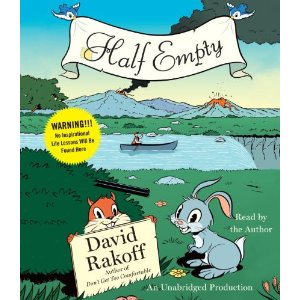
Half Empty is the hot new book by hot Hebraic homosexualist writer David Rakoff (no relation). The title, which arguably needs a hyphen, refers, he told us in radio interviews, to the book’s exegesis of the power of defensive pessimism, a concept introduced to him by Julie Norem in The Positive Power of Negative Thinking.
A sparkling, immediately useful concept, brought to us by just the right neurotic source. Spoiler alert, though: It makes for a better radio segment than it does a book in part because it’s barely in the book. It’s discussed over a few pages and that’s about it.
I complain endlessly about the apparently completely absent editing of modern books. Not just typography and copy-editing, marginally less bad here than usually found in U.S. publishing. (It’s set in Adobe Garamond, a typeface that book designer Michael Collica probably got for free with Photoshop. Some typos, e.g., errant space. Use of only two f-ligatures suggests this is yet another book typeset on Windows, a self-defeating exercise, or Quark, a masochistic one.) (Collica: “Abode Garamond is from the Adobe Font Folio and the book was set on a Mac with InDesign.”)
Here I am talking about an editor, or more likely editrix, who cracks the whip and demands Rakoff stop being so parenthetical, discursive, tangential, self-indulgent.
Select a category to see additional posts. Add feed/ to a category to subscribe via RSS
The foregoing posting appeared on Joe Clark’s personal Weblog on 2010.10.08 14:33. This presentation was designed for printing and omits components that make sense only onscreen. (If you are seeing this on a screen, then the page stylesheet was not loaded or not loaded properly.) The permanent link is: https://blog.fawny.org/2010/10/08/half-empty/
Esteemed television commentator Bill Brioux calls the only interesting Canadian series, Being Erica, a muddled ratings failure.
Yes, it’s a tough timeslot. Dancing with the Stars is huge Tuesday nights on CTV — over 2.1 million viewers tuned in last night according to overnight estimates. Over at Global, NCIS: Los Angeles arrested 1,867,000 viewers.
Is Being Erica exceptional in having been pitted against popular American shows, or is that merely the inevitable consequence of a TV system built on simultaneous substitution?
Over 60% of Erica’s modest audience is 50+. Young women – the audience the show should be connecting with – are just not into her.
Except the “young women” who watch it via TiVo, iTunes, Bittorrent, or later DVD. I know we have the new, improved people meters now, but they still don’t count the way this group watches television. Brioux is making the same argument CBC made when shitcanning jPod: Not enough of the right people are watching it. Except they are – where nobody’s counting them. Besides, all CBC shows skew old.
(And don’t be handing Corpse mandarins specious reasons to shitcan TV shows. They came up with enough of those all by themselves to shoot down everything Chris Haddock made.)
Each week is like watching another pilot. Characters come and go, families, boyfriends and workplaces keep changing. It can’t decide if its a comedy or drama. The character is supposed to jump back and forth in time, not the people making this show.
Clever! And of course wrong.
Nothing like Being Erica has ever been attempted: A show with a science-fiction premise that isn’t science fiction. It was written by, stars, and revolves around women. The last time we tried this, what we got was Quantum Leap – agreeable enough, but guyish and now passé.
I’m as tired of the CBC’s all-girl lineup as the next fellow, but even I had to be honest about my reactions and admit, with no embarrassment, that I love the show. It’s still very strong, not to mention novel. It even dares to be set in Toronto.
If ratings were really a determinant, every Strombo show and the one about that fanciful Muslim enclave on a snowless prairie would have been shitcanned years ago. It isn’t about ratings. It’s about taste, and there Brioux has shown a lapse: He suggests CBC should throw its weight behind has-beens and retreads, namely Ron James and Rick Mercer. Both are aging and gumless, and one owns a manse in Playter Estates. (He and his husband are set for life.)
Advocating Rick Mercer over Being Erica is a display of bad taste that makes me wonder if Brioux also thinks Stargate: Atlantis is better than Caprica and really deserves more of a push.
Shorter Bill Brioux: The national governing broadcaster should cancel its sole dramatic series set in present-day Canada because he doesn’t get it and, infallible statistics prove, the wrong people watch it. But if the Privates – as they have done and are doing now – can keep Blue Murder, Murdoch Mysteries, Whistler, and that turkey Flashpoint on the air when “nobody” or “the wrong people” watch them, then Erica deserves a full run.
I do have one question: Why use this as a vehicle to complain about Being Erica when its egregious product placement is right there begging for a hit? An Irishman in a nail-polish-pink Fiesta uttering “Commando, actually” into a handsfree dashboard cellphone is, if nothing else, comedy gold.
Select a category to see additional posts. Add feed/ to a category to subscribe via RSS
The foregoing posting appeared on Joe Clark’s personal Weblog on 2010.10.07 15:52. This presentation was designed for printing and omits components that make sense only onscreen. (If you are seeing this on a screen, then the page stylesheet was not loaded or not loaded properly.) The permanent link is: https://blog.fawny.org/2010/10/07/brioux-erica/
Why, that adorable Michael Alig is almost out of the clink! It seems like only yesterday he was convicted of the manslaughter of Angel Melendez, whose dismembered body washed up on the shores of the Hudson River in 1996.
But I have an even fresher memory. It is of two filmmakers – and full-on Friends of Alig – named Fenton Bailey and Randy Barbato. In this memory, they jovially submitted to Q&A after a screening of their Party Monster documentary at the Inside Out festival years ago. “I’m conflicted!” one or the other of this interchangeable starfucking pair blurted. What Alig did was horrible, he admitted, but he’s my friend, he said. (Strongly implied: And he’s such a little rapscallion!) “I’m not conflicted,” a guy in the audience loudly countered.
I asked why the proceeds from the feature film the duo made of this kooky klub kid eskapade, also entitled Party Monster, couldn’t be directed to Rodriguez’s family. There was a nonanswer in which one or the other of them thought I was talking about the documentary we just saw (I clearly said “feature film”).
In response to recent questions, Barbato refused to comment, but Bailey wrote: “I feel he deserves a second chance…. [T]he cinematic treatment of what he did in both the documentary and the film neither minimized [n]or downplayed his actions. Both focussed on it and tried to paint a fuller/broader picture of his life. I guess I’m not completely understanding your perspective.”
I guess you aren’t, Fenton! Because I don’t excuse, appease, apologize for, and minimize the harm done by killers just ’cause I think they’re adorable! or for any fatuous reason.
And the hits just keep on coming!
A site curiously named the New Gay conducted a breezy interview with Alig. Writer Jeremy Gloff admits “I… found myself enraptured by his story. Murder aside.”
Because why let something as trivial as manslaughter get in the way of a fun night out on the town in the very near future with somebody who really knows how to party? (“Here, Michael! You can use my iPhone to Google Gaga!”)
When right-wing assholes lambaste us for hedonism and amorality, sometimes they’ve got a point. They’re just looking in all the wrong places. Public Enemy Nº 1 is clearly Michael Alig, who will soon have done his time. Occupying the next slots on that list are his many supporters. Just as rich men thought Conrad Black had contributed too much to society to actually go to jail (one rich man told me that to my face), klub-kid manqués think Alig was just too fabulous to hit the slammer. (What are you waiting for? Like him on Facebook!)
What about Angel Melendez? How fabulous is he right now?
It’s trendy for gays to think gays who are menace to society should get away with it.
Select a category to see additional posts. Add feed/ to a category to subscribe via RSS
The foregoing posting appeared on Joe Clark’s personal Weblog on 2010.10.07 13:45. This presentation was designed for printing and omits components that make sense only onscreen. (If you are seeing this on a screen, then the page stylesheet was not loaded or not loaded properly.) The permanent link is: https://blog.fawny.org/2010/10/07/alig/
Structured documents for managers and editors: How to commission and evaluate E-books
You’re a manager or editor who commissions work for E-books, for the Web, or for (iOS) applications
You haven’t had to deal with developers (i.e., programmers), but you’re doing that now or are about to start
You are having trouble getting your head around the technical aspects of E-books, or your imprint has E-books that don’t work
This session will equip you with basic concepts and vocabulary to commission and evaluate the structured documents required by E-books.
What you’ll learn
You can’t just ask for a “manuscript” delivered as an “MS Word file”; there are specific requirements nobody has told you about – until now. We’ll teach you about structure.
This isn’t about dramatic or three-act structure. It’s about how writers mark up and annotate their text so that machines can do things with it.
We’re going to teach you document structure or structured markup. We’re keeping things at a managerial level. We’ll teach you the basic concepts and the vocabulary to go with them. We’re also teaching ways to specify deliverables and evaluate whether those deliverables have been met.
You need basic knowledge of document structure if you hope to credibly manage E-book development. Nobody’s bothered to give you this training before. We will.
What are structured documents?
You’re swimming in them. Every Web page you browse (Flash excluded), every Web app you use, every E-book you read, and every app with a lot of text you tap through all use structured documents.
The easiest example is the Web, which cannot even function without structured documents. HTML, the language of the Web, is a form of document structure. Every E-book is a structured document. We’ll teach you enough to manage the writers and developers who supply content to you.
Why this is something you’ll want to learn
Few managers, and no editors, in Canadian publishing understand document structure. Walk into a meeting with this kind of knowledge and you’re already one step ahead.
You can bypass the funding agencies. Got an idea for a Web site, a Web app, an iPad app? Is there a lot of writing in it? Well, you don’t need to apply for grants from conventional funding agencies. You can just go out there and join forces with computer programmers and other developers. It will suddenly be possible to talk to those developers; you’ll speak enough of their language to do business.
One skill, many venues. Once you learn the basics of managing structured documents, you can use those skills everywhere – often the very same skill with no modification.
What this isn’t about
We aren’t going to teach you how to write anything, let alone how to write structured documents. We’re giving you basic understanding, a vocabulary, and a set of tools.
Skills you’ll learn
A new sense of the word “semantics”
Separating content from presentation
Recognizing structural elements in existing documents
Standards you can require vendors to meet
Verifying that vendors really have met those standards
The standard we’ll teach you is HTML – real, valid, correct HTML you can use anywhere, including in electronic books.
Select a category to see additional posts. Add feed/ to a category to subscribe via RSS
The foregoing posting appeared on Joe Clark’s personal Weblog on 2010.10.07 13:25. This presentation was designed for printing and omits components that make sense only onscreen. (If you are seeing this on a screen, then the page stylesheet was not loaded or not loaded properly.) The permanent link is: https://blog.fawny.org/2010/10/07/booknetpitch/
 I complain endlessly about the apparently completely absent editing of modern books. Not just typography and copy-editing, marginally less bad here than usually found in U.S. publishing. (It’s set in Adobe Garamond, a typeface that book designer Michael Collica