
Orange crush
The foregoing posting appeared on Joe Clark’s personal Weblog on 2010.08.29 13:35. This presentation was designed for printing and omits components that make sense only onscreen. The permanent link is: https://blog.fawny.org/2010/08/29/coketruck/
Worst line-editing of the year
It’s in the most overrated book of the year, The Imperfectionists by Tom Rachman, a man with no sense of flow or dialogue. The cause is concisely revealed in Rachman’s condensed bio – “born in London and raised in Vancouver.” Nobody’s more dogmatic about proper British English, but less able to produce it, than a Canadian Brit from B.C. (Pop quiz: Pronounce “water.”)
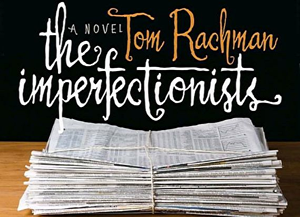 Our young anglophile even weaves in a zinger in the form of a character named Menzies. So very few people know how that’s pronounced. (Kind of like “zinger.”) Mostly people who wouldn’t pronounce a postvocalic R if a gun were pressed against their temple.
If this thing is a bastardization of British English written by a Canadian who in turn is a traitor to his dialect, why is the whole book rendered in American spelling? The type, more or less competently handled for a change (designer: Barbara M. Bachman), uses a face that works only in a printing technology from two centuries back. (That era is about right for the book’s subject, newspapers.) But the typesetting interferes all by itself from time to time, as in the book’s opening words: LLOYD SHOVES. Is that like orange groves?
Isn’t it the role of editors to compensate for authorial failings? Sure, if we still had editors, or if anyone at all knew what line-editing was and why it’s important, or, at the very least, if we had editors with a legitimate ear for dialogue and an eye for repetition. (Another pop quiz: What are Kathleen and Dario busy eating? Could it be olives? Is it possible what they’re doing is eating olives?)
Who, then, was the editor or editrix? Rachman credits Susan Kamil, clearly old enough to know better, for a “wisdom and deft touch” – complete hands-off approach? hitting Print on the delivered manuscript? – that “helped make The Imperfectionists that much less imperfect.” Not much less enough.
The foregoing posting appeared on Joe Clark’s personal Weblog on 2010.08.25 13:58. This presentation was designed for printing and omits components that make sense only onscreen. The permanent link is: https://blog.fawny.org/2010/08/25/imperfectionists/
‘Super Sad True Love’ coinage
Neologisms in Super Sad True Love Story, whose äpp sücks.
- äppärät (pl. äppäräti)
- alkalinized water
- AlliedWaste, AlliedWasteCVSCitigroup; ColgatePalmoliveYum!BrandsViacomCredit; LandO’LakesGMFordCredit; UnitedContinentalDeltamerican
- American Medicle Response
- AmericanMorning portfolio
- ARA (American Restoration Authority)
- armo[u]red Fung Wah bus
- ass hookah
- ass-plug (v.)
- AssLuxury
- Bipartisan Party
- Boston-Nanjing Metallurgy College
- bound, printed, nonstreaming Media artifact
- BRIC [Brazil, Russian, India, China]-A-BRAC High-Performing Nations Fund
- Brownstone Brooklyn
- Cervix (“the newly hip bar in newly hip Staten Island”)
- Cetaphil Gentle Skin Cleanser
- Child Abuse Multimedia
- China South Airlines
- China-Worldwide
- Community Parameters
- Credit; Media; Retail
- Credit Pole
- CrisisNet
- Debt Bombing (v.)
- dechronification
- Desking Ceremony
- durability (health)
- EmotePad
- extro (adj.)
- FAC (Form a Community)
- five-jiao men
- fuckability index
- FoxLiberty-Prime; FoxLiberty-Ultra
- GlobalTeens; teen (v.)
- GlobalTrace
- H-Mart (or H-mart)
- Harm Reduction (displacing the poor)
- HNWI; LNWI
- HolyPetroRussia
- Hyundai Town Car; Hyundai Persimmon
- Infinite Sadness Endurance Test
- ITP (impossible to preserve); Fallacy of Merely Existing
- JuicyPussy summer dress; JuicyPussy4Men
- Lacy Twaät, starlet
- Lao Wai foreigner passport
- LIBOR rate
- Life Lovers
- Mediastud; MediaWhore
- NORC (Naturally Occurring Retirement Community)
- New York Lifestyle Times
- Onionskin jeans
- Oslo Delight sandwiches
- Parakkeet blazer
- Patterson-Clay-Schwartz Language Cognition Test
- Pine-Sol Wild Flower Blast
- RAG (rapidly-aging geezer)
- RateMe, RateMePlus
- the Rupture
- Saaami nippleless bras
- Saudi Arabian Monetary Agency
- Secure Screening Facilities
- “security shed”
- SecurityState Israel
- SmartBlood
- Soft Policy
- Staatling-Wapachung; Wapachung Contingency; Wapachung Intelligence; Staatling Property Relocation Services
- Stability(-Canada)
- StatoilHydro (Norwegian state oil company)
- SUSTAINABILIT¥ score
- whorefuckrevu (magazine)
- TeenyBopper
- ThaiSnak franchises
- TotalSurrender (or Total Surrender)
- UGuangdong-Riverside
- UNRC (United Nations Retail Corridor)
- verbal (v.)
- yuan-pegged dollar
- Zoo York Basic Cracker hoodies
The foregoing posting appeared on Joe Clark’s personal Weblog on 2010.08.22 16:58. This presentation was designed for printing and omits components that make sense only onscreen. The permanent link is: https://blog.fawny.org/2010/08/22/supersadneologisms/
Those who fail to learn the lessons of Natalia Ilyin are doomed to repeat them
Design Is History is the new site that perpetuates the misapprehension, convincingly diagnosed as harmful by Natalia Ilyin in Chasing the Perfect, that “design history” is a sequence of discrete jumps from A to Z with stops at every letter in between.
The foregoing posting appeared on Joe Clark’s personal Weblog on 2010.08.22 16:55. This presentation was designed for printing and omits components that make sense only onscreen. The permanent link is: https://blog.fawny.org/2010/08/22/designishistory/
Why does ‘Cognitive Surplus’ exist?
I have received, obviously from the library, Cognitive Surplus from the much-loved Mr. CLAY SHIRKY. Why does this book exist? The system demanded it.
The book qua book makes Clay Shirky more entrenched, also richer. It makes the publisher seem like a purveyor of brave new ideas that had actually been worked out long before in a medium it is loath to acknowledge. This case, like others before, reveals structural deficiencies on the nonfiction-book industry.
-
Shirky’s cognitive-surplus concept has been more than adequately explained online. You knew all about it even before he explained it in the intelligentsia-ratified environment of the TED conference. The concept isn’t so intricate it requires 213 pages of explication (with, as expected, poor copy quality and half-assed typography). The concept does not comprise that much content. But there is a fallacy at work that good ideas need to be expanded.
-
A resemblance to the Peter Principle is surely coincidental, but the Commentariat Publishing Lifecycle follows this path:
- A semifamous commentator issues an interesting idea, usually via blog post. (Publisher: Self.)
- It spreads to the point that one of a vanishing few magazines, like the Atlantic Monthly, commissions a thinkpiece that “expands on” the idea. (Publisher: Struggling mid-sized house; foundation.)
- The idea has thus been ratified to the midlevel of the intellectual discourse.
- The article does not acknowledge that the idea originated on the Web.
- The commentator, now more than semifamous, may then be invited to further “expand on” his idea in a printed book, for which he will be paid an advance and possibly royalties. (Publisher: Multinational conglomerate.)
- The idea has thus becomes ratified to the permanent canon.
- The book passingly acknowledges the article as the genesis of the book.
-
This process pretends to be evolutionary or benignly incremental but smacks more of the purgatory of greatest hits, in which semipopular bands are doomed to play hour-long sets in one-horse towns to dwindling crowds who showed up to hear the hit single and have no patience for anything else.
-
The progression from blog post to magazine article to printed book becomes a form of velvet handcuffs for the freelance intellectual, who is forced to nursemaid the same idea, now well beyond its training-wheels stage, just when he should be coming up with new ideas. (Or already has – and, if he’s published them, those new ideas are eclipsed by the old idea or are taken as proof that the intellectual has only as many really good ideas as he has books.)
A book takes a year or two out of your life and generally costs you. Why would a public intellectual agree to write one?
-
Even for a writer with a good business outside the book trade (like, presumably, Shirky), a single book advance makes for a reasonable down payment on a house or a tidy college fund for a child. Or it just makes you richer.
-
The book stays on shelves – somewhere – for the rest of your life and then some. It becomes a tangible record of your achievement.
-
Last but not least, the whole process is an arms race of flattery, in which people with more and more power and influence make you one offer after another you can’t refuse.
Who gets left behind in this process, which, in true power-law fashion, benefits people who are already famous and well-remunerated, like Clay Shirky, Nick Carr, Andrew Keen, and Jeff Jarvis? I could name a category or two of losers in this game.
Instead, I will mention that Carr long ago recommended I gin up one of my ideas to a form that a magazine like the Atlantic would publish. I’d be doing that just to grease the wheels of the publishing industry, which has proven to me to be inept, ignorant of its own generations-old protocols, brusque, disingenuous, mendacious (in one case to my face), dismissive, riven by fear, and broadly deserving of its own demise.
But should authors who aren’t established names have to go down with the ship?
Should Shirky, Carr, Keen, or Jarvis turn down their next book offer? Should, or why should, their next books exist?
The foregoing posting appeared on Joe Clark’s personal Weblog on 2010.08.21 15:39. This presentation was designed for printing and omits components that make sense only onscreen. The permanent link is: https://blog.fawny.org/2010/08/21/commentariat-publishing/
Richard Florida overgays it
(UPDATED) Richard Florida aggressively posits that neighbourhoods and cities that welcome gay residents are the most creative and flush with cash. (When criticized for such statements, he commissions new research and publishes that. He intensifies his point.) Florida is, of course, the name-brand analyst who believes nail-salon operators and baristas are “creative,” hence part of the “creative economy”. Nonetheless, is it really is in dispute that gay populations and creativity correlate?
But this likable self-promoter and millionaire can and did take things too far, as he did when he claimed the following: “As [Gary] Gates and I have pointed out elsewhere, the presence of [gay] people isn’t a sufficient condition for wealth creation in and of itself; gay men and lesbians are no more… economically productive… than any other group on average.”
Gary Gates knows full well that this statement is false, based on the preponderance of evidence from U.S., Canadian, Swedish, and Dutch data sources, most of which show significant earnings penalties for gay men and even more significant earnings premia for lesbians. To state this another way, gay males earn less money than straight guys and lesbians earn more money than straight girls.
(U.K. data shows no difference for males but shows a premium for lesbians. One U.S. paper [Carpenter 2005] shows no difference for either group. One paper on Australian data [Carpenter 2008] shows an earnings penalty for lesbians. The trend, however, among all research specifically on the U.S. and Canada, conforms to what I have stated above.)
Gary Gates is quite aware of this trend, having written or cowritten at least two papers I know of on the topic of lesbian and gay economics, about which I am writing the sole annotated bibliography.
Florida’s statement reeks of a “Gays are people too!” blandishment and mythmaking; it has no basis in fact. With the armies of research assistants who do the bulk of his work, and with Gates as collaborator, how did Richard Florida manage to make that mistake?
I posed that question to him via electronic mail last month. Kimberly Silk, who I presume is some kind of assistant, read or opened the message, according to the read receipt, but there was no comment since then. (I didn’t ask Gates because he wasn’t the one who made the statement.)
Update
(2010.08.24) Gary Gates wrote in to state his belief that, when all economic factors are taken into account, Florida’s statement is accurate. I wrote back stating that I disagree for the simple reason that the mainstream reader of the Daily Beast will invariably interpret “economic productivity” as wages or earnings, which are lower for gay males and usually higher for lesbians. Neither of those reported effects is reconcilable with the statement “gay men and lesbians are no more… economically productive… than any other group on average.” Civilian readers of a general-interest news blog will not be Ph.D.s in economics who understand that economics encompasses more than money.
The foregoing posting appeared on Joe Clark’s personal Weblog on 2010.08.12 16:05. This presentation was designed for printing and omits components that make sense only onscreen. The permanent link is: https://blog.fawny.org/2010/08/12/overgayed/
5

(Cf.)
The foregoing posting appeared on Joe Clark’s personal Weblog on 2010.08.05 16:04. This presentation was designed for printing and omits components that make sense only onscreen. The permanent link is: https://blog.fawny.org/2010/08/05/5ingold/
Print-hostile pages
What New York, which already can’t get a handle on the concept of print-friendly pages, now thinks a print-friendly page is (“The James Franco Project” [“printable”], linewrapped):
Print Page
<
http://nymag.com>Building Printer-Friendly Page…
/,"");

$("#text").append(' '+headerText+'

');
					$("#narrow-bubble").remove();

}
		 				var pageText

= d.substring(d.search
("")+16,
d.search('\<\/div\>\
<\!-- \/end \#story--\>'))
.replace(/\n/g,"");

$("#text").append(' '+pageText+' ');

getPage(pgNum+1); 			})

}
 		$(function(){ 			getPage(0);});
<http://www.omniture.com>
<http://www.quantcast.com/p-52tlJ-QdbVwC->
At one time, New York had an excellent site hacked into fruition by Mr. MARCOTTE. Now it has been well and truly fucked, all for the want of print CSS.
I thought all the incompetent Web developers lived here.
The foregoing posting appeared on Joe Clark’s personal Weblog on 2010.08.05 13:27. This presentation was designed for printing and omits components that make sense only onscreen. The permanent link is: https://blog.fawny.org/2010/08/05/www-printthis-clickability-com/
Riding the TTC by farecard
We will eventually enter the late 20th century and begin using electronic farecards to ride the TTC. Exactly what those fares should be really isn’t up for discussion, as Steve Munro insists it should be. He’s right, of course, but as a thought experiment, how could we implement electronic farecards tomorrow with the fewest changes to today’s TTC fares?
Student and senior fares
They could still exist, but a card for such fares could not be issued by a machine or over the Web because a human being has to verify that you really are a student or senior. This in itself is an argument against completely automated stations.
Since only students or seniors can use these cards, they need to be visually and tactually distinguishable from regular farecards – changing the colour, imprinting STUDENT or SENIOR in raised type, and printing those words on the front would suffice. You have to make it unlikely to accidentally use the wrong card if you live in a household to which more than one fare type applies. If everybody in the house piles their farecards on the table in the front hall, granny’s card and junior’s card have to be difficult to grab by accident.
Single fare ($3/$2/75¢)
A single $3 fare essentially disappears under this system. You should be able to intentionally buy a single-use $3 farecard, as in the New York Metrocard system, but it should be discouraged. Single fares become an edge case for day and weekly passes.
If you have a farecard with a balance of $3 or above and make exactly one trip in a seven-day period after seven days of no trips, we would ding you the full $3.
Day pass ($10)
All travel within 24 hours caps at $10 if and only if no other travel takes place in the six following days. If it does, what you then have is a weekly pass.
Weekly pass ($36/$28/NA)
A weekly pass disappears in this system. Instead, if your number of trips over seven days is 12 or fewer, each of them costs $3. All further trips that same week, without limitation, are free.
Weekly fares begin whatever day you buy your pass (even if you buy it at 23:59 hours) and last six more days. (There are a couple of ways to define “six more days,” none of which affect our fare experiment here.)
What happens the next week? If you keep using it, your farecard by default becomes a Metropass.
Metropass ($121/$99/NA)
If a weekly pass is really just a cap on single fares, then a monthly pass becomes a cap on weekly passes. In effect, if you use the system every day or most days for a full month, instead of dinging you for four (or, uncommonly, five) weekly passes, we give you a discount on multiple weekly passes. The unit of currency here becomes weeks of travel, not individual trips.
The equivalent of a Metropass comes into existence on your 41st trip of the month if your usage takes place over eight or more days. (41 or more trips in seven days fall under a weekly pass.) This means you can take, say, 42 trips in eight days and none for the remaining 20, 21, 22, or 23 days and still pay only for a monthly pass.
My assumption here is that monthly passes no longer peg themselves to calendar months and always run a fixed number of days, which rationally should be 31, the maximum possible. We stop counting your trips for that month on the 32nd day; no matter what happens, your fare counters reset to zero.
Now, I said before a weekly pass becomes a de facto Metropass if you use it a second week. There is an edge case where that isn’t true. If you use the system for a full week then only once on the eighth day and never again for the next 23 days, we ding you a weekly pass plus one full fare, because that conforms to your actual behaviour.
Express fares (+$2.50/+1.65/+55¢)
They could still exist and would immediately ding you that fixed amount the moment you touched in. This would seem to be one of the several cases where the system needs to allow you to run a deficit until the next increment of payment; farecards are supposed to reduce or eliminate passengers hassling drivers over fares and vice-versa, so if you’re short by any amount the system should just let you on without any other indication and force you to pay up later.
The mysterious express sticker for one’s Metropass, which I’ve seen exactly once and which can be bought at an exorbitant $35 at exactly two stations for no more than about 120 days a year, could be modelled as a cap on express fares.
Timed fares
We have these already on St. Clair (go anywhere you want for two hours, though the exact boundaries have never been stated). The system could easily be programmed to provide zero-cost additional fares for 120 minutes when you touch in on any vehicle serving St. Clair (currently 126, 312, 512, 71, and 90[A]). Unless we develop an ironclad algorithm to determine when one trip begins and ends, it’s computationally simplest, and least niggardly, to simply tack on two free hours of travel no matter what.
There. What could be simpler?
I see now it borders on a waste of time to adapt a fare system that relies on single-use tokens and limited-time passes for which you pay up front. It may be simplest to configure the system for 24-hour, seven-day, and 31-day caps without calling them passes. Each increment rolls over to the next. Edge cases would still exist, like a full week’s travel followed by a single day’s then nothing for the rest of the month, as mentioned, but that edge case is nonetheless handled by the three-cap system.
The existing GTA Pass ($52, another mysterious creature) becomes conceptually difficult under a new fare system because we would have to synchronize fares across the TTC and neighbouring agencies, a topic this posting does not address. (The GTA Pass could be like a single-fare pass – something you buy deliberately up front. Farecards are supposed to reduce or eliminate upfront purchases.)
The foregoing posting appeared on Joe Clark’s personal Weblog on 2010.08.01 12:40. This presentation was designed for printing and omits components that make sense only onscreen. The permanent link is: https://blog.fawny.org/2010/08/01/farecard-experiment/