Scott Schuman writes the Sartorialist. He had previously bragged to the Globe, perhaps while drunk, that he’s good in bed with the ladies.
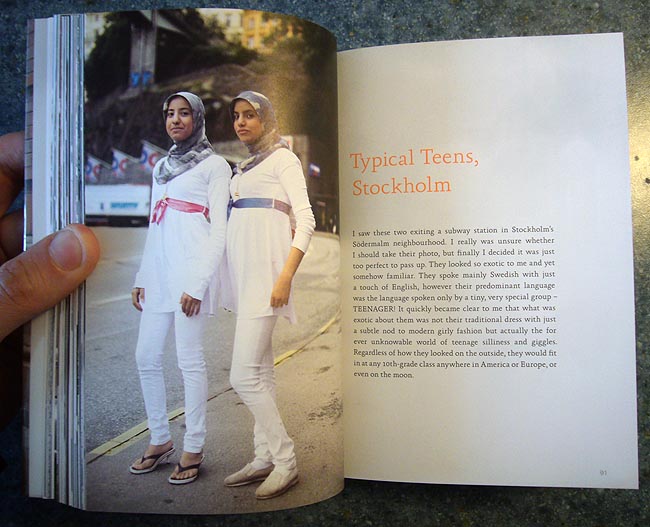
For some unaccountable reason, a blog consisting of pictures with a few snippets of text has been turned into an overly thick book full of pictures with a few snippets of (ill-proofed) text. For example:
Typical teens, Stockholm
I saw these two exiting a subway station in Stockholm’s Södermalm neighbourhood…. They looked so exotic to me and yet somehow familiar. They spoke mainly Swedish with just a touch of English[;] however[,] their predominant language was the language spoken only by a tiny, very special group – TEENAGER! It quickly became clear to me that what was exotic about them was not their traditional dress [continues for some time – Ed.]
Sure, they’re “typical teens” for the Sweden of 2030, when, as the T-shirt says, they take over. At that point Schuman might want to stay out of the country lest he be beheaded in the public square as a louche idolator, pornographer, and apostate. That would surely set Schuman’s sex life back to about the year 630.
Select a category to see additional posts. Add feed/ to a category to subscribe via RSS
The foregoing posting appeared on Joe Clark’s personal Weblog on 2010.03.14 13:21. This presentation was designed for printing and omits components that make sense only onscreen. (If you are seeing this on a screen, then the page stylesheet was not loaded or not loaded properly.) The permanent link is: https://blog.fawny.org/2010/03/14/schumanism/
The Galleycat column reported the exact way “Forbes reporter David K. Randall scored a book deal”: By querying an agent.
For authors who don’t already have agents and connections, this is how it’s usually done. It is a symbol of the ongoing dysfunction of the publishing business that business as usual is considered news.
I asked Randall for comment on that topic, but heard nothing back. Interestingly, the writer of the piece, Jason Boog, is listed as an instructor at NYU Journalism. And so is Randall. It looks like one academic told another academic he’d sold a book the standard way books are sold, and the latter academic wrote a news article about it. But Boog tells me he quit NYU after he got hired on at Mediabistro and merely consideres Randall “a professional contact.” Still, the whole thing is a bit insider, and the news value is precisely nil – unless, like the writer, you’re a friend of the subject.
The shocking thing is that somebody this well connected had to resort to a cold call. I’m one of those people who would like publishing to have a future. I want to meet somebody within that industry who might actually make it happen.
Select a category to see additional posts. Add feed/ to a category to subscribe via RSS
The foregoing posting appeared on Joe Clark’s personal Weblog on 2010.03.12 15:45. This presentation was designed for printing and omits components that make sense only onscreen. (If you are seeing this on a screen, then the page stylesheet was not loaded or not loaded properly.) The permanent link is: https://blog.fawny.org/2010/03/12/boog-randall/
Select a category to see additional posts. Add feed/ to a category to subscribe via RSS
The foregoing posting appeared on Joe Clark’s personal Weblog on 2010.03.11 14:59. This presentation was designed for printing and omits components that make sense only onscreen. (If you are seeing this on a screen, then the page stylesheet was not loaded or not loaded properly.) The permanent link is: https://blog.fawny.org/2010/03/11/thecreature/
John Hilton III has written an article for for First Monday with the deceptive title “From PDF to MP3.” It has nothing to do with PDFs or MP3s. The article attempts to demonstrate the usefulness of Creative Commons licensing in the creation of alternate formats – and fails.
Hilton studied eight printed books by five Internet academics and copyright reformers (which alters the experiment right there) – Benkler, Boyle, Doctorow and Lessig (inevitably), and Zittrain. Hilton tracked down some creators of derivative works made from these books.
“The most common reason for derivatives was to increase the ability for others to access a given work,” he writes. Yet Creative Commons licensing had no bearing on the creation of any of the derivative works. Nothing was specially enabled by Creative Commons. While there were no barriers or illegalities resolved by Creative Commons, such licensing may have put authors in breach of contract.
Hilton mentions how a contributor “converted Boyle’s The Public Domain into a DAISY digital talking book for the blind,” and later mentions a separate Braille conversion. In the U.S. and many other places, alternate formats for print-disabled readers can be converted as of right without asking permission, assuming the copyright holder hasn’t beaten you to it. Alternate formats rely on a specific exemption built into copyright law and are not something special you need a licence for. Alternate formats are already permitted up front.
Hilton discusses foreign-language translations. You always need advance authorization for those (save for sign-language translations as an alternate format in Canada, but this is U.S. law Hilton is addressing). The problem is most authors assign the right to authorize translations to their publishers. There are good reasons for that: Publishers have all the contacts and all the files necessary. (Generally, one publisher license a foreign-language version to another publisher, who hires a translator.) Not atypically, publisher and author split the proceeds, which may not be a lot of money.
Nonetheless, the authors involved may not have had the right to assign translations. That means they could be in breach of contract. Creative Commons licensing does not override the terms of an author’s contract with a publisher. When I twice asked him about this, Hilton refused to even confirm he verified that authors had the rights they assigned. (So much for First Monday’s peer review, one might say.)
Audiobook versions are mentioned, but rights to those may also be assigned to publishers by contract. (That is almost always the case because a different set of rights – confusingly named publishing rights, denoted by ℗ – come into existence with a recording. Plus they are a lot of work to create. It’s a hassle that publishers are better equipped to handle.)
Hilton writes: “A[nother] theme emphasized was the importance of authors giving credit to the individuals creating derivative [works].” No clause in copyright law requires any such acknowledgement, and neither does Creative Commons licensing. It’s extraneous at best and shows how Creative Commons proponents have a hard time staying on topic.
Also extraneous is a discussion of the importance of publishing digital versions rather than paper books only. Copyright law doesn’t force or prevent any such action and neither does Creative Commons licensing.
The real problem with Hilton’s thesis
Hilton misstates copyright “regulations” when he claims they “often prevent derivatives from being created.” Copyright law prevents unauthorized derivatives from being created, and allows certain others as of right. Copyright law does nothing to impede authors from authorizing derivative works. The only thing impeded is illegal creation of derivative works. Copyright law, like surprisingly many laws, makes some things illegal, but there’s an easy escape clause here.
At root, Hilton argues that ante-facto Creative Commons licensing makes more works possible. But authors didn’t even necessarily have the legal right to authorize many of these works under any guise. Others could be made right away. For still others, authors could be easily contacted and asked for permission directly. Had that happened, authors could have checked their contracts and refrained from granting subrights they didn’t have in the first place.
Hilton consistently implies that Creative Commons is the only practicable way for authors to let others create derivative works (“As more authors license their works in such a way as to permit derivatives, and as more individuals learn that they are legally permitted to create derivatives”). If you want to create a derivative work, you can just ask the author for permission. Other times you can forge right ahead.
Hilton discusses the importance of crediting creators of derivative works, but, when I asked, dismissed the practicality of having those creators contact the original authors. This is ridiculous, since all parties are online and that isn’t going to change until they drop dead. Hilton says authors should go out of their way to thank creators of derivative works, but suggests it’s too much trouble for such would-be creators to actually contact the authors.
Hilton contacted 28 creators of derivative works, but didn’t bother telling us how many actual works were created. Even so, five authors could handle 28 requests among them pretty handily. This is not a lot of E-mail to sort through.
The advantage of appealing directly to authors is, first of all, they can actually say yes or no (Creative Commons creates a permanent yes) and they at least know who they’re working with. Knowing exactly what somebody plans to do in advance is perfectly reasonable and causes no harm to anything, let alone the commonweal.
As another Internet academic, Douglas Rushkoff, put it, “Where’s the Creative Commons licence that I could say ‘OK, you can have it for free, but at least you have to ask me for it’? ‘Free if you send me an E-mail’? I just want to give it to you rather than to it.”
The worst copyright paper of the year?
Well, the year is still young, but for now, yes. John Hilton III didn’t prove Creative Commons solves any problem he raised. Everything creators of derivative versions did they could have done without Creative Commons licensing just by asking for permission.
You can’t really be serious if you think asking for permission would have been a barrier in any of the cases Hilton describes.
Additional annoyance
As with apparently all First Monday articles, some twit has gone out of his way to convert every hyphen to an en dash. They’ve known this is a mistake for ten years, because that’s when I first reported it to them.
Select a category to see additional posts. Add feed/ to a category to subscribe via RSS
The foregoing posting appeared on Joe Clark’s personal Weblog on 2010.03.11 14:45. This presentation was designed for printing and omits components that make sense only onscreen. (If you are seeing this on a screen, then the page stylesheet was not loaded or not loaded properly.) The permanent link is: https://blog.fawny.org/2010/03/11/hiltoniii/
2007 January 9: CBC débuts Little Mosque on the Prairie, a situation comedy in which multiracial Muslims populate a small Prairie town, living with fellow Canadians in wacky peace and harmony
2010 January 16: Two members of Toronto 18 sentenced to 12 years and life imprisonment, respectively
2010 March 9: CBC Toronto runs advertisement in Toronto Star (for upcoming news segment) explaining where “you” can buy halal meat for “your family”
2010 April 15: An accused’s “idea,” court was told, was “ ‘We’re going to attack Parliament [and] take over and use the CBC to broadcast our victory’ ”
Select a category to see additional posts. Add feed/ to a category to subscribe via RSS
The foregoing posting appeared on Joe Clark’s personal Weblog on 2010.03.11 14:01. This presentation was designed for printing and omits components that make sense only onscreen. (If you are seeing this on a screen, then the page stylesheet was not loaded or not loaded properly.) The permanent link is: https://blog.fawny.org/2010/03/11/timeline/
Statistics Canada projects that large Canadian cities’ populations will be mostly “visible minority” by 2036. This immediately prompted the Star to warn that White people would be the visible minority in Toronto by that time.
This would make sense if you thought all White people are the same, a point made by the competing newspaper. (Jeffrey Reitz: “25 years ago they were issuing reports on how cities like Toronto were no longer majority British…. Now the Italians and the Poles are considered part of the dominant population.”) Obviously Italians look just like Serbs.
And the claim makes sense only if you are such a racist you can’t differentiate non-whites. I’m not talking about people who cannot, for the life of them, pick out a Japanese in a crowd of Chinese, let alone a Korean or Vietnamese. I mean people so racially biased that nonwhites are a massive blur. By 2036, these people will believe they are completely outnumbered by a teeming throng that surrounds them on the subway and on downtown streets.
But White people will not per se be a visible minority. Inspecting the actual statistics in Table 7 of the report (PDF), one scenario shows the following percentages for Toronto in 2036:
Not a visible minority (this means White people but not aboriginals): 37.2%
South Asian (this means Indic): 23.8%
Black: 8.0%
Chinese, 12.4%; Filipino, 4.6%; Korean, 1.6%; Japanese, 0.4%; Southeast Asian (this means Oriental but not Chinese, Korean, Filipino, or Japanese): 1.6%
Latin American: 2.6%
Arab, 2.3%; West Asian (this means Middle Eastern but not Arab, e.g., Persian and Pashtoun), 2.9%
Other visible minorities: 2.7%
If you’re good at numbers, which it seems the Toronto Star isn’t, you can see that, like Hawaii, nobody will have a majority. Whites will have a plurality by about 14 percentage points (not “14%”). (Not many people know the word “plurality,” it seems.) Nine different categories, comprising more than nine distinct ethnic groups, would account for less than 10% of the Toronto population each, and their numbers will barely change from now till then. Reading these numbers, the actually interesting fact seems to be the large growth in the South Asian population (more than 10 percentage points).
Of course the Star has to take responsibility for its own coverage, but so does the writer – in this case Noor Javed, who did not respond to a question on the foregoing points.
In one projection given in Table A2, 871,000 more Muslims will live in Toronto (essentially triple the current population). Which do you think will affect daily life more – almost twice as many Indics or three times as many Muslims?
Select a category to see additional posts. Add feed/ to a category to subscribe via RSS
The foregoing posting appeared on Joe Clark’s personal Weblog on 2010.03.11 07:20. This presentation was designed for printing and omits components that make sense only onscreen. (If you are seeing this on a screen, then the page stylesheet was not loaded or not loaded properly.) The permanent link is: https://blog.fawny.org/2010/03/11/vizmin2036/
After trying out, and tiring of, one shitty E-book after another, and in recognition of plain facts and industry trends, I wrote a giant piece for Zeldman: “Web Standards for E-Books.” I hope it will be the definitive article demonstrating that the future of most electronic books is ePub, which in turn is real XHTML. Your Web-standards knowledge can serve you well here, although by advocating this HTML-triumphalist view I am foreclosing future book formats. (Check the sidebar of “typographic tragicomedy” in E-books.)
Errata
The published piece is missing the section on sections:
Sections. HTML’s single biggest deficiency for long documents is its lack of sections. They exist in HTML5, but ePub doesn’t use HTML5. Sections in nonfiction books may sometimes be differentiable through the use of headings, but the classic book-design paradigm of leaving extra space between sections (with different type on initial words of the new section) simply can’t be marked up in HTML. (In uncommon cases, section breaks like these occur right at the bottom of a printed page and have to be inferred.)
There is another tradition in book composition that can be adapted – typesetting a fleuron or dash between sections. It’s functionally equivalent to the use of HR, which can, with difficulty, be styled to be less intrusive. Nonetheless, you are still merely suggesting that sections have changed; what you are not doing is definitively encapsulating sections in their own markup.
Despite delivering it correctly and flagging the error, “I’ve Got Chills. They’re Multiplyin’ ” is mistypeset.
Coming up
One tries to walk the walk, as it were. Organizing Our Marvellous Neighbours: How to Feel Good About Canadian English will be reissued quite soon in actual ePub. You’ll have to buy it all over again, of course.
Select a category to see additional posts. Add feed/ to a category to subscribe via RSS
The foregoing posting appeared on Joe Clark’s personal Weblog on 2010.03.09 16:23. This presentation was designed for printing and omits components that make sense only onscreen. (If you are seeing this on a screen, then the page stylesheet was not loaded or not loaded properly.) The permanent link is: https://blog.fawny.org/2010/03/09/ws4eb/
Another year, another bobsleigh season, where giant strapping specimens of manhood gather, two and four at a time, to run faster than anyone you’ve ever met can run. These specimens gather, in essence, to be the exact opposite of Johnny Weir and of contestants on Project Runway; we’ve been through this before .
You can’t do what they can do and neither can I. It’s a combination that can’t be beat: No other group of guys, not even in pro football, is consistently this tall, this big, this strong, and this fast.
And half of them are “on the Facebook,” and nearly all of them are my “Facebook friends.” This is merely the latest wrinkle in well more than a decade’s interest in an obscure, ruinously expensive, needlessly hazardous sport that muscles out everything but men’s “amateur” hockey for the elite spot at the Winter Olympics. (It’s one of only two sports Monaco has any real presence in; the other is equestrian, and if bobsledders don’t qualify as steeds I don’t know what does.)
I watch all bobsleigh coverage
My esteemed colleague gamely sat through three out of four runs at the Vancouver Olympics with me – 66 runs featuring 254 225-pound bobsledders. I am now at a point where what I blurt out at the television screen contains almost exactly half the content the actual colour commentator comes out with. We agree on quality and speed of starts nine times out of ten. I can peg a brush against the track before our “colour man” can get the words out. I’m not doing badly if I’ve got half as much knowledge as a former bobsledder who’s paid to talk us through a hundred runs every four years. Come for the beef, stay for the action.
I am not the only one who thinks this! 100% of the guys involved in bobsleigh love being around these giant strapping fellas. They never shut up about it and they like to use nonironic terminology – “beef,” “jackhammering quads,” “the big boys.” That endless fountain of quotable quotes, good Christian Lyndon Rush, calls 254-pound Kevin Kuske “the perfect specimen,” which he pretty much is.
Unlike why gay guys love amateur wrestling, everything I like about bobsleigh is what everyone who likes bobsleigh likes about bobsleigh. And there you were thinking there was something else going on I wasn’t telling you about. I am as upfront about what’s going on as the God-fearing Mormons and Republicans and Christians in the sport, and the Eurotrash. [continue with: Steve Holcomb’s thousand gay boyfriends →]
Select a category to see additional posts. Add feed/ to a category to subscribe via RSS
The foregoing posting appeared on Joe Clark’s personal Weblog on 2010.03.08 13:03. This presentation was designed for printing and omits components that make sense only onscreen. (If you are seeing this on a screen, then the page stylesheet was not loaded or not loaded properly.) The permanent link is: https://blog.fawny.org/2010/03/08/bob2010/
Select a category to see additional posts. Add feed/ to a category to subscribe via RSS
The foregoing posting appeared on Joe Clark’s personal Weblog on 2010.03.06 14:55. This presentation was designed for printing and omits components that make sense only onscreen. (If you are seeing this on a screen, then the page stylesheet was not loaded or not loaded properly.) The permanent link is: https://blog.fawny.org/2010/03/06/wychwood5/

![Headline: Buying Halal Food: Now you have more choices for your family. More and more restaurants and grocery stores are selling Halal meat and poltry in the GTA. Tonight, we show you how to find them. [photo of rare beef on plate]](https://fawny.org/blogimages/CBC-Halal-500.jpg)