Jervis is still using his “original template… five years later because I know very little about HTML.” So now we can peg exactly how long Joe·My·God has been crashing your browser: Longer than most of its readers have known what an “Internet” is. (Isn’t it that blue e?)
Meanwhile, Wockner was unaware one may future-post in leading Weblog platforms:
— I will write about eight or ten blog posts for the next day and put them on a timer to go up on the half-hour.
— I was just going to ask you about that because I know that you’re posting in your sleep…. Is that built into the Blogger software?
— It’s in the software. You just set the time you want the blog post to go up.
— Under “post options”?
— Yes.
— Who knew?
When Joe Jervis knows even one iota more about computers than you do, it’s time to go back to a typewriter.
Select a category to see additional posts. Add feed/ to a category to subscribe via RSS
The foregoing posting appeared on Joe Clark’s personal Weblog on 2009.12.03 14:31. This presentation was designed for printing and omits components that make sense only onscreen. (If you are seeing this on a screen, then the page stylesheet was not loaded or not loaded properly.) The permanent link is: https://blog.fawny.org/2009/12/03/jervis-wockner/
Pierluigi overheard some people speaking American. He approached them. “He is from America too,” he said, pointing to me. There were two guys sitting and talking loudly, with pronounced sarcastic hipster accents. They were dressed in traditional hipster garb as well. They didn’t look like non-heterosexuals. They had ironic but unflattering facial hair, disfiguring piercings, and loose jackets and pants. I think I saw corduroy.
Select a category to see additional posts. Add feed/ to a category to subscribe via RSS
The foregoing posting appeared on Joe Clark’s personal Weblog on 2009.12.03 14:23. This presentation was designed for printing and omits components that make sense only onscreen. (If you are seeing this on a screen, then the page stylesheet was not loaded or not loaded properly.) The permanent link is: https://blog.fawny.org/2009/12/03/hipster-garb/
Caleb Crain committed the following malapropism to the electronic pages of the Times, which in itself leads people to believe it’s accurate. (Then Gruber linked to it, making matters worse.)
Wordspaces should not be taken for granted. Ancient Greek, the first alphabet to feature vowels, could be deciphered without wordspaces if you sounded it out, and did without them. Spaces or centered points divide words on early Roman monuments, but Latin, too, ceased to separate words by the second century. The loss is puzzling, because the eye has to work much harder to read unseparated text.
Shorter Caleb Crain: If it works for American, it oughta work for everybody. Numerous languages that are hale and hearty in the present day do just fine without wordspaces, though they tend to be extraneous off-brand gobbledygook like Chinese and Japanese. There are trickier examples (Thai, Lao, Khmer, Amharic, Malayalam, classical Mongolian), but the point is unchanged: If wordspaces were really necessary, every writing system would use them. And if anything, lengthier and lengthier URLs have shown that worspaces aren’t always even necessary for us. (IsThisCalebCrainsErroneousArticleInTheTimes.com?)
Select a category to see additional posts. Add feed/ to a category to subscribe via RSS
The foregoing posting appeared on Joe Clark’s personal Weblog on 2009.12.03 14:08. This presentation was designed for printing and omits components that make sense only onscreen. (If you are seeing this on a screen, then the page stylesheet was not loaded or not loaded properly.) The permanent link is: https://blog.fawny.org/2009/12/03/espacement/
Every time I think of Ryerson Journalism, I think of lengthy, knowing looks Gerald Hannon casts my way at public functions. (We’ve never exchanged a word.)
Who’s teaching Ryerson’s next generation of journalists, apart from Ryan Bigge? Who’s teaching them how to manifest the next generation of journalism?
Thus far, not me. I applied last year, which had all the effect, as I like to say, of a neutrino whizzing through the earth. Last year’s course description explicitly stated that code knowledge was irrelevant to an online journalist, a first sign of trouble.
Since then I’ve learned a few things. I reapplied for the job (excerpted):
First of all, is this really an open competition? I don’t think it is.
My mental model of the journalism profession in Toronto is as follows: If you get your byline into Toronto Life, you’re one of us and we’ll hire you. Somewhat unfair? Of course. But not without justification. After all, Ryerson hired Tim Falconer to sub in for another professor after a ten-minute chat. (How do I know? He told me.) Falconer is part of the Family Compact and I’m not. He gets in with a shrug and I don’t even get an acknowledgement.
So: I have reason to believe you aren’t running an open competition. You want to hire somebody you already know, i.e., somebody with the right bylines who goes to the right parties.
I do have countervailing evidence. I know there is a degree of student dissatisfaction with the way the online-journalism course is taught. I know this because I had a student sip tea in my living room and tell me about. I’m not sure that instructor even knows what the Web is, seeing as how she apparently requires MLA-compliant citations for every source instead of just linking to it. I concede this instructor is an exception to the rule. But if you’re going to hire outside the Family Compact, hire somebody who got online the year current Ryerson undergrads were born. […]
Unlike some others, I don’t jump onto bandwagons. When you’ve been online for 19 years, you’ve seen a lot of services come and go. (Where is Friendster now? Should I add you on MySpace?) Hence I am not the kind of person who thinks Twitter will save, will replace, or even has much of a role in journalism. I’m here to teach students how to use the Internet to report, not how to open an account on somebody else’s Web app. […]
I think what you’re actually looking for is a print journo who got stuck with a Web job five years ago and now wants to teach – somebody with experience at the (failed and halfhearted) Web division of a print newspaper. I’d say what you need is somebody with a print background and native Web experience.
Attitude queens: A love story
Don’t like my attitude? Well, who does, and what does it matter? A Canadian with a bad attitude is another way of describing a Canadian who hasn’t quite gotten fed up enough to leave the country yet.
Anyway, are you hiring for attitude? Do you think RyeHigh is? Which of you will be honest enough to admit it?
Let me tell you more about this intel I have on the previous instructor on the course. I had a J-student talk to me on the phone, and come over to my house, to interview me as a source for a story. Not much of a story, I wouldn’t say, but he was stuck with it. Now, this was a very smart cookie. Half my age, but still wants to be a newspaperman, a term uttered unironically. I’d hire him.
But he had a hard time explaining just what was being taught in his course on online journalism. It very much seemed a a reënactment of the proverb about the student becoming the teacher, though I don’t know which exact student should have taken over. This guy would probably have been a good choice. Among other things, he wouldn’t have insisted that every “online journalism” story has to include “text,” audio, video, and still pictures, and that every source must be documented in a bibliography.
With that kind of acumen, this contract J-instructor has a shining future of running her own Toronto Web shop. Her ability to get everything completely wrong in ways nonexperts see right through suits her perfectly for Toronto mediocrity. Imagine what she thinks of the awesome power of the Twitter to commit journalism. (Hashtags all ’round.)
Even if you’ve never seen me in action, you need to believe me when I tell you I’d love nothing more than to teach a roomful of smart kids. And I’d be amazing at it. I already have done it and I already was amazing. Plus they like me and they like my shit.
This isn’t hypothetical. You weren’t there, but I was. I just want to do it again.
Ryerson Journalism is a 20th-century faculty with a single graduate course oriented toward the future. I have evidence, albeit imperfect, that they only hire people they already know and like. Having any kind of audacity is viewed as a character flaw here; I have the audacity to challenge RyeHigh’s institutional biases. I defy Ryerson to ignore an applicant they don’t know but already dislike who can actually do the job better than anybody in town.
Did I mention I have a recommendation from the first person who ever taught this course? That won’t matter either.
Special update for haters: I was right
Mass electronic mail from the department secretary, who had, incidentally, previously apologized for failing to acknowledge last year’s application: “Once again the field was highly competitive and many experienced instructors are returning to teach again.” (Emphasis added.)
So yes, by the department’s own admission, RyeHigh J-school is an exclusive club. “Many” of its instructors previously were instructors. The only question I have is: How many of them have bylines in Toronto Life, how many swan about at the same parties as the department head and tenured faculty, and how many got hired after a ten-minute chat?
Select a category to see additional posts. Add feed/ to a category to subscribe via RSS
The foregoing posting appeared on Joe Clark’s personal Weblog on 2009.11.22 16:49. This presentation was designed for printing and omits components that make sense only onscreen. (If you are seeing this on a screen, then the page stylesheet was not loaded or not loaded properly.) The permanent link is: https://blog.fawny.org/2009/11/22/ryehighjclub/
Douglas Rushkoff, Web 2.0 Expo summit video, “Radical Abundance: How We Get Past ‘Free,’ ” ≈9:38:
And I think we’re mistaking what is free for what costs. Our work, our labour, is not “free.” Open source and crowdsourcing are not the same things, right? Open source is a bunch of people getting together to try to do something; crowdsourcing is a company figuring out how to get a bunch of people to do something for it….
But with this false notion of free in our heads, we end up living in a value system that insists that everything we do must be open-source and comments-on. Right? How dare you – you wrote up a blog post and you put comments off? [Mock gasp] Everything you write, everything you say, everything you think, everything you feel is supposed to be out there, supposed to be free. I mean, you try even putting a link to something with DRM on Boing Boing and you’ll get in trouble – because that goes against the philosophy. You shouldn’t “protect”; everything I do is yours! Not even just “yours,” everything I do is “the hive’s.”
This is what leads ultimately to copying, to a society of copying, to no originality, to this sort of DJing of culture…. And really, in the open-source movement, what did the open-source movement give us so far? Copies of things. Maybe better copies, but copies. We got a copy of Unix, a copy of Encyclopædia Britannica, copy of Netscape. You know, copy protection really means what? Protecting me from all these copies of things.
Where’s the Creative Commons law, where’s the Creative Commons licence that I could say “OK, you can have it for free, but at least you have to ask me for it”? “Free if you send me an E-mail”? I just want to give it to you rather than to it.
As a result of all this freedom, the abundance of creative material, the abundance of genuine creative output is declining. We are actually getting the scarce marketplace demanded by our legacy currency system…. The alternative is… the development of a digital culture that actually respects the labour of individuals. Right? My writing is my writing. It is not a medium for Google ads.
Select a category to see additional posts. Add feed/ to a category to subscribe via RSS
The foregoing posting appeared on Joe Clark’s personal Weblog on 2009.11.22 14:42. This presentation was designed for printing and omits components that make sense only onscreen. (If you are seeing this on a screen, then the page stylesheet was not loaded or not loaded properly.) The permanent link is: https://blog.fawny.org/2009/11/22/rushkoff-abundance1/
I used to chide the lovely Michael for missing a few technical details here and there (foundational ones, but few in number nonetheless). Now I have a strong suspicion he simply doesn’t understand how the Web works. (Yet he’s still employed by Daylife!)
Here is how a Web site works, Michael. You start with content, typically text and images. You mark it up semantically with HTML – not just any HTML you can think of, but the actual elements called for by the content. You associate a stylesheet to suggest how the page should look in browsers and when printed. (That’s where you specify a list of fonts a browser must use if a preceding item on that list isn’t available.) If you want to go crazy, you use JavaScript to add behaviours to the page.
There. Now Michael Surtees knows how the Web works.
In our next lesson, we explain that blogging in public exposes Michael to public response, which he and his apologists mistake for “harassment.”
Select a category to see additional posts. Add feed/ to a category to subscribe via RSS
The foregoing posting appeared on Joe Clark’s personal Weblog on 2009.11.19 09:02. This presentation was designed for printing and omits components that make sense only onscreen. (If you are seeing this on a screen, then the page stylesheet was not loaded or not loaded properly.) The permanent link is: https://blog.fawny.org/2009/11/19/surtees-knowledge/
Michael Surtees’s site has them. The lovely designer who knows so little about code it gets him into trouble has again displayed his misunderstanding of the Web by offshoring his comments to a service that just doesn’t work without JavaScript and Flash. The system either does or does not have a login identity for me, does or does not have my password, will or will not send me a password-reset E-mail, and will or will not permit login via OpenID. No matter what combination of the foregoing I use, I can’t post comments.
Then again, since I’m the only one telling Michael he’s getting by on his looks and can’t code his way out of a paper bag, maybe I’ve been banned.
In any case, Michael’s latest display of technical ignorance comes complete with the ungrammatical hed “Are renting fonts for a Web site a good idea?” (Is our children learning?) Ostensibly it’s all about how if he stops paying his Typekit bill, the Web sites he designed will revert to “default.” This sort of thing never happened with Trajan’s Column!
If one’s Typekit-licensed fonts aren’t available, the design will not revert to a “default” but to the next available specified font. If only Michael understood the CSS font stack. (If only he could write adequate CSS.)
Designers have no control over the type that is displayed on a user’s system, or even the page design. Designers only make suggestions. Neither Michael Surtees nor any other Web designer is engaged in inscribing something permanent when they create a Web site.
Why does he not know that?
Why isn’t Michael Surtees getting any better at what he does?
UPDATE (2009.11.19): What Surtees calls “harass[ment]” I call “accountability.” You’re working in public, Michael, and when your work sucks, the people who know what they’re doing are going to say so.
Select a category to see additional posts. Add feed/ to a category to subscribe via RSS
The foregoing posting appeared on Joe Clark’s personal Weblog on 2009.11.18 13:20. This presentation was designed for printing and omits components that make sense only onscreen. (If you are seeing this on a screen, then the page stylesheet was not loaded or not loaded properly.) The permanent link is: https://blog.fawny.org/2009/11/18/surtees-default/
Why else should your site not have comments? Because Joe·My·God has them. If 4chan notoriously has the worst comments on the Web and YouTube the second-worst, this grizzled positoid staggers back from Blowoff with the bronze tiara digging into his scalp.
Technically, the worst blog in the world
Just to recap, Joe·My·God is, at a technical level, the worst blog in the world. Numbers like the following are sometimes deceptive for reasons Joe·My·God types could not fathom, but when your homepage claims to be Strict XHTML but still has 568 validation errors, you are fucked. (It chokes Validator.NU after 415 errors.) Last month’s archives page – all 1.5 MB of it – shows 8,700 errors and 3,300 warnings. Those are typical monthly numbers: Run through a year’s archives and your browser has to deal with 116,000 errors and warnings.
Hence Joe·My·God will reliably crash your browser. It’s an amazing achievement in the 21st century. Browsers are pretty solid these days. They handle really good sites like mine with aplomb, and have ever-more-hardened defences against shitty sites. But Joe·My·God is a kind of Chernobyl that lays waste to your equipment. There is no browser in existence that is impervious to Joe·My·God.
Why?
When bloggers barely understand computers
Like so many people online now, and like so many Windoids, Joe Jervis barely knows computers. I can explain Web standards to anyone in eight minutes flat and can deprogram a classroom of blind students in an afternoon, but people like Jervis just are not equipped with a neurology that permits them to understand how you cannot shove EMBED inside P inside DIV. They don’t know how the Web works or how browsers work, and in fact they don’t know what they don’t know.
Even after explaining it to them they don’t know. Even after you rid them of their ignorance they stay ignorant. People like this, when confronted with rudimentary technical details, stand there dumb as a mule. “I don’t really understand computers.”
This is the same reason why you should never ask a typical gay man to do anything practical. Hem your skirt, sure. Blow-dry your hair, maybe. Take your deposit at the bank, of course. But not change your tire, calculate compound interest (even at the bank), or learn what P, DIV, and EMBED are. (Or not top-post.)
The gay-male bridge brain just does not do practical. It only does pretty. And sometimes it doesn’t even do that very well, as the angry-fruit-salad nondesign of Joe·My·God demonstrates. I guess the thing Joe·My·God’s bridge brain does well is racontage, because he enjoys a reputation as a raconteur nonpareil.
Outsourcing comments
Like so many technical nonadepts, Joe·My·God outsources his comments section to a third party, Haloscan. This is a recipe for disaster on any number of levels and is itself a reason why the site crashes your browser. Beyond that, offshoring your comments means you don’t control them. Joe·My·God is still hosted on Blogspot, so I suppose this is merely one form of imprudence twice over. Then again, no commercially viable host anywhere would agree to run Joe·My·God, for technical and legal reasons. Nor could Jervis afford the bandwidth (who could?).
Legal reasons? In a kind of Godwin’s law manqué, all comment sections eventually evolve toward a lawsuit. In this case, weirdo Christian fundies finked out Joe Jervis to the FBI. Baseless, of course, but a needless spot of trouble.
Then there’s this superspecial kind of shit in the pool:
Last week’s JMG post… brought in about 1.2 million pervy hits…. That doesn’t mean much for us, except that porn spammers have been dropping malware and virus-laden links into many… posts. Beware and do not click out!
WARNING: Do NOT click on ANY outgoing links left in the comments of this post. Spammers are pouring in with malware and virus-laden links to their porn sites.
That classic Joe·My·God trope: Warning you of how dangerous his own site is. (Actually, shouldn’t that be grounds for legal action right there? I exaggerate, but only somewhat.)
What else are the fundies doing?
Republishing Joe·My·God comments in a new context. (Religious group: “We will reproduce all the offensive comments on our Web site. The pro-family Christian defense organization Liberty Counsel has contacted the FBI regarding the threatening post.”)
When you allow pretty much any comments into your system and implicitly consent to a Doctorow-style remix culture, you shouldn’t be surprised when your enemies reproduce your comments and use them to make you look bad. It’s an extension of anti-gay videos showing risqué highlights from gay-pride parades.
At any rate, Jervis has no moral standing to pretend his site’s comments, standing by themselves in their intended context, don’t make him look bad anyway.
Joe·My·God causes nothing but harm
The fact that Joe·My·God harms your browser is merely where the trouble starts. Links in its comments sections can damage your Windows computer (and, as a Windows user, you’ll be stupid enough to click those links). They overtax various hosts and systems, tend to attract nutbar fundamentalists, trigger specious complaints to law enforcement, induce copyright and moral-rights infringement, and reduce an already risible site to a cesspool.
Too harsh? I don’t think so. The American gay press is dying off before our very eyes, a trend even Jervis covers. It is nothing short of a shocking debasement of gay journalism that Andy Towle, Pam Spaulding, and Joe Jervis are the best Americans can come up with as a replacement. There is no historical parallel for this degree of incompetence. Even the Mattachine Society’s newsletters had higher production values. Blogs like these are a step backward, and, in Jervis’s case, are a menace in some respects.
Reconstruction
The problems could be solved. But Jervis doesn’t have the taste or acumen to do it. Joe·My·God won’t be fixed because Joe Jervis can’t be.
Incidentally, it’s intentional that I did not induce you to “click out” to Joe·My·God. I’m also not going to cut the brake lines of your car, roofie your Diet Coke, or shove a stick through the spokes of your kid’s bike.
Select a category to see additional posts. Add feed/ to a category to subscribe via RSS
The foregoing posting appeared on Joe Clark’s personal Weblog on 2009.11.16 17:31. This presentation was designed for printing and omits components that make sense only onscreen. (If you are seeing this on a screen, then the page stylesheet was not loaded or not loaded properly.) The permanent link is: https://blog.fawny.org/2009/11/16/joemygod-cautionary/
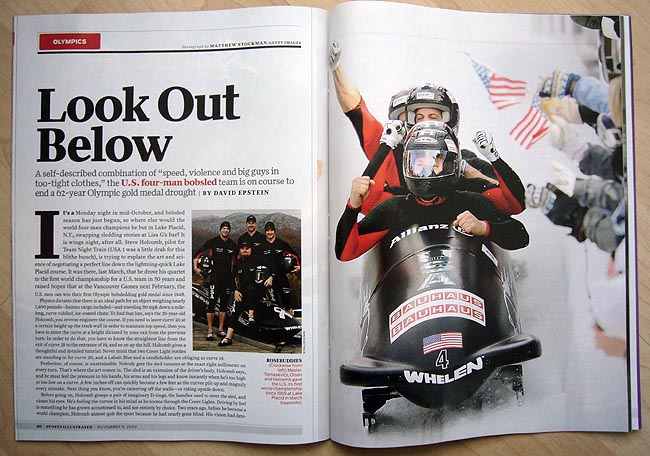
(UPDATED) As two years have passed, Sports Illustrated and the sports press in general again pretend to give a shit about the Olympics. This week, SI examines the state of American bobsleigh.
We endure yet another mention of tight bobsleigh uniforms (how else are they supposed to dress – like Santy Claus?), but here’s the kicker:
Driving by feel is something [Steve Holcomb] has grown accustomed to, and not entirely by choice. Two years ago, before he became a world champion, Holcomb almost quit the sport because he had nearly gone blind. His vision had deteriorated to 20/500 from a degenerative eye condition called keratoconus in which the corneas bulge outward.
Well, how very interesting. I just had Canadian bobsledder dudes telling me it was really out of the question to put a blind man on the team, even if he was otherwise one of the lightning-fast giants they aren’t exactly churning out by the thousands on an assembly line. How would that guy drive the van around Europe, they asked rhetorically? He wouldn’t, I said. You’re going to bounce him from the team just for that? You’ve got three other guys who can drive, plus coaches and staff.
And, well, whaddya know: The driver of USA1 has been visually impaired all along. Check the pullquote on the next page:
Now, maybe he’d had his bionic eyes plugged in for those latter results (SI: “Last year doctors implanted lenses made of a special polymer behind Holcomb’s irises”), an experimental operation he almost had to pay for himself. But the difference is immaterial. He drives with a fuzzed-over visor now and he’s been driving blind for seven years anyway. He never lost his place as captain of USA1.
USA Bobsled will accommodate the adventitious visual impairment of an athlete they already know can do the job, but it seems no bobsleigh federation wants to even try out an athlete who walks in the door half-blind. (Update, 2009.11.15: There may be a surprise coming through the pipeline from Alberta.)
How many guys do you know who could even lift one corner of a bobsleigh into a van? And people are worried about driving the van?
Can somebody tell me what kind of sense it makes to turn away talent in a sport whose physical demands ensure that only one in a million guys could even try out? Want to make that one in five million?
Are you trying to lose this thing or something? Not only can you put a blind guy in the sled, he can drive it. Why stop at just one?
Select a category to see additional posts. Add feed/ to a category to subscribe via RSS
The foregoing posting appeared on Joe Clark’s personal Weblog on 2009.11.14 14:57. This presentation was designed for printing and omits components that make sense only onscreen. (If you are seeing this on a screen, then the page stylesheet was not loaded or not loaded properly.) The permanent link is: https://blog.fawny.org/2009/11/14/blind-bobsleigh/