“NOT EURO” Choire Sicha will hereby be pimped, as he has contributed to the dead-tree book Never Threaten to Eat Your Co-Workers along with several Usual and Unusual Suspects.
ChoirePimping™
The foregoing posting appeared on Joe Clark’s personal Weblog on 2004.04.23 10:05. This presentation was designed for printing and omits components that make sense only onscreen. The permanent link is: https://blog.fawny.org/2004/04/23/choirepimping/
Gender politics at the relay service
And speaking of relay services: If you hack Sprint’s astonishingly-noncompliant site, you can eventually watch ASL videos explaining the IP-relay process. It’s a rare case of subtitled online video: There’s no speech, only sign.
Now, what happens if you’re a woman and want a female relay operator? Let the nebbishy pipsqueak male actor fill you in!
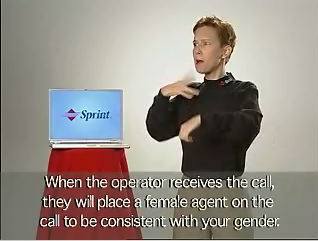
And as a public service, here’s the full list of QuickTime videos, including one they don’t want you to see.
The foregoing posting appeared on Joe Clark’s personal Weblog on 2004.04.23 08:00. This presentation was designed for printing and omits components that make sense only onscreen. The permanent link is: https://blog.fawny.org/2004/04/23/relay-grrrlz/
Here’s your jeezly RSS
An advantage of WordPress: Automatic syndication. What’s your poison?
Do with these what you will. They are also discoverable through the head element, if your device can read that.
The foregoing posting appeared on Joe Clark’s personal Weblog on 2004.04.22 19:43. This presentation was designed for printing and omits components that make sense only onscreen. The permanent link is: https://blog.fawny.org/2004/04/22/rss-links/
The Nigerian TTY scam
As has been documented in a few places –
- “Overseas crooks abuse phone service for deaf”
- “Con artists target phone system for deaf” (seriously-broken and noncompliant MSNBC page; consider Google cache)
- Slashdot (first, second)
- Longest headline of the year: “International Scam Artists Steal Big Money Through a New Telephone Service for the Deaf – and AT&T and the State of Maryland Benefit” (“a fourfold increase in that single category of complaint, even while other criteria such as typin accuracy and speed improved”)
- The hard-to-find message board on the topic (which has a habit of crashing)
– our dear Nigerian friends are using the Web interfaces to relay services to call bookstores, computer retailers, and the like, and clumsily attempt to place fraudulent orders. (See the FCC homepage on relays, which is curiously underreported online.)
These IP relay services, as by MCI, Sprint, and AT&T, are not mandated by any law anywhere, let alone the United States, the only country I know of that has them. They’re entirely optional. They permit scammers to make “TTY”-to-voice calls within the United States at zero cost. If the scammers wanted to use the relay service the conventional way, they’d have to place an overseas call, and that would eat into profit margins.
I’ve used the IP relay services here and there. Usually they won’t let me call Canada. One operator admitted her system did not differentiate between calls originating from TTYs or from the Web. Well, that’s your first clue right there: Set a flag on every operator’s terminal.
But more importantly, this entire fraud problem could be eliminated overnight by shutting down the IP relay services, which would cause no inconvenience whatsoever to nearly every TTY user. It’s already a toll-free call to contact the relay service (nearly everywhere in the U.S., you just dial 711), and every legitimate user has a TTY already or can get one easily. You can use computer software, even on Macs. We don’t need IP relay.
I can imagine a rare case in which a deaf person with a dexterity impairment finds it easier to type on computer than on a TTY, but that would remain true with TTY software. In fact, it would be more reliable in that case. IP relay services are Web applications. Apart from violating the User Agent Accessibility Guidelines, they’re slow and buggy on every system I’ve used. The AT&T phone kiosks in Newark airport reliably crash 30 seconds into any call – and those are provided as the only way to make a TTY call at the airport. I can get some IP relays to work sometimes in IE and Safari, but never in Mozilla.
IP relay is a nice idea. A variation of same – video relaying, using sign language – is something I experienced firsthand a month or so ago, and it seems to work OK. But the pool has been sullied. We do not need IP relay to use the damned phone.
If that seems drastic, do what the Australians do and set up a registration system – for IP relay only. (I thought the British had a similar registration system, but both countries eliminated nearly all such registrations. I called them up to ask.)
Curious factoid: After reading yet another reiteration of the following shibboleth, I simply could not get EuroCory to accept that a chief function of a relay service is not, in fact, to enable a deaf person to “order a pizza.” Its chief function is to enable deaf, hard-of-hearing, and speech-impaired people to call anyone they want, and vice-versa, for any purpose for which voice calls can be used. Yes, that does indeed include phone sex in some places. (Others either prudishly prevent such calls or cannot bill them, as via 900 or 0876 numbers.) There is no killer app for relay services; relay services are the killer app.
In one example, some arsehole on the Captioning list defamed my commitment to improved captioning and accessibility. Wasn’t he surprised to find his TDD lighting up a few days later with me on the end demanding an apology, which I got. EuroCory dismissed this as an atypical use case. There is no typical use case – any more than there is such a thing for voice calls.
The foregoing posting appeared on Joe Clark’s personal Weblog on 2004.04.22 18:45. This presentation was designed for printing and omits components that make sense only onscreen. The permanent link is: https://blog.fawny.org/2004/04/22/tty/
B-links, April 22
Bit o’ catching up to do.
- Trompe-l’œil switchboxen. ¶ 22a
- Possibly the best gay-sports photo of 2004, if not ever. Why? Rough, tough, jolly sorts of fellows nonchalantly sheltering themselves under umbrellas at football game. Real men hold brollies, and are 6′4″ and 200 pounds. Can you even tell they’re gay? ¶ 22b
- Man Happier About Switch to Mac than Conversion to Christianity ¶ 22c
- Hasn’t “gay rapper” been done already? ¶ 22d
- cameron diaz height. cameron diaz height. Searching for cameron diaz height? … Get yourself a pair of Elevator shoes to get the answer for cameron diaz height. ¶ 22e
- Apple archæology. ¶ 22f
- Web server made from a thousand iPaqs, right here “on Laird.” Loved the SPY-CAM action. ¶ 22g
- Enabling Cuneiform Support in InfoPath 2003 SP1: “This will also install all the files needed for the Voynich, Vinca, Iberic, Etruscan, Linear A (Minoan form), Linear B (Greek form), and Rongo Rongo language support. Please be aware that the default currency will be switched to zuzu and the default date format will be synodic.” ¶ 22h
- Serbian v. Russian Cyrillic italic forms. Michael Everson professes not to understand the fuss. ¶ 22i
- Similarly, Greek in Unicode. ¶ 22j
- Un journaliste faussaire du Chicago Tribune démasqué par un weblogueur. Dig that last word. Been there, done that. ¶ 22k
- Accessibility LiveJournals. ¶ 22l
- Japanese traditional Deba knives. ¶ 22m
- Semantic data extractor: Can you extract anything from your sites? Well, I certainly can. ¶ 22n
- Crowns! I clearly remember Husqvarna bikes when growing up. ¶ 22o
- IE bounding-box problem with italic rendering. ¶ 22p
- ASCII art skin for Opera. ¶ 22q
- “Oh. My. God! Is that…. Yes, it is, folks. Irascible Oscar winner Russell Crowe has arrived in Toronto.” ¶ 22r
-
Web Awards Disconnect: “This emphasis on web standards and accessibility has been present in the last several SXSW Interactive events. It would be reasonable to assume that SXSW would practice what it preaches. But an examination of the SXSW Interactive website argues otherwise. The code does not validate…. It is also missing the most basic accessibility feature a website can have:
alttags on the images…. Only two sites actually validated and were easily accessible….
The disconnect is obvious. In the panels we’re told that accessibility and web standards are important…. I think SXSW Interactive needs to decide what it supports and be consistent about it. If Flash sites are going to continue to grab the awards, let’s see half a dozen panels on designing motion graphics. If the Web Awards represent the best in web design, let that be reflected in the panels so that we designers can learn how to make the best web sites.” ¶ 22s - What’s Wrong with the BBC Web Site ¶ 22t
- How to unfuck Outlook mail formatting. Why not just give up on Outlook? It is the cause of great pain. ¶ 22u
-
Corian® kitchen. (Via Wallpaper
<asterisk>.) ¶ 22v - Tiny Cubit Wintel boxen. ¶ 22w
- In the Belly of St. Paul by Underworld–Tomahto. ¶ 22x
- A new kind of Amazon profile; it was actually the Alexa profile all the while. ¶ 22y

The foregoing posting appeared on Joe Clark’s personal Weblog on 2004.04.22 17:31. This presentation was designed for printing and omits components that make sense only onscreen. The permanent link is: https://blog.fawny.org/2004/04/22/b-links/
Live from Houston
*** System shutdown message from [luke à mail.veldt.ca] ***
System going down at 16:30
Server is going down in 45 minutes.
It was indeed an exciting afternoon on March 24 as Master Luke euthanized the Veldt. We had a valiant run. We lived gloriously and by God we died gloriously. My esteemed colleague, who had hosted my sites for upwards of four years, will shortly be taken vigorously to dinner and thanked with extreme sanction.
One is now hosted by young Matt Müllenweg, a developer of WordPress, the content-management system all the hip kids are now starting to use. I’m neither hip nor a kid, but I’m glad to announce I have entered the 21st century: fawny.blog is no longer handrolled. (Neither is Axxlog, but that is old news.)
Yes, dear friends, that means:
- each posting can have its own page
- you need not load an entire month’s postings at a time because I failed to subdivide them into, say, weekly increments
- page anchors are largely done away with
- I’m using UTF-8 encoding, which simplifies typography
- categories and a functioning search engine (that will, of course, report search terms back to me for later publication)
- and, yes, ravening hordes, you finally get a goddamned RSS feed. You can get off my damned case
Certain layout features will continue to be improved, particularly the page footer. Also, anticipated additions are as follows:
- Photographs
- Blogroll: Yes, you finally may learn what sites I read (apart from the obvious response, “seemingly all of them”)
- Better navigation, including morally-correct, semantic designer navbars
- Possible declared WCAG AAA compliance, but this is dicey by definition
And wait till you see what Matt and I have up our sleeves for a future edition of WordPress. Let me put it to you this way: If you thought captions and both kinds of descriptions (long and audio) were too much of pain in the arse before, you’re about to be pleasantly surprised.
The foregoing posting appeared on Joe Clark’s personal Weblog on 2004.04.22 12:40. This presentation was designed for printing and omits components that make sense only onscreen. The permanent link is: https://blog.fawny.org/2004/04/22/wordpressification/
Not ‘The Nigerian TTY scam’
This article is a placeholder for a test of Web standards.
The Nigerian TTY scam
As has been documented in a few places –
- “Overseas crooks abuse phone service for deaf”
- “Con artists target phone system for deaf” (seriously-broken and noncompliant MSNBC page; consider Google cache)
- Slashdot (first, second)
- Longest headline of the year: “International Scam Artists Steal Big Money Through a New Telephone Service for the Deaf – and AT&T and the State of Maryland Benefit” (“a fourfold increase in that single category of complaint, even while other criteria such as typin accuracy and speed improved”)
- The hard-to-find message board on the topic (which has a habit of crashing)
– our dear Nigerian friends are using the Web interfaces to relay services to call bookstores, computer retailers, and the like, and clumsily attempt to place fraudulent orders. (See the FCC homepage on relays, which is curiously underreported online.)
These IP relay services, as by MCI, Sprint, and AT&T, are not mandated by any law anywhere, let alone the United States, the only country I know of that has them. They’re entirely optional. They permit scammers to make “TTY”-to-voice calls within the United States at zero cost. If the scammers wanted to use the relay service the conventional way, they’d have to place an overseas call, and that would eat into profit margins.
I’ve used the IP relay services here and there. Usually they won’t let me call Canada. One operator admitted her system did not differentiate between calls originating from TTYs or from the Web. Well, that’s your first clue right there: Set a flag on every operator’s terminal.
But more importantly, this entire fraud problem could be eliminated overnight by shutting down the IP relay services, which would cause no inconvenience whatsoever to nearly every TTY user. It’s already a toll-free call to contact the relay service (nearly everywhere in the U.S., you just dial 711), and every legitimate user has a TTY already or can get one easily. You can use computer software, even on Macs. We don’t need IP relay.
I can imagine a rare case in which a deaf person with a dexterity impairment finds it easier to type on computer than on a TTY, but that would remain true with TTY software. In fact, it would be more reliable in that case. IP relay services are Web applications. Apart from violating the User Agent Accessibility Guidelines, they’re slow and buggy on every system I’ve used. The AT&T phone kiosks in Newark airport reliably crash 30 seconds into any call – and those are provided as the only way to make a TTY call at the airport. I can get some IP relays to work sometimes in IE and Safari, but never in Mozilla.
IP relay is a nice idea. A variation of same – video relaying, using sign language – is something I experienced firsthand a month or so ago, and it seems to work OK. But the pool has been sullied. We do not need IP relay to use the damned phone.
If that seems drastic, do what the Australians do and set up a registration system – for IP relay only. (I thought the British had a similar registration system, but both countries eliminated nearly all such registrations. I called them up to ask.)
Curious factoid: After reading yet another reiteration of the following shibboleth, I simply could not get EuroCory to accept that a chief function of a relay service is not, in fact, to enable a deaf person to “order a pizza.” Its chief function is to enable deaf, hard-of-hearing, and speech-impaired people to call anyone they want, and vice-versa, for any purpose for which voice calls can be used. Yes, that does indeed include phone sex in some places. (Others either prudishly prevent such calls or cannot bill them, as via 900 or 0876 numbers.) There is no killer app for relay services; relay services are the killer app.
In one example, some arsehole on the Captioning list defamed my commitment to improved captioning and accessibility. Wasn’t he surprised to find his TDD lighting up a few days later with me on the end demanding an apology, which I got. EuroCory dismissed this as an atypical use case. There is no typical use case – any more than there is such a thing for voice calls.
You have reached the target
The foregoing posting appeared on Joe Clark’s personal Weblog on 2004.04.22 12:33. This presentation was designed for printing and omits components that make sense only onscreen. The permanent link is: https://blog.fawny.org/2004/04/22/not-tty/