
Chalkboard-like hand-lettering
The foregoing posting appeared on Joe Clark’s personal Weblog on 2004.12.21 13:31. This presentation was designed for printing and omits components that make sense only onscreen. The permanent link is: https://blog.fawny.org/2004/12/21/chalk/
519 girders
But are they transgenderist I-beams?

The foregoing posting appeared on Joe Clark’s personal Weblog on 2004.12.21 13:30. This presentation was designed for printing and omits components that make sense only onscreen. The permanent link is: https://blog.fawny.org/2004/12/21/519/
B-links, December 20
- Jockohomo (sic): “Is it a uniform now for all the young dudes to wear jeans [and a] short-sleeve T-shirt over a long-sleeve white thermal underwear shirt, or was this just functionality?”
- Area-code and prefix lookup (with valid HTML, no less)
- Quote Colors, made possible solely by format=flowed
- Matt Siber: Removing type from photos or everything but type
- Looking at the Look Book: “I would give her a shopping bag so she doesn’t have to wear all the clothes she owns at the same time”
- Storm Large and the Balls MP3s, as seen on VulturePulp™
- Tony Stark on Etech: “They are at a conference called ‘WestTech,’ which seems pretty obviously to be O’Reilly’s Emerging Technology conference”
- Want It Now: Spy magazine before 1990
- $756,891.76
- Colin Farrell’s Man-on-Man Movie Kiss Manual: He shot that selfsame movie a single block away from me and walked obliviously past me at one point
- On the Prowl with Panther: An Orientation to Mac OS X 10.3
- Tables Gone Wild: “[T]his post is also about reckless exploitation and amateurs. But I am talking about the reckless use of tables I found in a client’s Web site, created by an amateur Web designer”
- The Libertines band site almost validates
- Even more fun with subdomains : “I implemented a couple of PHP subdomain detection tricks for quick testing of hex and RGB colour codes: typing ff0.milov.nl, cc6633.milov.nl, 100,100,200.milov.nl, 0,255,150.milov.nl (and so on) in your Address bar will fill the browser window with that particular colour”
- When Black Is Not Black: “Stop using black for copy text. Just stop. It hurts my eyes. All you contrast freaks, stop telling me that default black (
#000) text is a necessity on white backgrounds. It is not, I repeat, it is not. I will stop reading blogs and web sites that insist on defying commonsense rules of design, legibility and style.” You mean like the IC-Style? (Retrenchment) - Maki’s DVD collection using WordPress (considered and later abandoned for ultimately-Wikipediated described-DVD list)
- Where’d you get that colour scheme?
- “The server does browser sniffing, and delivers invalid URLs to Safari (at least), and valid ones to Internet Explorer on Windows”
- Dolphin’s forms mode better than Jaws’s (as if anything couldn’t be): “By using Dolphin’s new Forms Mode, you can tab through all of the form fields and enter details within the form easily. No need to continually select the field required, it’s done automatically. Compare this with other products, where users have to continually switch between different modes in order to enter information into a form…. [F]orm field labels are now announced as the user tabs through them, labels above the field or to the left of the form field can be repeated with new hotkeys”
- Must everything be XML?
- Mini vMac: A miniature[-]Macintosh emulator
- $7,950/month
- $1,100/month, but where is it?
- Live next to the sub shop
- Thunderous echoes of deafness: You’d think there’d be more deaf blogs (and blind ones, for that matter)
- “The World Needs More Canada: Strengthening Support for People with Disabilities”
- Bookshelf reorganized by colour: 1; 2; 3, 4; interview
- Cleese jilts TV for a joke on the Web: Expect his hog of a site to take over your computer
- Smart balanced on teacups
- Great Signs group
- “I’d say the mobile Web could be the killer app for Web standards”
- “Never start a conversation when you are naked in the locker room”
- “I’ve got an MPEG of the film… and need to lay a text copyright notice over the entire film”
- “One of a Kind? CulturePulp is Local, Non-Fiction Comic Strip”
- Playgirl’s Gay Porn Stars
- iTrick, apparently for real
- Men of the Jester, one of whom is an invert
- Delusions in Modern Primitivism: After watching it twice, it is still undetectable as a parody. It’s that good. And can you believe that red-haired fella?
- L. Kramer’s “The Tragedy of Today’s Gays” in valid code (which I marginally helped out with); MP3 page
- Royal Tenenbaum’s World of Futura
- “This is the TeX showcase…. It contains examples of what you can do with TeX, the typesetting engine”
- Web accessibility and screen reader survey
- Exercises in Style, soon to be a book
- The 10 Least Successful Holiday Specials of All Time
- Researchers create tool to automatically search handwritten historical documents
- “Please play back the Windows tada.wav sound file whenever I’m viewing a page on the W3.org site and either
valid-xhtml11orvalid-xhtml10image is displayed” - The QA Handbook Working Group Note
- User frustration study
- Singingfish video search
- “Tides of War tells the story of Commander Burt Hable, a gay Navy veteran (Adrian Paul), who, while navigating North Korean waters, believes his submarine is being attacked by an unidentified enemy ship”
- Offensive Interference: “For decades women sportswriters faced intimidation and harassment from male athletes, coaches and even colleagues ”
- What are Amazon.com Citations?
- Public Documents as Blogs: “[T]he majority of these are released as PDFs…. In June 2004, the UK government released its latest consultation document on ID cards. The document was made available as a PDF…. The blogosphere was willing to answer this call, but it did face a basic problem: linking into the document.” You can link to a page of a PDF no problem, or just wait for Google to index it
- Web Accessibility QA Favelet (nothing hugely original, but it works fine)
- Quechua 1.0: Microsoft to launch Windows in the language of the Inca[s]
- New HTML Editor designed to optimize accessibility
- “TV viewers vote Pim Fortuyn as greatest Dutchman”
- “Can you make any money giving away an E-book? I think you can”
- Language Identifier
- WikipedïzeText
- Forms aren’t tabular data!
- The Sound of the Accessible Title Tag Separator
- “David Shulman, a self-described Sherlock Holmes of Americanisms who dug through obscure, often crumbling publications to hunt down the first use of thousands of words, died on October 30”
- OverDrive digital audiobooks
- URL Decoder/Encoder: “Input a string of text and encode or decode it as you like. Handy for turning encoded JavaScript URLs from complete gibberish into readable gibberish”
- What is Google SMS?
- The Search for Love in Manhattan:
Okay, let’s say you’re blind. And let’s say you want to go to the movies. And let’s say you want to go to a foreign movie with English subtitles, like, oh, say, Hero. And let’s say that, since you don’t speak Chinese, you decide to bring a friend along to help you follow the action and the dialogue. Do you think it might occur to her not to read every single subtitle in the entire movie to you as loud as she possibly can? And, if it doesn’t, could you please sit somewhere other than right in front of me? You should both thank your lucky stars I interpret the Second Amendment very narrowly.
img alt=, next generation- MediDisc 4.7GB 4x Speed DVD-R
- Interview with Doug Turner and Chris Hofmann of the Minimo Project
- LaBruce, B.:
I’m getting really sick of all these tired American film critics – especially, it seems, the liberal ones – who can’t get past the bad dye job and the eye-liner and the camp acting and actually examine what the movie is saying and how radical it is to be saying it at this particular moment in history…. The camp aspects of the film, whether totally intentional or not, fit in perfectly with the conventions of the sword-and-sandal epics of fifties Hollywood – pageantry, over-wrought acting, anachronisms – and if you can’t get beyond that, you’re an idiot…. I think the fact that they aren’t shown having sex with each other makes it even stronger, making the point that the sex between them was only one aspect of their complex and deep relationship…. Alexander’s ludicrous bedroom romp with Rosario Dawson was more trite and explicit – almost pornographic – because his relationship with her wasn’t as profound. Two thumbs and one dick up.
- Walking tour of Chelsea
- “Again we have another major publication writing with amazement that these ’blogging folks’ can attract a huge readership without anyone hiring them, appointing them or providing them any sort of support”
- Digital Copyright Terminology (Canadian, no less)
- San José Hotel completely booked for South by Southwest, so don’t bother
- Athletic Model Guild DVDs (no doubt with compression artifacts and surely without accessibility)
- How we work: Culled from existing sources, it’s rampantly inconclusive and shines no light at all on the unspoken issue it addresses, procrastination
- A. Lane:
[I]t’s only in the writing that I discover what it is that I think. And I can only write to deadline. I can’t do the blank sheet. You know, “Chapter One: He adored New York…” And I don’t do the specifically sharpened pencils in the specifically designed notebook in the specifically built dacha… The other day I wrote a piece sitting on the floor of the train to Cambridge, which was straight out of Buster Keaton, with squatting room only. And there was one point last summer when there was someone on every floor of the house, so I wrote on the staircase with my computer on my lap. My thighs got sunburnt, which constitutes an accident at work. I am suing myself…. The truth is, that if you’re working on a piece at three in the morning, you’re not Keats; you’re just late.
- Gigapixel camera (with chromatic aberrations you must correct, hence its photos are not immediately true-to-life)
- Amerikanski History X director interview
- German accessibility bookmarks
- LettError has a Weblog (which almost validates); LettError also has a Wiki
- Tyler Hamilton has a Weblog
- CRIAWatch
- Cops nailed for picking on invert
- Sixth mistake band sites make: Pretending Web standards don’t exist
- “[L]ooking for a bud who I used to hook up with once in a while on the Ryerson campus[. Y]ou are Maltese[,] over 6 feet[,] shaved head[,] beefy build and uninhibited. Hit me back if that’s you or you know who I’m talking about.” You mean Dave?
- “[P]roduction company seeking 8 men for a very uninhibited reality show…. The show cast features men only but there will but both men and women in the show as the conquest. The show will be seen in an overseas market ONLY!”
- The Cripple: One way to overcome procrastination
- Preferred voice recorder, apparently: Sony ICD-MS1VTP
- “Notational Velocity is an application that stores and retrieves notes”
- Amazing Slow Downer for Mac OS X
- Origin of ^H
- “ ‘You don’t know anything about me or what I do,” I tell him, so your judgments mean nothing.’ As I turn and walk away, he snorts loudly to his friends: ‘Fucking faggot.’ So I get back in his face for one last retort. ‘Pal, at least you got one thing right’ ”
- “Dude” (PDF; text): Supplementary Materials (“In L.A., everyone dudes”)
- Utterly incomprehensible article about a Muslim punk band (“homo”? “fag”?)
- Spacing: The Tiles of the TTC (plus macarons)
- Zeugmas
- Foot Locker reaches settlement in Columbia gay discrimination case
- Complex but not overwhelming standardista site
- “PDF Adder is an AppleScript for iTunes that will assist with adding a PDF file to iTunes and tagging it with a selected track’s Artist and Album tags. iTunes 4.7 can accommodate PDF files, which are useful for album art, lyrics, production notes”
- Mathew Englander v. Telus: Another example of how to beat the bastards, so to speak
- Butcher gloves, great at Xmas for the practicing veganist
- D. Salo:
Someone with more sensitive fingers than I have might be able to read this book blindfolded, the printing has so dented the pages. Not smooth, these pages, not at all, not around the edges and not on the printed surface. Do people who whinge about the ‘feel of the paper book’ have any idea about this? I doubt it. My job? Proofreading the OCR and sharpening up the existing TEI markup for the electronic edition of this book…. I’m rescuing this book. I’m renewing it. Materially, it is a modest thing; it exists for the sake of the words, and the words are what I am recasting anew. So the old red covers don’t have to endure the touch of many hands, and the pages don’t have to risk crumbling altogether as they are turned. I preserve the words, and the intent of the artisans who put the words on the pages, as best I know how. This is, stripped to its essentials, what I do. I rescue the souls of modest old books for new readers and new uses. And it irks the life out of me, turns me purple and speechless with fury, when people (more often than not, librarians!) loftily proclaim that I do this because I have no respect for the physical codex.
- Creating an office for writing: “I write with the same software as most people, Microsoft Word.” I rather think not
- Unicyclisme! (Also trialsin)
- The 6 Myths of Creativity
- Way too damned many frames
- Yinzhen silver needle tea
BigMuscleBlogs
Self-evidently not safe for work.
- Muscle Brute Stud, allegedly
- More blackletter tattoos (or better alternative)
- “I’m physically fit, clever, cheeky, and I love to sportfuck.” To what?
- Fiddle or violin?
- “I live in the mecca of bodybuilding so I see the hottest bods in the world but if a guy is stupid, I get bored in about 5 minutes. I’m passionate about what I believe in. That’s why I became a Marine. Ultimately it’s also why I decided not to stay in. I’m very sexually oriented but when I do meet the fella I want to settle down with…it’s just gonna be him and me…. None of that open-relationship BS for me…. I’m still in the process of being discharged from the USMC. I wrote a one-man show based on my journals from Iraq” (photo)
- 6′7″ (similar)
- Now, that’s a kilt!
- Complexion and proportions (always important)
The foregoing posting appeared on Joe Clark’s personal Weblog on 2004.12.20 19:04. This presentation was designed for printing and omits components that make sense only onscreen. The permanent link is: https://blog.fawny.org/2004/12/20/b-links/
Amazon cannot handle ligatures
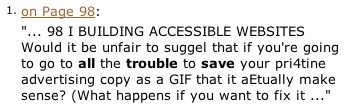
One may search inside the book at Amazon; it’s all part of its “Alexandria” project.
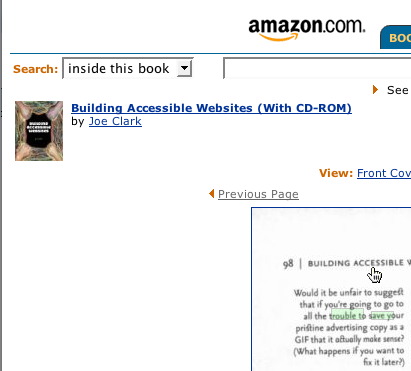
The system quite evidently uses optical character recognition to read the book pages, which are often visibly out of square when seen online. However, the OCR cannot handle uncommon ligatures.
Page 98 of my book contains a photo cutline that reads as follows:
- Unencoded text (but with markup)
-
Would it be unfair to suggest that if you’re going to go to all the trouble to save your pristine advertising copy as a GIF that it actually make sense? (What happens if you want to fix it later?)
- Unicode text
-
Would it be unfair to suggest that if you’re going to go to all the trouble to save your pristine advertising copy as a GIF that it actually make sense? (What happens if you want to fix it later?)
- Text with entities
-
Would it be unfair to suggest that if you’re going to go to all the trouble to save your pristine advertising copy as a GIF that it actually make sense? (What happens if you want to fix it later?)
(Note that the ct ligature has no Unicode encoding, and, I am very testily informed by Michael Everson, never will. Note further that the fi ligature worked fine.)
And Amazon renders it thus (truncation theirs):
-
-
-
Would it be unfair to suggel that if you’re going to go to all the trouble to save your pri4tine advertising copy as a GIF that it aEtually make sense? (What happens if you want to fix it
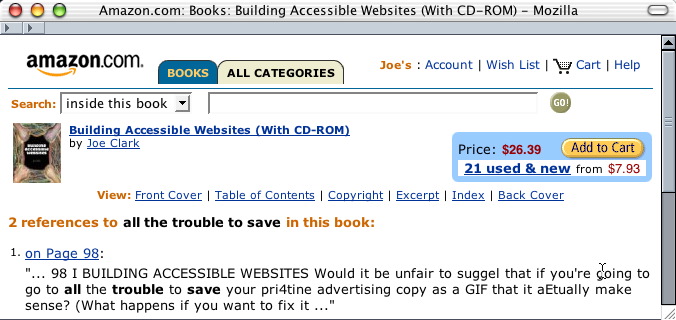
Got a wee bit of work to do there, I think.
The foregoing posting appeared on Joe Clark’s personal Weblog on 2004.12.19 15:56. This presentation was designed for printing and omits components that make sense only onscreen. The permanent link is: https://blog.fawny.org/2004/12/19/ligatures/
More gay writers
Some further excerpts from Hear Us Out: Conversations with Gay Novelists by Richard Canning (Columbia, 2003):
Christopher Bram
- R.C.
And then there’s Larry Kramer. You wrote a generous essay about Faggots, arguing that we should listen to the tale and not the teller.
- Christopher Bram
Yes, well, Kramer is a better playwright than he is a novelist, but Faggots is not the one-dimensional screed that his enemies or even Kramer said it was. It’s as if he believed the attacks and no longer notices what’s in his own book. Faggots is actually a very good novel folded up inside a bad novel. The good novel is full of wonderfully dangerous, mixed feelings about sex and love and community, but Kramer can no longer admit that, now that he’s become the village scold. […]
A few years ago I thought: “It’s going to happen soon. The breakthrough’s around the corner. They will read our books as naturally as we read theirs.” But I’m getting impatient. Even Michael Cunningham, after the success of The Hours, said in an interview: “I can’t help noticing that as soon as I write a novel without a blowjob, they give me the Pulitzer Prize.”
- (pp. 80; 82)
Michael Cunningham
I wrote Golden States in order to have finished a novel by the time I was 30. I wrote it in about 45 minutes.
It’s not a bad book, but it’s not good enough…. Even at the time it came out, I was never anxious for it to have an extensive life in the world. Writers crank out too many books that aren’t the best goddamn book they could possibly write – that don’t contain much in the way of heart’s blood. I feel like we as readers are all drowning in “OK books.” […] But I’m adamant about that: It will not be reissued. It’s done. It served its purpose. Jeanette Winterson has a book no one knows about – Boating for Beginners, her second. It’s my impression that the book disappeared for similar reasons. Winterson simply didn’t think it was part of a dialogue. […]
I think sex – the actual depiction of sex that transpires between characters – is overlooked by most writers, for reasons I understand…. And the English language actually deserts you. There’s no useful term for the female sex organ. “Vagina” feels a little more clinical than you might want. “Cunt” feels derogatory. We’re literally deprived of language in the face of this. Yet it’s obviously hugely important. It seems to me the one one area available to writers who are alive and working now.
(pp. 91; 105–106)
Paul Russell
Writers work differently. I tell my students all the time to figure out how their own brain works. If it works in a weird, messy way, there’s nothing they can do about it, as much as they might like to transform themselves into a different kind of writer. […] Usually I’ll start collecting stuff for the new novel when I’m in the final year of writing the previous one. I wish I were like Anthony Trollope and could draw a line at the bottom of the page and start the next novel. But I have about a year of mental exhaustion before the next book starts to coalesce.
(pp. 209; 211)
Matthew Stadler
- R.C.
Did [whatever] ever lead you to verse? [Question redacted so it makes sense]
- Stadler
Do you mean linebreaks and stuff? Linebreaks never occurred to me…. Dennis Cooper is both [a prose and poetry writer]. How do we know which piece of his is a poem and which is prose? The distinction is made mostly because of linebreaks, I think.
- (p. 268)
Stadler also suggests two books by Steve Weiner, The Museum of Love and The Yellow Sailor.
Philip Hensher
I have a sense of what an incredible imposition it is to ask anybody to read a manuscript. I wouldn’t readily do it. I don’t know why reading manuscripts of typed A4 [stationery] is such hard work, but it is. I’ve done it a few times. Every time I’ve found it difficult to come to a view as to the quality of the thing. Once it’s bound up, you do have a sense of how good something is.
- R.C.
It’s something to do with typesetting.
- Hensher
That’s right. Typefaces can influence your reading. I’m obsessive about typefaces. I’ve always got a clear sense of the right typeface for a particular novel. The Kitchen Venom typeface was wrong. It gave everybody a headache. For Pleasured, it looks like a children’s book.
- R.C.
I noticed in Kitchen Venom that you appeared to be rendering “Trafalgar square” with a small s deliberately.
- Hensher
That was a tiny joke to tease the clerks in the House of Commons. It’s Hansard style. Whenever they refer to a street or square, they use the lower case in Hansard.
- (pp. 309–310)
And a question I’ve always wanted to ask
I’m just gonna vent for a moment here. Paul Russell, p. 225, emphasis added: “When I tried to render Allen in the first person, all I was getting was this flat, clipped, inflectionless astronaut-speak.”
What the hell does “clipped” speech sound like?
Does it sound as if the transitions between words (surely you are aware that we speak in a continuous stream; we only interpolate individual words) are removed, with all the segues “clipped” away? Does it sound like bad speech synthesis? Choppy? Overdiscrete?
Or does it refer onomatopœically to the voiceless stops at the end of the word “clipped” itself (-pt)? The -pt- sequence always sounds like a tidy, self-contained drumbeat (in the word “optical” particularly).
Why do people resort to the word “clipped”? It’s a discomfiting term, with many synæsthetic connotations, including cigars, fingernails, and foreskins, the last of which are often described by hateful leftist girls, with a cutesy smirk of comeuppance, as being “clipped,” with a distinct misunderstanding of anatomy that men could never get away with in discussing equivalent alterations of their genitalia.
The foregoing posting appeared on Joe Clark’s personal Weblog on 2004.12.14 22:42. This presentation was designed for printing and omits components that make sense only onscreen. The permanent link is: https://blog.fawny.org/2004/12/14/writers/
Nine Months Ago in ‘Spy’
I spent enough time in the Southern Hemisphere to have my circadian rhythms reversed. But that has come to an end: The spring–summer hibernation is over, and Ten Years Ago in Spy is back. For your pleasure: Tama Janowitz looking her age.
(Illustrations forthcoming.)
The foregoing posting appeared on Joe Clark’s personal Weblog on 2004.12.13 15:37. This presentation was designed for printing and omits components that make sense only onscreen. The permanent link is: https://blog.fawny.org/2004/12/13/spy/
Worst closet case of the year
Don’t hit this link before reading the warning that follows: Cone of gayness (sic).
The text reads:
I am NOT gay. This is just the result of some online bantering between a friend and I [sic]. Oh[,] and in case it is not clear, I am NOT gay. (And neither is my friend.)
Also, no offense intended to homosexuals, I hope. It’s just a joke.
My friend actually drew this out for me when I asked him for clarification on what a “20 metre melee area” was.
There follows a broken image link to a “cone of gayness.”
So let’s recap:
- A blogger spends two boldfaced paragraphs explaining that he and his friend aren’t gay, and apologizing in advance if any gays should take “offense.”
- Then they attempt to run a high-larious illustration of a Dungeons & Dragons–style “cone of gayness.”
- That image doesn’t even load.
Wouldn’t we conclude that the author and his friend are sophomoric closet cases? Sure, we would. All the classical evidence is there.
But it gets better!
You can’t even view the page without being asked over and over again to log into the guy’s router (screenshot; unchanged in multiple browsers).
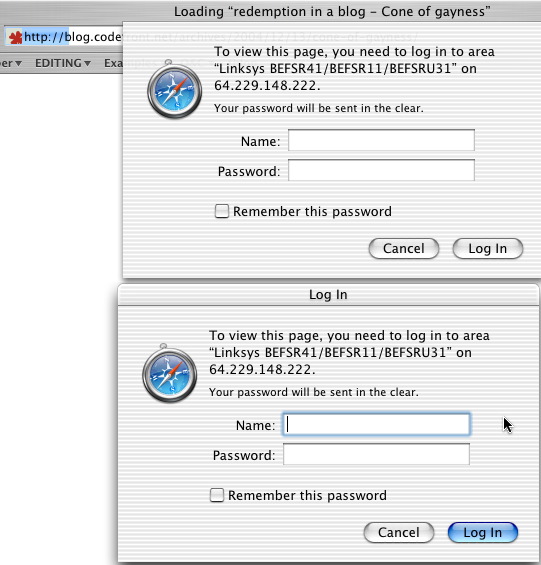
You know how I believe in longevity of electronic documents and in retaining online postings indefinitely unless some unimpeachable reason arises to remove them? Well, we are replete with unimpeachable reasons here, beginning with ill-advisedness, alighting briefly on the lily pad of technical incompetence, and coming to ultimate rest on the mantle of flat-out embarrassment.
The foregoing posting appeared on Joe Clark’s personal Weblog on 2004.12.12 17:54. This presentation was designed for printing and omits components that make sense only onscreen. The permanent link is: https://blog.fawny.org/2004/12/12/gayness/
Oy, curmudgeon
Yes, as foreseen, TVO presented an airing, with simply appalling captioning, of Alan Zweig’s I, Curmudgeon. Here one may record for posterity the words of Toby Young that caused me to plotz on first viewing (emphasis added):
- Zweig
- – Early on, you said something about having negative charisma.
- Young
- – Yeah.
- – What is that?
- – I define negative charisma as meaning that I can walk across a crowded a room in which I know no one and no one knows me and already ten people hate me.
- I was a kind of fairly prototypical embittered loser, kind of, for a while. It became such a source of sort of energy that I worried that if I did kind of achieve some modicum of success that I would mellow out and sort of lose that source of energy.
- [Glances to the side] Come in! Come in! Aw, fuck, it’s room service.
(Toby Young looks nothing short of fuckable with his tight pasty skin, round intellectual glasses, shaven head, and stiff- and high-collared shirt. “Come in!” “Coffee, tea, or me, sir?”)
At any rate, a second viewing of most of I, Curmudgeon reinforced my reservations from the first viewing. In fact, slouching in the armchair at my esteemed colleague’s pad, the longer I watched the show the more morose and self-denigrating I became. (The movie is its own party mix; you can talk right over it.) The initial half-hour still is a triumph of identification (“I’m like that!”); the rest of it is a symptom of Zweig’s unerring fatal instinct toward the downward spiral. He picks at scabs and revels in misanthropy. If I may resort to neologism (Calvin: “Verbing weirds English!”), he tends to loserize.
After my first viewing, I exchanged a few tremendously souring and dispiriting E-mails with A. Zweig, as his From: field names him. Everything I said he countered with a paraphrase of “Nobody else, including very seasoned broadcasting professionals, has complained about that yet” or, more worrisomely, a flat-out denial. At one point he actually claimed not to have made a film about curmudgeons. What, and Vinyl wasn’t about record collectors? I know his entire œuvre is a forum to beat himself up in public, but Zweig’s documentaries do in fact have themes and subjects. I was worried that the next step in E-mail would involve his denying he’d even made a movie.
(Incidentally, the captioning on I, Curmudgeon is enough to warrant a CRTC complaint unto itself.)
Zweig’s active airing of and luxuriating in his own inadequacies and bitterness leaves one flatly disillusioned by his two pictures. If I wanted a sour taste in my mouth, I’d cue up the most distressing film ever made, They Shoot Horses, Don’t They? I don’t expect to feel down after a movie about curmudgeons.
The foregoing posting appeared on Joe Clark’s personal Weblog on 2004.12.06 20:21. This presentation was designed for printing and omits components that make sense only onscreen. The permanent link is: https://blog.fawny.org/2004/12/06/oy/
What’s missing from iTunes Music Store Canada?
Lots, as it turns out. For comparison, I looked up every artiste mentioned by $50,000-a-year Toronto Star “music critic” Ben Rayner in his inventory of his old box of tapes.
| Missing | One album | One song | Two albums | Raynerisms |
|---|---|---|---|---|
|
|
|
|
Kajagoogoo, it will be noted, is in Rayner’s tape collection and can be downloaded from iTunes.
The foregoing posting appeared on Joe Clark’s personal Weblog on 2004.12.03 13:33. This presentation was designed for printing and omits components that make sense only onscreen. The permanent link is: https://blog.fawny.org/2004/12/03/ixnaytms/