
N
The foregoing posting appeared on Joe Clark’s personal Weblog on 2008.08.03 15:19. This presentation was designed for printing and omits components that make sense only onscreen. The permanent link is: https://blog.fawny.org/2008/08/03/neon-n/
Do not taunt Happy Fun Driver
Advice to anyone riding the perplexing, borderline-pointless 26S Dupont short-turn bus: Don’t ever argue with the young black guy who started driving the route this week (his first of six, unless something happens) over his cellphone use. Suddenly you might find the bus parked – twice – so he can stand behind the white line and yell at you, call you an ass three times, and threaten to destroy or steal your camera.
All the while, he’ll inexplicably be holding three $5 bills.
And, should you later choose to have a supervisor called over, that supervisor will take your report and also lie to your face and state that photography isn’t allowed on TTC property.
Did you know there’s more? There’s more.
The same young black male bus driver will induce you, and everyone else on the bus, to leave the bus by the back door so you won’t be able to jot down the run number visible only through the windshield. If you walk to the front and take a picture anyway, he’ll close the door and drive off in a rush. The problem is that someone might still be trapped in the bus while he does that.
All this happened to me last night. TTC: Your safety partner.
Question for Bob Kinnear: Are these the kind of “operators” you really want on hand to replace the sarcastic, uncaring old guys who are dying off and retiring?
The foregoing posting appeared on Joe Clark’s personal Weblog on 2008.07.31 19:50. This presentation was designed for printing and omits components that make sense only onscreen. The permanent link is: https://blog.fawny.org/2008/07/31/26s/
Tradesmen

The foregoing posting appeared on Joe Clark’s personal Weblog on 2008.07.30 17:25. This presentation was designed for printing and omits components that make sense only onscreen. The permanent link is: https://blog.fawny.org/2008/07/30/tradesmen/
Michael Bierut isn’t a writer
He’s a raconteur. (NOW WITH UPDATE)
Didn’t he steal the show in Helvetica?
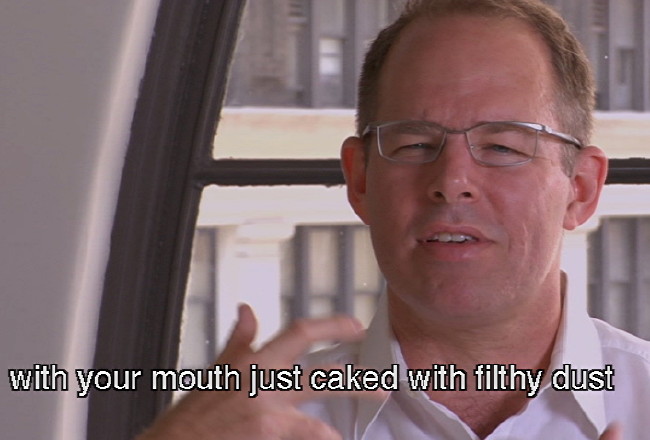
Wasn’t he adorable as the excitable host of the AIGA ⌘X competition (2007)? (Bierut does excitable shockingly well. That’s how he succeeds in a blue-chip firm. He really sold Kurt Andersen on rebranding Christmas as X.mas, cheerfully batting objections out of the way.)
Bierut eventually agreed to be interviewed in person by Debbie Millman in How to Think Like a Great Graphic Designer, which, by virtue of being a book, thankfully silences her unlistenable yowl. Did you know he absolutely has to jog three miles in the morning?
You really want to know? I have a chart in my basement, and I have years and years of calendars on clipboards. They all have different markings on different days. There are markings I make when I do certain things, and certain marks I make when I do other things. Sometimes I give myself a special dispensation not to run, which is either one of three [“either,” Michael?] reasons: Either I have an 8:30 appointment, it’s raining pretty hard, or it’s below 10° – not including the wind chill…. If I sleep late, I draw a little sad face for that day on the calendar, a frown face…. It’s horrible all these really compulsive things. On the other hand, exercise is good for you.
Shortly thereafter, Bierut writes his own epitaph: AN ENTIRE WEEKEND-LONG METHODOLOGY FOR DOING THE LAUNDRY. (“What made me mad was that no one seemed to appreciate my efforts.”) Classic!
There is of course the failed enterprise of “graphic-design criticism” that is Design Observer – gassy, unwanted, and still without so much as a print stylesheet or real post titles. There Bierut sounds dull and overprepared and stilted and like he’s just trying too hard, which he is. He’s trying to put on some kind of voice. He already has a voice! It just doesn’t work well in writing.
The only thing Michael Bierut ever wrote there that actually sounds like himself is this single graf about Mad Men (buried miles deep in compost):
Jesus God in heaven! “Not until I know I’m not wasting my time”! From the minute Don launched his this-meeting-is-over bluff, I was on the edge of my seat, and my lovely wife Dorothy will tell you that I literally clapped my hands at that line. For me, this sequence is as close to pornography as I ever get to see on basic cable.
Get this man off the Interwebs and put him on television. Give him his own show. Give him a podcast. A video podcast. Something! Let him speak!
Hear Bierut live!
(UPDATE, 2009.03.24) I’ve collected a few links to podcasts and other online videos where you can hear Bierut yourself (assuming you can hear – not always a fair assumption with my readership). All links open at iTunes.
-
AIGA Command X competition (delicious!)
-
Design Matters (warning: prolonged exposure to Debbie Millman’s voice)
The foregoing posting appeared on Joe Clark’s personal Weblog on 2008.07.29 14:50. This presentation was designed for printing and omits components that make sense only onscreen. The permanent link is: https://blog.fawny.org/2008/07/29/frownface/
This isn’t what ‘off the record’ means
Joe Nocera (no relation):
[Steve Jobs] went on to say that he would give me some details about his recent health problems, but only if I would agree to keep them off the record. I tried to argue him out of it, but he said he wouldn’t talk if I insisted on an on-the-record conversation. So I agreed.
Because the conversation was off the record, I cannot disclose what Mr. Jobs told me. Suffice it to say that I didn’t hear anything that contradicted the reporting that John Markoff and I did this week.
And there you go: In one fell swoop, Joe Nocera reported the contents of an off-the-record conversation. He said the off-the-record remarks had the same meaning as something he and another journalist previously wrote. Nocera even goes on to admit what he did:
I had just been handed, by Mr. Jobs himself, the very information he was refusing to share with the shareholders who have entrusted him with their money.
And he went right ahead and reported it.
“Off the record” means the journalist cannot report the substance, facts, details, gist, or any other meaning imparted by the off-the-record conversation. You can reveal the conversation happened, but you can’t reveal what was said. Some reporters have a hard time distinguishing these two states; I assume they’d have just as hard a time distinguishing the fact that a defendant in a court case entered a plea and reporting what that plea was. (This actually happened in the Homolka–Bernardo case. Wired couldn’t differentiate those two concepts. Wired’s side of the story was documented, I recall, on a Gopher site that no longer exists, but I see now somebody has written a précis.)
Usually, I complain that the Kids Today think going off the record means they can write “Steve Jobs refused to comment. But, off the record, Jobs candidly admitted he has serious digestion trouble in the wake of his surgery and has suffered numerous infections as a result.” But now we’ve got the Times doing it, so I guess the bar has been permanently lowered.
The foregoing posting appeared on Joe Clark’s personal Weblog on 2008.07.28 14:26. This presentation was designed for printing and omits components that make sense only onscreen. The permanent link is: https://blog.fawny.org/2008/07/28/nocera/
D-Crit (D for Death of)
News slowly travels up the brontosaurus’s tail to its brain. But there’s a lot of body to get through en route. Yes, graphic-design “criticism” is dying, but not without some really fancy pallbearers.
-
Rebecca Cottrell attended “The State of Graphic Design Today,” a lecture series.
The trouble is the very idea of “criticism.” It implies personal taste, which is fine for art criticism and literary criticism. The “arts” are full of ambiguity and subjectivity.
Design has something more objective about it: something well-designed is something that works. Unfortunately, writing critically about design is more complicated than this. It’s somewhere between something that works (science) and something that appeals to taste (art). Much of the “criticism” I’ve read about design seems to be more along the lines of historical documentation….
[A]long with all of its other troubles, perhaps the main trouble with “design criticism” is that many of the writers are art historians, not technologists and designers.
-
There was a fawning article about the eye of the hurricane, the new MFA in design criticism program at the School of Visual Arts (q.v.), in Step Inside Design (né Step-by-Step Graphics). The program’s name is D-Crit; is the hyphen an é?
It is claimed, as if with a straight face, that a program of study for intellectuals “aims to extend design criticism to the masses.” Inevitably, Heller and Twemlow parody themselves: Their statement of the problem they wish to solve is a statement of the reason their program should not exist.
“We’re looking at the critic as a critic of design, who can be a journalist, poet, curator, filmmaker,” explains Heller, who began conceiving the program, nicknamed “D-Crit,” [so he’d have a job after leaving] the Times in summer 2006. “We’re trying to say there are many platforms on which to evaluate design and many different ways to evaluate design….” [T]hey might curate a museum exhibition, produce a radio segment, create a multimedia blog or write an essay.
Step Inside Design and its competing design magazines, many of which are owned by a single company, survive almost exclusively on contra deals with paper manufacturers and, of course, advertising. You could delete all the “criticism” from their pages and the feature well would be left with a healthy residue of showcases and designer profiles.
“Classic” design criticism existed only because a scarce and expensive medium, the design magazine, paid for it. It seemed prestigious. But blogs have knocked the knees out from under design magazines. We know now that not every topic in design requires 2,000 words and six pages, and it is now evident to everyone, not just experts, that design is too workaday to stand up to “criticism.”
“So much design criticism has been done by designers themselves,” observes Peter Lunenfeld, professor in the graduate-level Media Design Program at Art Center College of Design. “As interesting as I find it, I think it’s limiting. It’s been very much concerned with how practitioners involve themselves in the craft of making and often too little about the production of meaning. My eyes glaze when I read various disputes about fonts.”
At some point, the students in the D-Crit program are going to have to realize there will be no market whatsoever for their services. At least if they were art-history majors they could get a job answering phones at a gallery in Chelsea.
-
A transcript of Q&A at a D-Crit open house included a few zingers. Heller just can’t get past the fact he’s being left behind by evolution.
[M]ore magazines, more newspapers, and certainly more internet sites are engaged in design writing. Some of that is criticism, some is journalism, and some of it is just blogging.
Of course. “Just.” (Heller described all those as “jobs,” by the way. How many of them pay? How many might actually pay if Heller didn’t write or cowrite one-third of the design books published every year?)
“[T]his conference is not only about presenting but it’s also about getting feedback, and not just on the Web, where most feedback is coming from now.” (Emphasis added.) Freudian slip?
-
And finally, there was a giant conference the other week entitled New Views 2: Conversations and Dialogues in Graphic Design. This conference conformed completely to the stereotype that design conferences can’t produce legible designs for their own conferences. I challenge you to read the conference program (PDF). I printed it out: Critical occurred 60 times, criticism 16, discursive five. -Based as a suffix is now the new darling of critical jargon (26 occurrences). Foucault is in there. (So is Hrant.)
I saw a couple of potentially interesting discussions of self-directed work, which has been possible in graphic design for Peter Saville in the 1980s and for anyone now with the Web and for no one else at any other time. There are at least six papers based on real research that I will request. (Did you know design students are under continuous camera surveillance in Singapore classrooms? Is that a surprise?)
But as a conference on design criticism? The centre cannot hold, kids.
Is anyone ever going to realize that designers are designers because they aren’t that good at writing, let alone “writing critically”? Does it follow, then, that design writers are lousy designers? I mean, I am.
The foregoing posting appeared on Joe Clark’s personal Weblog on 2008.07.27 13:33. This presentation was designed for printing and omits components that make sense only onscreen. The permanent link is: https://blog.fawny.org/2008/07/27/decrit/
Worst-edited book of the year
Get to Work: A Manifesto for Women of the World by Linda R. Hirshman. I mean edited, not written.
I read many of the popular economics books irrespective of topic. Ostensibly, Hirshman presents the case that the “choice” of university-educated women to drop out of the workforce and have kids, essentially unassisted by their husbands, has unintended consequences: It reduces those women’s income and takes them out of the running for positions as Leaders of Tomorrow. Her claimed solutions involve having only one child (not clearly explained) and insisting that husbands take over their half of childcare and housework. She destroys the common blandishment that two working parents couldn’t possibly afford all-day childcare. There are costs, she says, to infantilizing yourself by raising infants, and costs to studying art history in university. Actual costs.
Most amusingly, Hirshman looks up Ph.D.s and other overachievers and finds nearly all of them have dropped out to have kids. Actually, it might have been all of them, though I’m not too sure.
Why?
It was a struggle to understand this tiny book – at 92 principal pages, it is an elongated magazine article or blog post. (Hirshman has a Flash site I won’t link to that’s stuffed with these keywords: mommy wars, stay at home moms, working mothers, feminism, choice feminism, values, taxing women, flourishing lives, glass ceiling, housework, urban baby, feminist philosophy, personal is political.) The book is typeset, not very well, in Adobe Garamond. (Except for that one line on one page that switched fonts.)
Can you understand this paragraph?
“If I work at a smaller firm, I still have to put in 50 or 60 hours a week, occasional nights and weekends, and my salary will once again be eaten up by childcare.” (This is obviously absurd: A lawyer in private practice working fifty hours a week makes more than any nanny except Mary Poppins.) Socially privileged women and just regular folks. Highly educated and the whole American female workforce. All the data reflect that women are tied to the household today in a way that rebuts every expectation of the feminist movement.
To hear Hirshman tell it, she gets a lot of bad press. I mailed her a question about the editing of her book and received the following top-posted response: “This E-mail seems oddly overwrought. I can only assume that the objection must be to content. Further messages will be sent to junk mail.” I take this as proof Hirshman has never met an editor, even during the preparation of her book. (Wendy Wolf was her acknowledged editor. What was the extent of Wolf’s involvement? Taking lunch?)
If Hirshman objects to her reputation as a total bitch, maybe she shouldn’t act like one. That has a cost too.
The foregoing posting appeared on Joe Clark’s personal Weblog on 2008.07.27 12:14. This presentation was designed for printing and omits components that make sense only onscreen. The permanent link is: https://blog.fawny.org/2008/07/27/gettowork/
Bay

The foregoing posting appeared on Joe Clark’s personal Weblog on 2008.07.25 15:08. This presentation was designed for printing and omits components that make sense only onscreen. The permanent link is: https://blog.fawny.org/2008/07/25/balconies/
Geistards™
I was going to go to the Michael Geist love-in tonight, and laboriously liveblog it, at the cost of much time and effort and significant arm discomfort. (I did it once before.)
All along I realized I wanted to go there only to see what Geistards™ look like in person, and to use that term to describe them later – if it suited them, of course. I was prejudging them somewhat, but I assumed that was warranted. While they want “fair copyright for Canada,” fundamentally they want any provision of the Copyright Act that does not conform to Creative Commons replaced with something that does.
I am one of only two definable persons in the whole country who wants (fair) copyright reform but who does not approve of Creative Commons. I agree with all of Geist’s major points and nearly all of his minor ones. I just don’t agree with or support Creative Commons. I have been told this makes me no better than a pirate. In Geistards’ eyes, it makes me a tool of an acronymous organization like the RIAA or the MPAA or CRIA.
So no, I’m not schlepping all the way across town in the rain to sit in a room full of Geistards who might think of me as the enemy.
The foregoing posting appeared on Joe Clark’s personal Weblog on 2008.07.24 19:00. This presentation was designed for printing and omits components that make sense only onscreen. The permanent link is: https://blog.fawny.org/2008/07/24/geistards/