Yes, it is barely possible to eat veganist at the world’s most famous restaurant (which, incidentally, designed its own pictographs): “We can ask to the kitchen to do [whatever is] possible, but it is not easy to go on with 33 tastings showing you all the concepts and techniques without dairy products and eggs.”
Veganist at El Bulli
The foregoing posting appeared on Joe Clark’s personal Weblog on 2009.03.20 07:26. This presentation was designed for printing and omits components that make sense only onscreen. The permanent link is: https://blog.fawny.org/2009/03/20/elbulli/
Why hasn’t Andrew Sullivan been deported yet?
The irksome positoid bottom, who, in a previous incarnation he’d like you to forget about, posted an ad on a bareback site soliciting unsafe sex (“no such thing as too hairy”), whined last year that somebody as special as him was faced with having to comply with the laws of the country he loves. In this case, it’s a ban against positoid visitors and immigrants, a ban that is obviously unfair because it impedes his own life. (Well, he’s the one who took loads up asses.) Sully was faced with leaving the United States in March.
Now it’s March. Why is he still there? Don’t the rules apply even to a clearly exceptional, truly important visitor with an O visa?
Sullivan held a private audience with Obama, which remains off the record but surely involved a direct entreaty to end a policy that affects Sully personally. The only news that RawMuslGlutes can manage to report is that a repeal of the ban is “in the works.” Does he really think his President will sign an executive order just for him personally within the next dozen days?
Update
Sully got busted for pot, a charge that was squelched from on high so he wouldn’t get deported.
If I understand matters correctly, Sullivan has violated the laws of the United States by attempting to gain immigration status there while carrying an inadmissible disease and by doing drugs on federal land. Again: Why hasn’t he been deported yet?
The foregoing posting appeared on Joe Clark’s personal Weblog on 2009.03.19 12:45. This presentation was designed for printing and omits components that make sense only onscreen. The permanent link is: https://blog.fawny.org/2009/03/19/frogmarch-rawmuslglutes/
Google smothers designers
Google, I correctly contend, is overrun with unsocialized Aspergerian math guys who think anything to do with visual design (or, for that matter, accommodating cripples) just does not compute, viz:
It is still an engineer culture that believes in traditional inside-out design. If you can’t write code, you don’t have credibility – and the anthropologists didn’t have credibility. “You have to convince the engineers to get anything done,” she said. She used workshops, brainstorming sessions and cartooning – cartooning – to transmit the anthropologocial research to the engineers. With varying degrees of success, I expect.
About as much success as the multi-billion-dollar monolith’s sole functioning visual designer, Doug Bowman, ever had. This is, after all, a place where usability head Irene Au recapitulates her own math nerds and derides typography as something twee designers fiddle with to make pages “breathe.”
A lot of designers want to increase the line height or padding in order to make the interface “breathe.” We deliberately don’t do that. We want to squeeze in as much information as possible above the fold. We recognize that information density is part of what makes the experience great and efficient. Our goal is to get users in and out really quickly. All our design decisions are based on that strategy.
Welcome, Irene Au, to the title of Worst Enemy of Web Design.
Tell me: Have you ever found a remotely attractive Google product or service? (Is Google Analytics – believed to be the first service Bowman worked on, and, apparently, the last – the closest thing to one?) These people have less taste than Microsoft, previously the low-water mark.
A culture that smothers a leading standardista and prototypical graphic designer, one that reduces him to a designer of delete buttons and a debater of line widths, is a culture of anti-intellectualism and visual illiteracy masquerading as one of unstinting empiricism. No wonder Bowman finally quit (for Twitter). I welcome him back to a world where he is actually wanted.
The foregoing posting appeared on Joe Clark’s personal Weblog on 2009.03.19 12:30. This presentation was designed for printing and omits components that make sense only onscreen. The permanent link is: https://blog.fawny.org/2009/03/19/google-antidesign/
Error correction
Every six months, somebody writes a new story about captioning that gets a dozen facts wrong. This time it’s Sue Ellen Reager’s turn. She makes so many mistakes she should go to work for Aberdeen Captioning, the scrappy little company that suppresses the comments I post correcting their umpteen errors.
Reager:
-
“The time in history has arrived when captioning and subtitling are beginning to blend into one”: Only if you think “captioning” means “Line 21 closed captioning” and “subtitling” means “two lines of yellow Arial.” Yesterday, subtitling and captioning were two separate things (everywhere, including Britain), and tomorrow they still will be.
Hence “Users could flip a switch to see subtitles (which were called captions to differentiate their new on/off capability from the burn-in variety)” is still false.
-
“Programs will become available in two, five, 20, or 40 languages”: Adding one language requires 1.5 times the effort (translation plus subtitling or captioning). Today, barely any “programs” are even available in two languages, and half the time that’s done by machine translation of scrollup captioning.
-
“In 1980, the first set-top closed-caption decoder box with its own antenna was made available for $200”: It didn’t have an antenna. (I own one.)
-
“About 400,000 set-top boxes were sold over 25 years”: What, through 2005? Decoders pretty much disappeared after 1994.
There’s no source for this citation, nor does anyone but John E.D. Ball know how many external decoders were really sold, if even he does.
Greg Downey (Closed Captioning: Subtitling, Stenography, and the Digital Convergence of Text with Television, pp. 97–98) stated that, by 1981, only 35,000 decoders had been sold; the projected sales were 100,000 a year. By 1986? Fewer than 100,000 (p. 200); NCI claimed 100,000 in 1985 (p. 206), but that was mostly to unload an old inventory of circuit boards and generally to save face.
-
“In 1990, the Decoder Circuitry Act” – the Television Decoder Circuitry Act – “mandated that all televisions sold in the U.S. with screens 13″ or larger must contain a built-in caption-decoder chip,” but only starting in July 1993. “That law signaled the death knell of the set-top box manufacturers,” who were, for all intents and purposes, singular: Sanyo manufactured the decoders Sears sold for NCI.
-
“The advent of the decoder chip enabled all 24 million hearing-impaired people to be assimilated into our lives”: How condescending. Isn’t it great we assimilated those hearing-impaired people into our collective?
-
 “Another effect of the [Television] Decoder Circuitry Act was the ability to control captioning with a remote control” (emphasis added): My TeleCaption II had a remote. Still does.
 -
“Today, captioning is mandatory for all broadcast media with a few exceptions, such as new companies, companies with less than $3 million in revenue,” companies outside the U.S. (a possibility simply ignored here), “and Internet channels,” which aren’t regulated anyway.
-
Imagine this writer describing an elephant to a blind person. Here’s how she describes a monospaced font: “equidistant lettering in which an I must be as wide as a W.”
-
“[T]he network or content manager either accepts responsibility for the encoding or outsources the task”: What’s encoding?
-
Inevitably she describes “the French” as “always striving to be different”; they “use SECAM,” which is merely PAL with a couple of tweaks. It isn’t a completely separate thing.
-
“Live captioning is generally performed by court reporters using 10-key machines in which the keys are a form of shorthand. The 10-key output is translated via software into English words”: That might be true if stenotype keyboards didn’t have 24 keys (plus machine-specific extras). Even your phone has more than 10 keys. (Press 1 for fact-checking.)
-
Reager copies and pastes some self-promotion from Vitac (“VITAC”) and a couple of small houses with a service to sell. Hint: Adobe doesn’t sell captioning software and there’s no research that shows a reading rate of 15 characters a second.
-
Apparently computer translation is just as viable as translation by bilinguals.
-
“CPC’s software breaks a transcribed script instantaneously into the raw captions required, splitting each sentence into the proper two or three subtitles, all of correct length as specified by the FCC”: There’s no such specification. (Good God, man – what if my sentence is only three words long?)
-
Here’s Reager’s closer. Purple prose or full-fledged self-parody?
As 50,000 channels flood the Web, the internet is revolutionizing the way people feel about captioning, languages, and subtitling. In five years, at any time and on any day, billions of people around the world will be watching global internet channels from 300 countries, many subtitled and/or captioned in dozens of languages, and a new, global marketplace will explode before our eyes. As for those who cannot see the explosion, audio description for the blind technology, perhaps as text-to-speech, is in the works.
There’s a reason why you never heard of a Web site called StreamingMedia.com before this. And now you know you can safely ignore it.
The foregoing posting appeared on Joe Clark’s personal Weblog on 2009.03.18 13:34. This presentation was designed for printing and omits components that make sense only onscreen. The permanent link is: https://blog.fawny.org/2009/03/18/reager/
‘How Designers Fail’
Jason Tselentis points out what, in retrospect, should have beeen obvious.
Rather than learn from the critiques and repeated suggestions to change one thing or another, they leave for another major: All of these changes? My work is bad? Forget it, I’ll go elsewhere. Some will argue that these drop outs play into the natural state of attrition, sorting out the can-do students from the cannot. Does it have to be this way? Why can’t all design students learn to cope with stressful critiques and do-it-over suggestions? Because some of them have been fawned over during years of grammar and high school, and it’s not easy to teach them new tricks. […]
Designing and building a home is not like graphic design in scope, and therein lies the problem. If audiences see large-scale designs happening between 8:00 and 9:00 p.m. Central Standard Time on Sundays, they expect (demand!) smaller-scale design problems to happen much much faster. I call it the Time Compression Paradox: If a large-scale project should happen in one hour; a project 1/10 its size should happen in 1/10 the time. The most prevalent place this happens with design students is software. […]
[D]esign has become synonymous with fame. Go to school; learn design; get a degree; get a job; and get famous. This is the American Idol Paradox: as more and more people take pride in looking at themselves or getting looked at by others, less and less of us will actually become famous – fame may even disappear. Paradox aside, design isn’t about fame – it’s about unfame. Servicing the client is one of the most unfamous things you can do because it’s their name and their dollar [Cf. Saville].
The foregoing posting appeared on Joe Clark’s personal Weblog on 2009.03.18 12:46. This presentation was designed for printing and omits components that make sense only onscreen. The permanent link is: https://blog.fawny.org/2009/03/18/tselentis/
Inverting the 20th century
An amazing piece by Diana Zlomislic in the Toronto Star actually suggests that one department store’s choice of six guys as top fashion designers is evidence of sexist discrimination in the world of ladies’ fashion.
The most ridiculous thing you’ve heard all day? Probably, because these guys are teh Gay. Even if they aren’t (hold that thought for a moment), ladieswear designers of all descriptions spend their every waking hour beautifying women. Surely this is as much a hotbed of sexism as, say, a rural construction site in the 1970s.
Or did Zlomislic’s own sources explain what was really happening?
Jennifer Halchuk, 36, the co-designer of Mercy…, says she knew she had to decide early between having a family and having a career. “It’s like a 24-hour, seven-days-a-week career. Most women decide if they want to have a family and children, this is not the right option. I know I’ve had to give up those options to make this happen.”
Exactly. Those who fail to learn the lessons of Susan Pinker’s The Sexual Paradox are doomed to repeat them. Men, on average, are more willing to go the distance and put in unreasonable amounts of work on single topics, on single projects, or in a single profession. Women, on average, are reticent to place all their eggs in one basket, literally and figuratively, and at almost exactly the same point in their lives get tired of the rat race and want to have kids.
In this respect, fashion design is exactly comparable to engineering and geology. (This pattern repeats itself in every field from high finance to advertising. And type design.) Predispositions for these behaviours manifest themselves in the prenatal brain; it’s nature, not nurture. (Check a useful segment on The Agenda.)
It would be more interesting to examine why we are not celebrating male ascendancy in this ostensibly female (Zlomislic: “feminine”) field, since the entire discourse about wymmynz in the workplace revolves around the male standard. Our culture is clearly a failure because women do not hold down half of men’s jobs like engineering and geology, but we never even bother talking about the (surely obvious) failure of women’s jobs, like teaching and nursing, to attract men.
We don’t actually want equality in the workplace; we just think men’s jobs are the standard and women should have half of them.
So I called Zlomislic up and told her all about this. The best part of our conversation? She denied that “all” the featured designers were gay, but refused to out the straight one. I complimented her on her inversion of the 20th century.
Here, then, is Vince Talotta’s photo of Kirk Pickersgill, Mikhael Kale, Stephen Wong, Philip Sparks, Jeremy Laing, and Denis Gagnon.

Based on hearsay and rumour, I openly accuse one of these guys of not being queer. You tell me which one.
The foregoing posting appeared on Joe Clark’s personal Weblog on 2009.03.17 14:34. This presentation was designed for printing and omits components that make sense only onscreen. The permanent link is: https://blog.fawny.org/2009/03/17/zlomislic/
‘Generous in granting fame, but stingy in granting fortune’
Jaron Lanier wrote a paper for MTS Allstream, the Prairie telco, which was delivered last December for a CRTC hearing. It is almost impossible to find on the CRTC site and isn’t visible elsewhere, but seems rather important in the discussion of how to promote Canadian identity online.
In his (evidently correct or at least persuasive) analysis, the only way to make money selling multimedia online is to tie such selling to a certain bit of hardware like an iPod. Every other attempt has failed; we’ve watched a ten-year parade of such attempts, so let’s stop pretending somebody is likely to come up with a magic bullet. (And it doesn’t work for everything – iTunes doesn’t sell much video.)
However (and here Lanier rides his virtual-reality hobbyhorse), perhaps with hugely expanded Internet infrastructure, new forms of entertainment, like tele-immersion, may be technologically practicable and actually profitable, because they will be so magical as to be worth paying for.
I don’t see how someone with Lanier’s integrity would take a corporate consulting assignment on the understanding that the outcome were predetermined, but he does seem to make the case, apparently independently, that taxing an ISP or somehow otherwise making CanCon cost more will merely subsidize existing business models or drive Canadian producers to host their content overseas. This is, nonetheless, exactly the position MTS takes.
(And, in a nice little detail, Lanier predicts that Canadians who came from other cultures might just make OtherCultureCon from their Canadian home bases. Isn’t that what we already do when we shoot Battlestar Galactica in Vancouver?)
In the grand tradition of fair dealing, I made an HTML version for review and comment. Some of Lanier’s bons mots (excerpted):
-
The Internet as it exists today is generous in granting fame, but stingy in granting fortune.
-
Can a nation’s creative community remain vibrant if it is no longer earning much money? As a musician like Dallas Green lives his life, has children, and so on, will he be able to continue to tour and interact with fans to the degree needed to self-promote on the Internet? It is possible that the Internet will give rise to a great many promising early creative careers, but few, if any, lifetime careers, unless some form of the old mainstream media can continue as a parallel option that generates revenues for content producers.
-
An extremely amateurish video of a music performance posted on YouTube or MySpace will occasionally gain a huge instant audience. The reasons are somewhat random. The crowd of eyeballs has to converge on something once in a while. Attention in the online universe is like weather, and sometimes there is a random storm.
-
[W]e must now measure the Internet as if it were a part of nature, instead of from the inside, in the way that we can examine the books of a financial enterprise. We must explore it as if it is unknown territory, even though we laid it out.
-
It is the non-glamorous events of life where most people spend most of their time and focus most of their concerns, and Google has found a way to commercialize them. The highest-paying Google advertisers are apparently American lawyers.
-
[T]here has been an endless parade of optimistic, high visibility ventures trying to find the secret sauce that will reverse the trend. After more than a decade of failures, however, it is becoming reasonable to treat all such quests as quixotic.
-
It might be true that the majority of amateur video production that involves a significant degree of planning or staging, as opposed to spontaneous Webcam presence, in the online domain takes the form of fan-generated parodies, tributes, and other derivative material.
-
We have witnessed a remarkable inversion of the fundamental dynamics that preceded the appearance of the Internet. The majority of seemingly-professional content flows over an open system, the Internet, where there is no need to apportion spectrum, and also no way to earn money from content. Instead, entrepreneurs develop proprietary hardware devices to deliver the same content. When content flows to proprietary gadgets it can earn money, and only then.
The foregoing posting appeared on Joe Clark’s personal Weblog on 2009.03.16 16:06. This presentation was designed for printing and omits components that make sense only onscreen. The permanent link is: https://blog.fawny.org/2009/03/16/lanierism/
New podcast appearance
I was interviewed about Organizing Our Marvellous Neighbours several weeks ago by Patrick Cox for his enjoyable podcast on language, The World in Words. The interview is finally up:
Transcript coming up soonish.
The foregoing posting appeared on Joe Clark’s personal Weblog on 2009.03.12 15:51. This presentation was designed for printing and omits components that make sense only onscreen. The permanent link is: https://blog.fawny.org/2009/03/12/twiw45/
Shortchangers
Shortcovers is a new E‑book service from Indigo, Canada’s Walmartesque bookstore near-monopoly. It’s got a good premise – instead of buying full E‑books, which carry sticker shock and seem too overwhelming to read all at once, you buy chapters at a time.
They’ve tried very hard to be au courant with the Web, and they seem to want recognition for that fact. But delivery mechanism and “content” are, as ever, two different things. With books, whether P‑ or E‑, apperance counts, and Shortcovers’ typography is atrocious. In retrospect, I wouldn’t have expected anything less.
Take Sharp Teeth by Toby Barlow, which I am finally reading on my third borrowing from the library. It’s a novel written in free verse about marauding human lycanthropes. The book lends itself to an instant design analysis:
-
Great cover design. (Those are just labels on cloth boards.)
-
Slipshod copy-editing. This isn’t Ratz Are Nice (PSP) territory here; using the wrong its is just a mistake.
-
Some apparent incompetence in how to typeset verse (always use hanging indents).
The designer of the HarperCollins version I have here is listed as Leah Carlson-Stanisic; she gets two stars at most. (And surely her surname is missing some diacritics.)
 Still, the P‑book is a Bringhurstian masterpiece compared to the E‑book. (See photos.)
-
Problems start right away on “page 1,” with ragged a right margin that bespeaks a mindless intermingling of soft and hard returns. Again, people: Hanging indents.
-
Apostrophes and quotation marks are neutral, a particularly egregious failure here because one early line reads “wanted” “wanted” “wanted” and I kind of want consecutive quotation marks to be correct especially in a case like that.
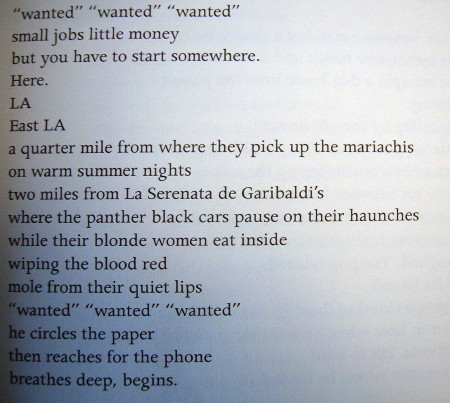
MS‑DOS called; it wants its “quote marks” back.
-
 They can’t even get any of this right on the Web version. It seems obvious now that jamming initial copy alongside a cover thumbnail is a bad idea.
What’s the culprit?
Export to “plain” text in Word for Windows? Not knowing what Unicode is because it’s too hard to figure out (in Windows)? Just not giving a shit?
Questions for Toby Barlow
- If you wrote a novel in verse and approved the creative cover treatment, did you really countenance slipshod copy-editing and text design in your printed book?
- Do you really think the electronic text does you any justice whatsoever?
- Did you even know any of this was a problem? (Why didn’t anyone spot the copy errors, for example?)
- Are you going to be able to fix the E‑version? Or is would that not be “worth it”?
What I visualize when I think “pack o’ werewolves”
No girls; a clear-eyed alpha male, leading by a pace and a half, threatening to get in some asshole’s face if he keeps giving me trouble. (Up to this point I never figured I needed a minder. But anyway: The perfect boyfriend?) Somehow all I can see is Hugh Dillon in a hoodie and bomber jacket. Packs of human werewolves would, by definition, be same-sex, and don’t you fuck with them. Their bites are like guillemets.
The foregoing posting appeared on Joe Clark’s personal Weblog on 2009.03.10 14:32. This presentation was designed for printing and omits components that make sense only onscreen. The permanent link is: https://blog.fawny.org/2009/03/10/shortchangers/