I started writing the Tea Makers blog on the CBC in July, and as of today I stop. Only part of the reason is external, i.e., it is due only partly to the epic incompetence of current CBC management, which will surely result in the decimation of the entire organization should the Tories win a majority government. Frankly, it is difficult to argue for the continued existence of public television in a multi-channel environment when its programming is indistinguishable from private broadcasters’. CBC does other things well, but they are never held in its favour. According to right-wing assholes, the CBC costs “the public” $1.1 billion a year and all of that goes into CBC Television. Who needs a state broadcaster in this day and age, they ask?
I wrote over 100 posts of generally excellent quality. They were certainly well researched. Nonetheless, people wanted Old Coke. Teatards™ tuned in to their own Price Is Right and expected Bob Barker standing next to the wheel. I am not Alphonse Ouimet and didn’t pretend to be, two facts that truculent readers pretended not to understand.
There’s a reason I don’t have comments here, and the reason is self-protection. I foolishly let my guard down in writing the Tea Makers, where I was routinely pilloried, even to the extent of anonymous cowards’ publishing confidential details that only a couple of people ever had access to. They weren’t just objecting to my presence or disagreeing with what I wrote or my writing chops; they were deliberately trying to hurt me. They succeeded. And now they win.
Select a category to see additional posts. Add feed/ to a category to subscribe via RSS
The foregoing posting appeared on Joe Clark’s personal Weblog on 2008.10.31 14:44. This presentation was designed for printing and omits components that make sense only onscreen. (If you are seeing this on a screen, then the page stylesheet was not loaded or not loaded properly.) The permanent link is: https://blog.fawny.org/2008/10/31/defaked/
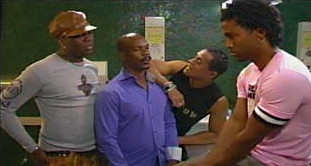
Noah’s Arc (sic) was an ensemble dramedy series telecast on one of the doomed Amerikanski “LGBT[TQQI2S*]” networks, Logo. We watched several discs’ worth of episodes, until we were nearly driven mad by the dreadful plots, half-assed writing, and full-on effeminacy of one or more characters. The guys who weren’t total fembots were built like brick shithouses, hence were trying too hard. In at least one case (that of Chance), effeminacy and a perfect body mixed and matched like chocolate and peanut butter.
And that reminds me: They’re all black! (Or “mixed-race.”)
The New England Patriots suit up for Super Bowl XLII
So we’re supposed to like this, right? Because “gay men of colour” are finally being represented? What if the representation is reprehensible? Even if it is, in some respects, accurate? (What, I’m not allowed to say that? These guys are fictional. I can say whatever I want about people who don’t exist.)
I’ve met a hell of a lot of black queens, but the black guys built like Olympic wrestlers whom I’ve known have been polite Canadians, not Americans with an overcompensation problem. Then again, one of those Canadians later went into porn. (Had we made it as far as Series 2, we would have discovered that the adorable Canadian with the self-explanatory name, Merwin Mondesir, had joined the cast. [Interview.])
In the magazine now owned by Logo’s competitor (here<bang> [sic] now owns the Advocate), creator Patrik-Ian Polk bats a weak wrist at critics of the show’s namesake maladaptive-in-chief, Noah. (Issue 1018, 2008.11.04, p. 59.)
“Real men are the ones who choose not to hide their sexuality, wear it proudly, and hold their head up high to accept whatever society throws at them[.]”
In truth, the “real men” who do that are masculine, well-built, and heterosexualist. (Noah’s dream man!) But when they do any of what Polk says, they’re ridiculed as sexist swine. Especially if you can’t even get a quick fuck out of ’em.
[B]loggers like [Rod 2.0] (whose recaps… often poked fun at the characters’ lack of masculinity) represent a “small group of men who clearly have issues that they’re dealing with. If they really look at the show in a realistic way, they’d see that these are not stereotypes.”
Or they’re just reprehensible. Maladaptives are long overdue for some bad press. Didn’t they choose to be that way? (Or do I have that wrong? Is a rewatching of La cage aux folles in order? Or can I make do with The Birdcage?) When is somebody going to write a full-on Project Runway takedown?
Now, what was Rod 2.0 saying about poor, picked-on Noah? Read the first and second instalments for yourself. Neither of them particularly rags on Noah’s girliness, or anybody else’s. These must be the best TV recaps I’ve ever read (and I was there at the birth of Hissyfit); the only thing that’s missing is a criticism of the obvious.
The feature-film sequel Noah’s Arc: Jumping the Broom is now playing at a theatre quite far removed from you. Blink and you’ll miss it, and your false eyelash will fall off.
Select a category to see additional posts. Add feed/ to a category to subscribe via RSS
The foregoing posting appeared on Joe Clark’s personal Weblog on 2008.10.26 17:40. This presentation was designed for printing and omits components that make sense only onscreen. (If you are seeing this on a screen, then the page stylesheet was not loaded or not loaded properly.) The permanent link is: https://blog.fawny.org/2008/10/26/maladaptives-arc/
Select a category to see additional posts. Add feed/ to a category to subscribe via RSS
The foregoing posting appeared on Joe Clark’s personal Weblog on 2008.10.24 13:21. This presentation was designed for printing and omits components that make sense only onscreen. (If you are seeing this on a screen, then the page stylesheet was not loaded or not loaded properly.) The permanent link is: https://blog.fawny.org/2008/10/24/tonneau/
The irksome positoid bottom with the atrocious mid-Atlantic “macho” accent writes:
This form of instant and global self-publishing, made possible by technology widely available only for the past decade or so, allows for no retroactive editing
False. A lie, even. How this got through the Atlantic’s verificationists, whom I’ve had to deal with for hours myself, eludes me.
[T]he historic form closest to blogs is the diary. But with this difference: a diary is almost always a private matter…. A few diaries are meant to be read by others, of course, just as correspondence could be – but usually posthumously
Funny, I wrote something similar in Deconstructing “You’ve Got Blog”: “Even handwritten diaries will be discovered posthumously, as every diarist knows deep down.” I assume the attribution was left out by accident.
Blogging – even to an audience of a few hundred in the early days – was intoxicatingly free in comparison. Like taking a narcotic.
Or smearing testosterone on your chest.
When readers of my blog bump into me in person, they invariably address me as Andrew. Print readers don’t do that. It’s Mr. Sullivan to them.
And when members of barebacking sites bump into him, it’s RawMuslGlutes all the way. (Read Andrew Sullivan’s Friendster profile, if you wish.)
As the blogosphere has expanded beyond anyone’s capacity to absorb it, I’ve needed an assistant and interns to scour the Web for links and stories and photographs to respond to and think about.
I manage pretty well with 1,560 RSS feeds. Man up, for Chrissakes.
Reading at a monitor, at a desk, or on an iPhone provokes a querulous, impatient, distracted attitude, a demand for instant, usable information, that is simply not conducive to opening a novel or a favorite magazine on the couch.
Select a category to see additional posts. Add feed/ to a category to subscribe via RSS
The foregoing posting appeared on Joe Clark’s personal Weblog on 2008.10.16 16:57. This presentation was designed for printing and omits components that make sense only onscreen. (If you are seeing this on a screen, then the page stylesheet was not loaded or not loaded properly.) The permanent link is: https://blog.fawny.org/2008/10/16/rawmuslblogs/
A few years ago, an economist at the University of Chicago named David Galenson decided to find out whether this assumption about creativity was true. He looked through forty-seven major poetry anthologies published since 1980 and counted the poems that appear most frequently…. The top eleven are, in order, T. S. Eliot’s “Prufrock,” Robert Lowell’s “Skunk Hour,” Robert Frost’s “Stopping by Woods on a Snowy Evening,” William Carlos Williams’s “Red Wheelbarrow,” Elizabeth Bishop’s “The Fish,” Ezra Pound’s “The River Merchant’s Wife,” Sylvia Plath’s “Daddy,” Pound’s “In a Station of the Metro,” Frost’s “Mending Wall,” Wallace Stevens’s “The Snow Man,” and Williams’s “The Dance.” Those eleven were composed at the ages of twenty-three, forty-one, forty-eight, forty, twenty-nine, thirty, thirty, twenty-eight, thirty-eight, forty-two, and fifty-nine, respectively. There is no evidence, Galenson concluded, for the notion that lyric poetry is a young person’s game. Some poets do their best work at the beginning of their careers. Others do their best work decades later. Forty-two per cent of Frost’s anthologized poems were written after the age of fifty. For Williams, it’s forty-four per cent. For Stevens, it’s forty-nine per cent.
Can you understand it better if I show it to you like this?
A few years ago, an economist at the University of Chicago named David Galenson decided to find out whether this assumption about creativity was true. He looked through 47 major poetry anthologies published since 1980 and counted the poems that appear most frequently.
The top 11 are, in order:
T. S. Eliot’s “Prufrock” (composed at age 23)
Robert Lowell’s “Skunk Hour” (41)
Robert Frost’s “Stopping by Woods on a Snowy Evening” (48)
William Carlos Williams’s “Red Wheelbarrow” (40)
Elizabeth Bishop’s “The Fish” (29)
Ezra Pound’s “The River Merchant’s Wife” (30)
Sylvia Plath’s “Daddy” (30)
Pound’s “In a Station of the Metro” (28)
Frost’s “Mending Wall” (38)
Wallace Stevens’s “The Snow Man” (42)
Williams’s “The Dance” (59)
There is no evidence, Galenson concluded, for the notion that lyric poetry is a young person’s game. Some poets do their best work at the beginning of their careers. Others do their best work decades later. 42% of Frost’s anthologized poems were written after the age of 50. For Williams, it’s 44%. For Stevens, it’s 49%.
Now the important part
Cézanne didn’t just have help. He had a dream team in his corner.
This is the final lesson of the late bloomer: his or her success is highly contingent on the efforts of others…. He would have been within his rights to make his son get a real job, just as Sharie might well have said no to her husband’s repeated trips to the chaos of Haiti…. But she believed in her husband’s art, or perhaps, more simply, she believed in her husband, the same way Zola and Pissarro and Vollard and… Louis-Auguste must have believed in Cézanne.
Late bloomers’ stories are invariably love stories, and this may be why we have such difficulty with them. We’d like to think that mundane matters like loyalty, steadfastness, and the willingness to keep writing che[que]s to support what looks like failure have nothing to do with something as rarefied as genius. But sometimes genius is anything but rarefied; sometimes it’s just the thing that emerges after twenty years of working at your kitchen table.
“Sharie never once brought up money, not once – never,” Fountain said. She was sitting next to him, and he looked at her in a way that made it plain that he understood how much of the credit for Brief Encounters belonged to his wife. His eyes welled up with tears. “I never felt any pressure from her,” he said. “Not even covert, not even implied.”
I read that and I nearly lost it. It takes a village to raise a genius.
Select a category to see additional posts. Add feed/ to a category to subscribe via RSS
The foregoing posting appeared on Joe Clark’s personal Weblog on 2008.10.15 15:08. This presentation was designed for printing and omits components that make sense only onscreen. (If you are seeing this on a screen, then the page stylesheet was not loaded or not loaded properly.) The permanent link is: https://blog.fawny.org/2008/10/15/dreamteam/
Select a category to see additional posts. Add feed/ to a category to subscribe via RSS
The foregoing posting appeared on Joe Clark’s personal Weblog on 2008.10.14 13:42. This presentation was designed for printing and omits components that make sense only onscreen. (If you are seeing this on a screen, then the page stylesheet was not loaded or not loaded properly.) The permanent link is: https://blog.fawny.org/2008/10/14/bluishorange/
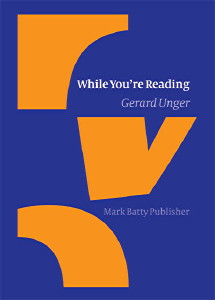
I put down 50 bucks at Pages, which unaccountably had a copy of this, senior type designer Gerard Unger’s latest book. It took me ages to get through it, despite the fact that, with its giant type, the book seems rather padded.
The publisher’s blurb states: “This book is about everything that happens while you’re reading – in front of your eyes and inside your head.” I really don’t think the book succeeds at this claimed goal. First, though, who is the target audience? A curious nonspecialist? They’d read popular-press books like Thinking with Type, which I see people reading out in public all the time, or the very solid Complete Manual of Typography. And how many people are really “curious” about type? Most people just use Word for Windows.
If not, then who is the audience? Typography pros? We kind of know all this business inside out already. What little exposition While You’re Reading gives us is rather thin gruel for the expert crowd.
Unger didn’t set out to write a book like the following, but we desperately need something nice and simple and concise that explains the facts about reading – and does so for Average People, many of whom will be shocked to learn that we read by skipping the eye across a line of text, not by scanning one word after another like printing with a labelmaker. Something like this has been on my to-do list for essentially ever. I pledge now to actually work on it if somebody sets up a standards-compliant site with a viable URL, like FactsAboutReading.com.
Typical of design books, the book has bizarre design. Gerard Unger is the designer.
The hardcovers are a beautiful indigo and there’s a nice vellum frontispiece.
But chapter break pages are almost illegible, since they begin with catchwords from the last graf of the previous chapter – and the first few words of the present chapter, looking for all the world like a heading. Those items fade in using grey type. Then all of a sudden the chapter starts up as normal in black type, repeating the opening words. (Would that be clearer if I showed you a picture? I tried it that way and it isn’t. It doesn’t work visually or when described in words.)
Citations are given as sidenotes that are too big and too close to the main text.
The translation from the original Dutch (by Harry Lake) kept getting in the way. Or maybe it was the copy-editing.
I assume that a certain cake was decorated in lemon yellow, not lemon cello.
Optical character recognition is OCR, not ITC (that’s who gave us the world’s worst Garamond).
Something that appears to mean “original year of publication” is given repeatedly as oorspr.
A shake-up is a shake-up and not a shake -up.
Unger’s countryman is Wim Crouwel, not Wil (Crusher?).
A tricky word in any dialect is flatly misspelled as manoeuver, and I’m finicky about the spelling of that word (one N, not two).
The č in háček is in the wrong font.
I know I tend to blow details out of proportion now and then, but it’s a bad sign when all I can really report about a book about a topic of great interest to me is the font used for a single letter from the Czech alphabet.
Select a category to see additional posts. Add feed/ to a category to subscribe via RSS
The foregoing posting appeared on Joe Clark’s personal Weblog on 2008.10.13 15:52. This presentation was designed for printing and omits components that make sense only onscreen. (If you are seeing this on a screen, then the page stylesheet was not loaded or not loaded properly.) The permanent link is: https://blog.fawny.org/2008/10/13/reading-unger/
Last April the blog Fawny posted a piece entitled “Mathew Ingram, the least original technological blogger.” (to which we immediately warmed when it referred to Matthew Fraser as the “nastiest prick in town.”)
All punctuation sic. The title of the post was actually the more grammatical “Mathew Ingram, the least original technology blogger.”
Resentment was quick to boil over in the commentary to Ingram’s latest headshaker, with Joe Clark of the undercapitalized Tea Makers blog posting “How disingenuous, Mathew, as nearly your entire online œuvre consists of rapidly summarizing other people’s posts so you’ll look connected or like some kind of guru.”
I would have hoped that Frank would have noted the plainly obvious and well-specified facts that I write this blog and write the Tea Makers. Remarks Frank attributes to two people were written by a single person – me. My name’s already right there in the story.
And: “Undercapitalized”? I shall have at thee, sirrah.
Select a category to see additional posts. Add feed/ to a category to subscribe via RSS
The foregoing posting appeared on Joe Clark’s personal Weblog on 2008.10.05 14:21. This presentation was designed for printing and omits components that make sense only onscreen. (If you are seeing this on a screen, then the page stylesheet was not loaded or not loaded properly.) The permanent link is: https://blog.fawny.org/2008/10/05/franked/
Select a category to see additional posts. Add feed/ to a category to subscribe via RSS
The foregoing posting appeared on Joe Clark’s personal Weblog on 2008.09.25 15:25. This presentation was designed for printing and omits components that make sense only onscreen. (If you are seeing this on a screen, then the page stylesheet was not loaded or not loaded properly.) The permanent link is: https://blog.fawny.org/2008/09/25/oomn-onsale/

 I put down 50 bucks at Pages, which unaccountably had a copy of this, senior type designer Gerard Unger’s latest