
Kamataki spool
The foregoing posting appeared on Joe Clark’s personal Weblog on 2006.05.10 14:14. This presentation was designed for printing and omits components that make sense only onscreen. The permanent link is: https://blog.fawny.org/2006/05/10/spool/
De facto Deaf Week
A while ago, I was walking to the Balzac’s (yes) and saw a sign tacked to a window on a storefront on the backside of the main building:
![Sign in Arial reads PLEASE LEAVE DELIVERIES AT DISTILLERY PROPERTIES... OR CALL ANITA AT [blanked] OR PAGE JOANNE AT [blanked] THANK YOU, DEAF CULTURE CENTRE MANAGEMENT](https://fawny.org/blog/images/DeafCultureCentre-500.jpg)
(Some details redacted. Apparently someone who is really good with Photoshop could uncover them; this isn’t exactly strong encryption.)
I thought: Deaf Culture Centre? Apparently so, yes, and it’s costing 1.3 mill. I walked by that location again today and peered in the window; all I saw was couple of hearing workmen doing not much, the backside of a bar, and a very nice floor-to-ceiling glass sign with the Canadian Cultural Society of the Deaf logo sandblasted in.
Anyway, this is de facto Deaf Week here in the province of Toronto.
- The Toronto International Deaf Film & Arts Festival – which, if you were to go by its Web site, is merely TIDFAF; there is no expansion of the acronym in plain text – runs from today to the 14th and opens with It’s All Gone Pete Tong.
- Nothing about the event talks about captioning, open or otherwise, or interpreters. If they’re just going to play a DVD and run the Line 21 captions, they’re going to be very surprised at all the dropouts our incompetent friends at CNST included. And if they use the subpictures, well, they aren’t captions.
- There’s some kind of invited speaker from Gallaudet, but they don’t tell us when or where she’s speaking.
- We’re advised that many events happen at the Deaf Culture Centre, which as yet doesn’t exist.
- Mayfest is this Friday. I’ve never been. Apparently I could show up and talk to the always-pleasant Jim Roots at the Canadian Association of the Deaf booth. Worth the trouble, especially since he’ll probably try to bill me for the interpreter? It remains an absurdity that MuchMusic runs a video dance party 16 years after I was one of the three people who made captioned music videos happen.
Can somebody explain to me why the Society can raise over a million dollars, but no deaf group in Canada can put together an even-barely-adequate Web site?
The foregoing posting appeared on Joe Clark’s personal Weblog on 2006.05.10 13:53. This presentation was designed for printing and omits components that make sense only onscreen. The permanent link is: https://blog.fawny.org/2006/05/10/deafweek/
The Solid Bore of Language
I went crazy at Swipe one day and bought The Solid Form of Language: An Essay on Writing and Meaning by that total bore Robert Bringhurst. I seem to be the only typographic intéressé(e) who doesn’t love that man to death, and every time I say so I undergo a fusillade of defamatory comments on pipsqueak blogs.
Anyway, this little pamphlet, complete with letterpress-printed cover, indicates a kind of arrested development in the august writer and translator, now pushing 60 years of age. I read every book on typography in the library growing up, and also many books on linguistics (actually more like philology) up to and through my time as a linguistics major, and I can say that a trope of those disciplines is the luxuriously-typeset table listing the letters and characters of a foreign language. The more foreign the better, though Chinese, Japanese, and Arabic are recurring favourites.
You see this in the seminal layperson’s work that pushed me over the edge and got me out of engineering and into linguistics, Language Made Plain by Anthony Burgess, and you see it all over the place in other books. It’s not as though the information isn’t useful – I spent a hundred bucks on The World’s Writing Systems, a book Bringhurst criticizes, so I could have handy access to such tables – but at some point it becomes a matter of convention more than anything else: Look at those foreigners’ crazy letters. (But really, is any letter – anywhere – truly stranger than a swash italic Q?) It’s rude to stare, and it’s childish to gawk at another language’s writing system that you have split up and put on display like ear-tagged hogs at auction.
Nine out of the 20 graphics in the Bringhurst pamphlet are these kinds of exotic type illustrations, which, were they photographs of black guys taken by Mapplethorpe, would immediately be decried as colonial, fetishistic, and objectifying. At this point I know what Chinese looks like, I know Arabic letters change shape, and I don’t need a whole list of hangul. I can Google that shit now, and I have a pretty good mental image already. In a book about type, it does nothing more than show off.
Nonetheless, Bringhurst makes some excellent points.
-
Non-readers seek out every wisp of pictorial residue in Chinese characters because learning to recognize the pictures is ever so much easier than learning to read the language. But fluent readers of Chinese do not see pictures of horses, trees, and mountains in their texts any more than fluent readers of English see pictures of I-beams, D-rings, T-squares, Vs of geese or S-shaped links of chain.
This is the mistake that wiggers make when they go in for tattoos that, unbeknownst to them, will someday end up on Hanzi Smatter: They’re responding to pictures, not words. Maybe their girlfriends will do the same thing, but wait till they find somebody who can actually read it.
-
He’s got a nice discussion of how scripts, developed after the fact for some aboriginal languages, look like sticks and balls and are, even a century later, impossible to handwrite in cursive. People just give up and use computers. (Check your International pane in OS X Tiger System Preferences; perhaps unbeknownst to you, you’ve got Inuktitut and Cherokee built in.)
-
There’s a great illustration – also showing off, but I totally learned something new that day – of a 16th-century book using Latin, Fraktur, and Greek scripts in different fonts, all of which were deemed necessary to express the respective thoughts. (That’s why bilinguals sometimes switch to the other language for entire sentences. Some concepts are just intrinsically English, or whatever.)
-
And finally somebody gets around to writing about the carriage-return character (yes, a real character – in fact, two ⏎) and how it is sometimes actually meaningful. You’d think this would be obvious, but it isn’t, especially during one’s laborious attempts to communicate with second-rate subtitlers and captioners.
The ubiquitous yet invisible symbol known nowadays as the hard return is an alphaprosodic symbol in metered verse but semiprosodic in grocery lists, computer scripts, some unmetered verse, and, usually, in literary prose.
Alphaprosodic means it represents the prosody of speech; semiprosodic means it represents the prosody of meaning. So a carriage return in a poem means “stop talking for a moment,” while in a grocery list it means “new item.” And here we had a lot of people thinking it only meant “send what I just wrote in my chat program.”
The foregoing posting appeared on Joe Clark’s personal Weblog on 2006.05.09 15:56. This presentation was designed for printing and omits components that make sense only onscreen. The permanent link is: https://blog.fawny.org/2006/05/09/solidbore/
Criticism of Mesh Conference
If Wikipedia can host a Criticism of Wikipedia page, surely the wiki for the alleged “Web 2.0” conference known as Mesh (q.v.) can host the same thing.
Let’s see how long the conference dedicated to “conversation” keeps that one up.
The foregoing posting appeared on Joe Clark’s personal Weblog on 2006.05.08 17:31. This presentation was designed for printing and omits components that make sense only onscreen. The permanent link is: https://blog.fawny.org/2006/05/08/mesh3/
Understanding the era of the browser wars
One’s esteemed colleague John Allsopp discusses a paper (PDF) by Bresnahan and Yin about the so-called browser wars.
IE did not win the browser wars, despite for a long time dominating market share. No one will ever win the browser wars, because the game is over. Standards won the browser wars.
The problem is that the paper specifically states that it covers what we would understand as the pre-standards era:
In this paper, we study the diffusion of new and improved versions of… browsers from 1996 to 1999. We focus on commercial browsers from Microsoft and Netscape.
The authors also imply that they know exactly what they’re talking about, that their topic is limited by design, and that the meaning of “standards” has changed.
There are also a set of semi-public standard-setting bodies for these protocols, like the W3C, to which we pay little attention, since the important standard-setting activity in the era we study was de facto and commercial.
They do, however, have a wise analysis of browser distribution and “support”:
This type of technical progress would only give users an incentive to adopt after Web sites took advantage of the improvements. Webmasters, in turn, could only get a wide audience for their more advanced Web sites if there was widespread usage of new and improved browsers. As a result, the rate of diffusion of the newest browser version depended on the time it took for Webmasters to become convinced that the newest version would be adopted by a sufficient number of users and subsequently release advanced Web sites.
For “the newest version,” read “Web standards.” [continue with: Understanding the era of the browser wars →]
The foregoing posting appeared on Joe Clark’s personal Weblog on 2006.05.07 16:33. This presentation was designed for printing and omits components that make sense only onscreen. The permanent link is: https://blog.fawny.org/2006/05/07/browserwars/
Yet more on CBC captioning
Another in a series of postings on CBC captioning (also see the separate page on the topic)
Keen readers will of course recall my three years of notetaking in fact-checking CBC’s arse when it comes to their requirement of 100% captioning. (My, weren’t people nasty in response? It’s as though they had no Web-standards club to attend anymore. And did you know I still want to do a reshoot of that photo?)
Anyway, CBC eventually got its act together and sent two letters in response, which the Canadian Human Rights Commission (again eventually) deigned to pass along – in cockeyed fax-o-grams. Then the Commission spent several weeks trying to derail the entire proceeding, something they are still trying to do. Defenders of minority rights and all that.
Veteran CBC-watchers will recognize the Corpse’s trademark feudalism and pique, what with using terms like disagree strenuously and dispute… vehemently. Vehemence is a personality flaw, not a negotiating position.
I have, nonetheless, posted a response to CBC’s letters, at a mere 12,900 words and will full references from the scientific and academic literature.
Still think there’s nothing substantive to what I’m talking about here?
The foregoing posting appeared on Joe Clark’s personal Weblog on 2006.05.05 15:24. This presentation was designed for printing and omits components that make sense only onscreen. The permanent link is: https://blog.fawny.org/2006/05/05/cbc-response/
Paging Jason Fried
For Iceweb 2006, I was tasked to speak about Ajax accessibility. I knew nothing about it, so I ran some user tests and presented original research. Which Ajax application did I test? Basecamp, of course!
Speaking notes and test results are now available. Surprise: Everybody could carry out my assigned tasks, though usually not easily.
The foregoing posting appeared on Joe Clark’s personal Weblog on 2006.05.04 14:38. This presentation was designed for printing and omits components that make sense only onscreen. The permanent link is: https://blog.fawny.org/2006/05/04/iceweb-results/
Iceland TorsoWatch™

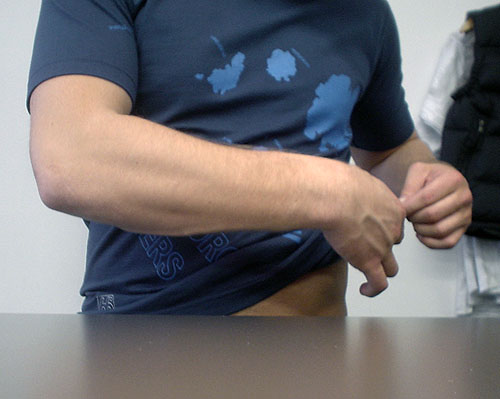

The foregoing posting appeared on Joe Clark’s personal Weblog on 2006.04.29 11:23. This presentation was designed for printing and omits components that make sense only onscreen. The permanent link is: https://blog.fawny.org/2006/04/29/icetorso/
Benediction
I gave the following benediction before my honoured speaking engagement on this magnificent ingot of volcanic rock:
Ég færi ykkur kveður frá landi sem forfeður ykkar ferðuðust langa leið til að flýja harðræði heimafyrir – aðeins til að upplifa sama harðræðið or í Kanada. Nú geta íslendingar notað veraldarvefinn til þess að miðla menningu sinni og sögu. Einnig til að varðveita hið einstaka tungumál sem þjóðin býr yfir.
The foregoing posting appeared on Joe Clark’s personal Weblog on 2006.04.28 12:55. This presentation was designed for printing and omits components that make sense only onscreen. The permanent link is: https://blog.fawny.org/2006/04/28/benediction/