At least in public: “I don’t pretend that I have all the answers.”
The least honest statement Cory Doctorow has ever made
The foregoing posting appeared on Joe Clark’s personal Weblog on 2010.01.26 15:33. This presentation was designed for printing and omits components that make sense only onscreen. The permanent link is: https://blog.fawny.org/2010/01/26/alltheanswers/
Unsinkable luxury liner seeks skipper
Hapless “wayfinding” organization SEGD (q.v., q.q.v.) needs a new executive director. This could be the club’s big chance to make its first competent hire.
The foregoing posting appeared on Joe Clark’s personal Weblog on 2010.01.23 13:22. This presentation was designed for printing and omits components that make sense only onscreen. The permanent link is: https://blog.fawny.org/2010/01/23/segd-boss/
Ink-stained wretches
As attendance was open to everyone, last night I visited the latest boozeup, presented by Ink Canada, for teleplay- and screenwriters. Seven of the 15 people I talked to were presently being paid to write for the screen, an impressive proportion. (The number was dragged down by the Canadian Film Centre grads huddled – and standing up – in the centre of the Paddock. Established hacks were getting shitfaced at tables.)
I openly betrayed my fondness for Being Erica, though it dearly needs some chest hair. I lectured a low-level writer on The Border about linguistic verisimilitude, something he didn’t even hear right the first time, necessitating a second lecture. I know: He just works there.
The conveneress wore a shocked expression when I introduced myself. The two women she was talking to reacted like I were trying to pick them up, plus one of them mocked my name. When I asked if she were getting paid these days, the conveneress wondered if I might not be familiar with her résumé. And did you know she only watches TV if she can download it? This ice princess regally oversees the industry.
I avoided McGrath. I wasn’t the only one, I inferred from a conversation.
I quite enjoyed myself. Later, waiting with the mob for the streetcar, a cab pulled up to the light and a handsome guy in the front seat glared our way. “Where you going tonight?” he asked. “Onto that streetcar,” I said, pointing. His gaze shifted, as if with an audible click, to the chicks standing next to me. “Where you girls going tonight?” “The streetcar,” one of them said, eyes rolling. My kinda gal. Check her résumé.
The foregoing posting appeared on Joe Clark’s personal Weblog on 2010.01.23 12:52. This presentation was designed for printing and omits components that make sense only onscreen. The permanent link is: https://blog.fawny.org/2010/01/23/bandpractice/
Designers as functional illiterates
For years I have heard stirring arguments about how designers need “a place at the table” around which important systemic decisions are made. And still that place at the table is not an assured place. […]
The reason that designers have only a feeble grip on that chair at the table is not because design is not respected, it is because most designers cannot write. I don’t mean they can’t write like Faulkner. I don’t mean they don’t have a discernable prose style. I mean they cannot write. They do not know where to put a subject and a verb and a capital and a period. They are functionally illiterate. […]
The odd part is that these designers have convinced themselves that they can write. They think they are fairly good writers and that a little dust-off with spellcheck will pretty much make them excellent writers. They have a totally unrealistic view of their own skills….
Now. Why is writing important to getting and keeping said much-ballyhooed chair? For two reasons. The first is that no one trusts illiterate people to make decisions. If they did, all countries would be democracies.
The second is that everyone else at that table can write and they look down on people that can’t. […]
No matter how brilliant you are, if you don’t know how to write well, you will never be perceived by the rest of that table as anything but a window-dresser wearing Prada.
The foregoing posting appeared on Joe Clark’s personal Weblog on 2010.01.22 14:32. This presentation was designed for printing and omits components that make sense only onscreen. The permanent link is: https://blog.fawny.org/2010/01/22/illiterate-designers/
‘[E]very book that is being published now depends on something that is in Twitter’
Mike Shatzkin is the latest to opine on the future of book publishing. People take him seriously as a technologist, it seems. I expect he would flunk any test of minimal technical qualification. Actually, now that I think of it, I ought to publish such a test.
[T]he market is going to shift in some ways from now on between the time you acquire a book and the time you publish it. Every book that is being published now was acquired before anybody had heard of Twitter. And every book that is being published now depends on something that is in Twitter. So that’s going to be normal.
God help us all.
The Safari Bookshelf: Great idea. Makes a lot of money for O’Reilly. It won’t make a lot of money in every context, but the idea of a searchable bookshelf? It should exist in every vertical. And it will exist in every vertical 20 years from now…. [W]hen your relationship to the consumer is that you can deliver them a file, you are no longer captive to any particular format.
Mm, no, that is a statement of the problem. You absolutely want to be hitch your wagon to particular formats – open, standard formats with no fantasy creatures (unicorn, Cerberus, DRM) harnessed to the wagon.
We have six major publishers. We’re not going to have six major publishers for a long time. I’d be very surprised if we have more than four [of them] four years from now…. The Wiley-O’Reilly Rule is that Wiley and O’Reilly do just about everything smarter than every one else, but it’s almost impossible for anyone to copy them, because of the nature of their business, the nature of their markets, and the nature of their companies.
Oh, come on. A book is a book and an E-book (in specified format) is an E-book. Everything O’Reilly does everybody else can do. Publishers insistently maintain that what has been proven to work for one publisher could not possibly work in general.
The other thing we’re going to see is that E-books are increasingly going to have a content edge. Authors will force this on publishers. It’s very uncomfortable for a publisher, because I published a book in January, a major even happened in April which changes something. The author says, “I need to add six sentences!” […] That’s a real problem, but it’s a problem we’re going to be facing, because the authors are not going to live with their E-books being out of date when they don’t need to be out of date. […]
Publishers also recognize creative possibilities and ideas that aren’t fully developed. As a matter of fact, publishers usually buy projects based on ideas that are not fully developed, and participate in the development of ideas. That is a very important skillset. That doesn’t go away. And the publisher is coordinating the whole range of disparate activities that are necessary to connect the creator to an audience.
You know what that is: It’s putting the art in the book, it’s deciding what typeface [!], it’s deciding what price, it’s deciding how to market. But sometimes it’s finding a coauthor for the book, or sometimes it’s finding an illustrator.
Based on experience, I do most of that better than real publishers do. There are times when all you need are an editor, a copy-editor, and a designer. Does your publisher then become a mule?
Publishers generally lack a culture of technology, or culture of experimentation.
Because they all use Windows, hence are afraid of their computers. They’re sensitive literary types who can’t read a line of HTML and can’t understand what an API is no matter how many times you explain it to them.
You’ve got to have an IT department where you throw them an idea in the afternoon and they come back with a sketch for you the next morning…. I think that’s not where publishers have been. We don’t have the skills to hire that, we don’t have the skills to find that, we don’t have the skills to direct it, but we need it. This is something that is going to be a drawback for publishers moving forward.
If all you understand is a blue pencil and “Track Changes,” you are fucked.
The foregoing posting appeared on Joe Clark’s personal Weblog on 2010.01.22 14:20. This presentation was designed for printing and omits components that make sense only onscreen. The permanent link is: https://blog.fawny.org/2010/01/22/shatzkin/
Republic of Description
Republic of Doyle (“Dile”), the brainchild of Mr. ALLAN HAWCO, is the hot new CBC seriocomedy. In it, a dashing knockabout detective pilots a Pontiac GTO over hill and dale in St. John’s. What’s not to like, at least if you aren’t a critic who expects everything on an hour-long action drama to be explained in words? (Setting is setting; it is not dialogue.)
Well, remember how I used to complain that the Trailer Park Boys do their own captioning? I guess they couldn’t get a job out on the oil patch and had to move to Newfoundland.
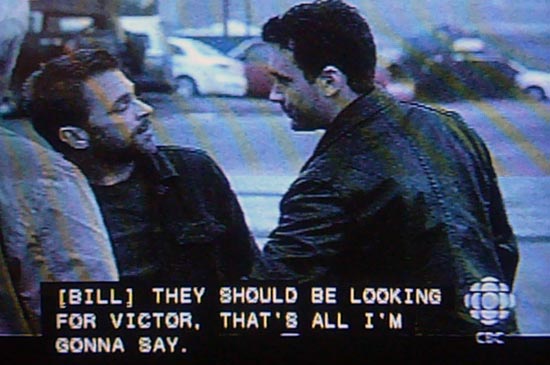
![Scrollup captioning: [NIKKI] SKID DADDLE.](https://fawny.org/blogimages/CCfoto-RepublicofDoyle-skedaddle.JPG)
Scrollup captioning doesn’t work for fictional narrative programming and is the mark of amateurs and cheapskates. (And the CRTC banned it.) We don’t caption in all-caps, and for the love of Chroist hire somebody who isn’t a 25-year-old female community-college graduate and knows how to spell. That requires life experience, which 25-year-old female community-college graduates lack. (I just thought of something: Maybe Nikki is doing it!)
But that’s not all! Dem blind kidz is watching the show too, with homegrown audio description you can barely hear. It gets a lot of things wrong and, when it isn’t narrating invisible or nonexistent facts or undemonstrated mental states, lies to the audience.
-
“A beautiful vista of St. John’s.” No personal opinions, please – this isn’t a John Doyle column.
-
“A totally pimped pickup truck… pulls uuup.” Don’t write cooler than the material. And don’t deliver cooler, either.
-
“Dick sees the official envelope from the province in Jake’s hand.” (Except we can’t see that.)
-
Malachy isn’t pronounced “Malakye” by anyone on the show, least of all “Malakee” himself. Our narrator can’t even name the character right.
-
“Opening.” (Then nothing else. No description of opening or closing credits. In fairness, the submaster they were working on might not have included the latter, but that would be the producer’s fault. Also no description credit, a major failing.)
-
A bit too fond of “exit” for “leave” or “get out of” and “enter” for “come in.”
-
“Victor tries to look relaxed, but he’s guarded and tightly wound.” (Really, Mr. Spock? Did you do the mind-meld? I can’t see that; how can you?)
-
“Jake starts to call Emma” (except we can’t see his iPhone display).
-
“She presses a few buttons. […] Rose presses 33.” (Both were invisible, hence something we couldn’t describe.)
-
“They look up to see Bill sitting in a rental car.” (Who’s Bill? And how do you know it’s a rental?)
-
“Jake notices Bill, so he approaches him.” (Mental cause and effect?)
-
“Bill is tossing things in Jake’s way – but Jake. knows his way. around boats!” (What Newfoundlander doesn’t? Stick to what you observe, not what you infer.)
-
“Jake has a better idea.” (Surely the Amazing Kreskin is our describer?) “He swings something” – actually, he mock-punches – “and Bill tumbles into a giant vat of fish. The guy holds up his hand for help. But first… Jake… has a question!” (More telepathy, and the writing here is as ripe as the fish.)
-
“Jake suddenly listens to Bill.” (Actually, he stares.)
-
“Bill holds out ten $100 bills.” (They’re invisible out of frame.)
-
“Bill smells himself and is appalled by the fishy smell.” (He just grimaces; you don’t know what he’s thinking.)
-
“She smiles despite herself.” (Again: Invisible mental state.)
-
“It’s a full-on crime scene!” (You don’t say! In fact, please don’t!)
-
“There’s a body inside with obvious head trauma. It’s Emma!” (Not shown at this point. Yes, we can predescribe when necessary, but this isn’t that case.)
“The Doyles take a glance at the victim and realize it’s Emma in the van.” (Only now shown, with not so much as a bump on her head. To “realize” is to come to an invisible mental conclusion, and we didn’t see that, obviously.)
-
“Charlotte, drink in hand, enters.” (She’s leaning on the railing of the upstairs deck; she never “enters.”)
-
“Victor leads them to the door, away from his crazed wife.” (No value judgements, please. “Beautiful” is already pushing it.)
-
“She goes in to talk to Victor.” (Nope, just goes in. You can’t see her intent.)
-
“Jake hits the van to let them know they’re leaving.” (Damn you, mind-reading Newfoundland community-college graduate!)
-
“He can read the bad news on their faces.” (Actually, all he sees are frowns and crestfallen looks. It’s all we see, too.)
-
“Mal gives him a look to let him go.” (Cause and effect.)
-
“There’s blood on the skateboard, but not… from Bill!” (You can’t prove that just from what’s shown.)
-
“Charlotte is heartbroken.” (Wouldn’t you be if you knew some guy in a postproduction house were reading your mind post-facto?)
-
“Charlotte’s in shock.” (You mean she looks shocked?)
-
“A few RNC vehicles”: What’s the RNC? (I know what it is, but let’s not be too insider.)
-
“Charlotte is left alone in agony as her family is taken from her.” (No passive voice if you can avoid it, and this is replete with invisible mental states and implied cause-and-effect.)
-
“Nikki’s trying to seduce Jake.” (Listen, who wouldn’t? But what are her actions?)
-
“Jake realizes they’re surrounded by dudes.” (But are they totally pimped? Again, too casual.)
-
“Jake and Nikki doing the thing they do best – ripping each other’s clothes off!” (No editorializing. And anyway: Surely reverse cowgirl?)
Do I ever miss Intelligence
Republic of Doyle follows in the footsteps of other CBC shows by filling its guest spots with actors from other (shitcanned) CBC shows. In this episode, it’s the craggy and ravishing Mr. IAN TRACEY.
Kiss me, you fool!
The foregoing posting appeared on Joe Clark’s personal Weblog on 2010.01.20 08:05. This presentation was designed for printing and omits components that make sense only onscreen. The permanent link is: https://blog.fawny.org/2010/01/20/doyle-dx/
The Michael Surtees Coding Horror Marathon continues
Another ill-coded Web site from the loveliest Web designer with the worst coding chops, Michael Surtees. How much skill do you have to lack to screw up a WordPress template this badly? (It’s not just the absent alt text and the misuse of display: none. How about opening links in new windows? How badly do you have to misunderstand the Web to make this many mistakes?)
With so little discernible acumen, however does he retain the task, in his day job, of coding actual sites? The design aspect is what got him his TN visa (though the new site has the angriest blue ever committed to screen, and is frankly hard to read). It’s the coding aspect that bothers me. It won’t stop Surtees from getting promoted at Daylife – or just poached by another company that also can’t tell the difference between a competent Web developer and a Web designer who adds to the office décor. (Even his dog is cute.)
And will Surtees ever learn the difference between its and it’s?
The foregoing posting appeared on Joe Clark’s personal Weblog on 2010.01.19 12:39. This presentation was designed for printing and omits components that make sense only onscreen. The permanent link is: https://blog.fawny.org/2010/01/19/linkdroptoday/
Jonathan Ive: Print the legend
(UPDATED) I read somewhere that the most important industrial designer, Mr. JONATHAN IVE, drives a Bentley or a Rolls, perhaps even a Phantom. I could not reconcile the mental image of one of the world’s few handsome Englishmen, packed into his de rigueur T-shirt, proudly piloting the car preferred by Alberta oil barons and Ben Affleck.
This turns out to be false-memory syndrome: Ive’s reported vehicle is a customized Aston Martin DB7. You can almost imagine a nicely-defined baldie in a T-shirt driving that sort of thing, even if the steering wheel is on the incorrect side.
I came up with two explanations Ive might have offered, perhaps in an Objectified sequel, for having chosen the wretched excess of either of these marques (long since separate entities).
-
The Rolls/Bentley model of manufacturing is the ne plus ultra of artisanal hand-craftsmanship. (Or it was thus at the time Ive would have bought one of these cars; arguably the Bugatti Veyron or the Spyker C8 surpasses that level.) With so much of his time spent developing processes (“fixtures” and especially “bosses”) for mass-produced items, the prospect of a car nearly every piece of whose interior is handmade offers welcome relief.

-
The Rolls/Bentley model offers not plushness, which one associates with whore’s-drawers interiors of 1970s Sedans de Ville, but sumptuousness. When the mass-produced items one designs have metallic or plasticized planes and radii, the capacity to sink into a car offers welcome relief from relentless Modernism.
In these scenarios, a tight-bodied, shaven-headed designer seeks refuge in a loose, fleshy, preputial cocoon. But either way, I couldn’t make it work in my mind’s eye. I just kept imagining Karim Rashid lecturing us about our inhabiting a post-industrial technological age by day only to retreat into a passé, kitsch, cushy, knurled-wood home environment by night.
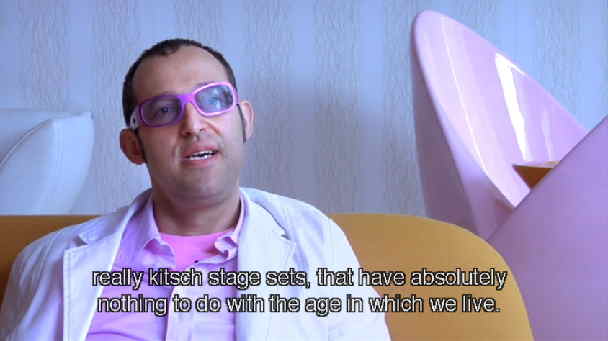
But what is the reality? Ive selected the British car that expresses the same pulled-back tautness of his designs and his own physical self.
There is no factual basis for the conceptual union of Ive and Rolls or Bentley. Given the choice between printing the truth and printing the legend, I’m going to print the legend.
Update: It’s a Bentley
The Daily Mail runs what is purported to be a photograph of Ive leaving home in his Bentley Brooklands.

I asked Pacific Coast News (note the watermark in the picture) for a complete photo credit, but did not hear back.
The foregoing posting appeared on Joe Clark’s personal Weblog on 2010.01.18 18:05. This presentation was designed for printing and omits components that make sense only onscreen. The permanent link is: https://blog.fawny.org/2010/01/18/bentley-rolls/
Too white! Too strong!
I still recall my days of sportswriting for the peripheral press. Now the peripheral press is the sports press – but with rather different tones and styles.
- White-masculinist approach
-
Colossal ginger slugger rather liked being big and strong – and you liked that, too!
“Do you have any idea what it’s like knowing instantly that a ball you hit is going to fly – no, soar – over a fence in a major-league stadium? Well, I do. And it’s fucking fantastic.
“I’m sorry everyone had a problem with it,” [Mark] McGwire added. “But I was having a blast.”
Though… there were times he almost regretted taking anabolic steroids, the former Oakland Athletics star said that, considering the tons of fun the performance-enhancing substances allowed him to have, he never thought twice about his decision.
“I was hitting baseballs over 450 feet,” McGwire said. “That’s really far. And high, too. Oh my God, were they high. Towering, in fact. I was, like, crushing these things….
“I also liked hitting it over their heads,” McGwire added while flexing his right bicep and then making a swinging motion with his arms. “Crack! Home run….
“They clearly knew I was taking performance-enhancing drugs, right? I mean, look at me. I look like a fucking monster. Plus, come on – I was hitting the ball really, really fucking far.”
- Antiracist, antimasculinist approach
-
White lesbian felt “dominated by white masculinity” and demands clones of herself on site for gay-male athletes, who have a hard enough time mustering masculinity as it is. White lesbian seems to think this is 1991 and the only game in town is Sports Illustrated. Untrue even then, but now we don’t bother trying to change the system from within; we just start our own sites. (Worked for Rod 2.0 [q.v.], didn’t it?) White lesbian already tried that, but now reverts to the time-honoured tradition of wielding the vernacular of women’s studies like a bludgeon. (Or is she just bitching?)
Still: If we have to downplay whiteness and masculinity, however will we discuss Caster Semenya or the fact that everyone at the Olympic 100-metre dash is black? How about those times when white lesbians approve of masculinity, viz when it erupts among other lesbians?
Why are nonwhite athletes important while disabled athletes are not? Nonwhites have no trouble getting attention (or, on the whole, funding) for playing sports.
Does a rugby team of effete nonwhite maladaptives with a record of 0–10 get a pass just because they uphold the white lesbian’s ideal of male homosexuality – being the kind of girls they could never be?
Bonus!
The foregoing posting appeared on Joe Clark’s personal Weblog on 2010.01.15 15:07. This presentation was designed for printing and omits components that make sense only onscreen. The permanent link is: https://blog.fawny.org/2010/01/15/mcgwire-lesbian/